CAS 682-01-9
:Tétrapropoxysilane
Description :
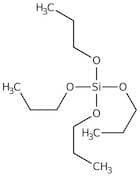
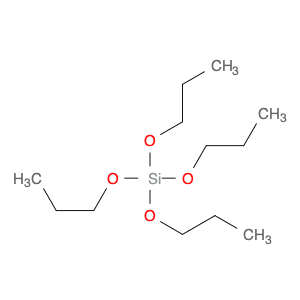
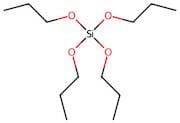
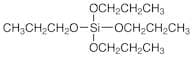
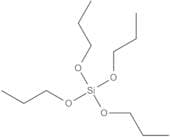
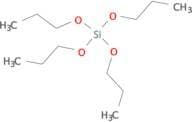
Tétrapropoxysilane, avec le numéro CAS 682-01-9, est un composé organosiliconé caractérisé par ses quatre groupes propoxy attachés à un atome de silicium. Ce composé est généralement un liquide incolore à température ambiante et est connu pour sa faible viscosité et sa volatilité relativement faible. Il est soluble dans des solvants organiques, ce qui le rend utile dans diverses applications, y compris comme précurseur dans la synthèse de silice et de matériaux silicatés. Tétrapropoxysilane peut subir une hydrolyse en présence d'humidité, conduisant à la formation de groupes silanol et finalement de silice. Cette propriété est exploitée dans la production de revêtements, d'adhésifs et de scellants, où elle contribue à la formation de réseaux silicatés durables et stables. De plus, il est important de manipuler Tétrapropoxysilane avec précaution, car il peut être inflammable et peut provoquer des irritations au contact de la peau ou des yeux. Dans l'ensemble, sa structure chimique unique et sa réactivité en font un composé précieux dans la science des matériaux et les applications industrielles.
Formule :C12H28O4Si
InChI :InChI=1/C12H28O4Si/c1-5-9-13-17(14-10-6-2,15-11-7-3)16-12-8-4/h5-12H2,1-4H3
Code InChI :InChIKey=ZQZCOBSUOFHDEE-UHFFFAOYSA-N
SMILES :[Si](OCCC)(OCCC)(OCCC)OCCC
Synonymes :- Dynasil P
- N-Pos
- Propyl orthosilicate
- Propyl silicate
- Propyl silicate ((PrO)<sub>4</sub>Si)
- Silane, tetrapropoxy-
- Silicic acid (H<sub>4</sub>SiO<sub>4</sub>), tetrapropyl ester
- Silicon orthopropoxide
- Silicon tetrapropoxide
- Sit 7777.0
- Tetra-n-propoxysilane
- Tetra-n-propyl orthosilicate
- Tetra-n-propyl silicate
- Tetrapropyl orthosilcate
- Tetrapropyl orthosilicate
- Tetrapropyl silicate
- Propyl silicate ((PrO)4Si)
- Silicic acid (H4SiO4), tetrapropyl ester
- silicicacidtetrapropylester
- Silicicacid,tetrapropylester
- silicicacid(h4sio4),tetrapropylester
- Tetrapropyloxysilane
- Tetrapropylsilicate
- CT2090
- TETRAPROPOXYSILANE
- Voir plus de synonymes
Trier par
Degré de pureté (%)
0
100
|
0
|
50
|
90
|
95
|
100
7 produits concernés.
Tetra-n-propoxysilane, 97%
CAS :This Thermo Scientific Chemicals brand product was originally part of the Alfa Aesar product portfolio. Some documentation and label information may refer to the legacy brand. The original Alfa Aesar product / item code or SKU reference has not changed as a part of the brand transition to Thermo SciFormule :C12H28O4SiDegré de pureté :97%Couleur et forme :Clear colorless to pale yellow, LiquidMasse moléculaire :264.44Silicic acid (H4SiO4), tetrapropyl ester
CAS :Formule :C12H28O4SiDegré de pureté :98%Couleur et forme :LiquidMasse moléculaire :264.4338Tetrapropyl orthosilicate
CAS :Tetrapropyl orthosilicateDegré de pureté :98%Masse moléculaire :264.43g/molTetrapropyl Orthosilicate
CAS :Formule :C12H28O4SiDegré de pureté :>98.0%(GC)Couleur et forme :Colorless to Almost colorless clear liquidMasse moléculaire :264.44TETRA-n-PROPOXYSILANE
CAS :Formule :C12H28O4SiDegré de pureté :97%Couleur et forme :LiquidMasse moléculaire :264.44Tetra-n-propoxysilane(Tetra propylorthosilicate)
CAS :S16425 - Tetra-n-propoxysilane(Tetra propylorthosilicate)
Formule :C12H28O4SiDegré de pureté :98%Couleur et forme :Liquid, ClearMasse moléculaire :264.437Tetrapropyl orthosilicate
CAS :Tetrapropyl orthosilicate is a particle that has been shown to have antimicrobial properties. The mechanism of the inhibition of bacterial growth is not well understood, but it appears to be related to the thermal expansion of the material. Tetrapropyl orthosilicate has also been shown to have high resistance to oxidation and hydrolysis reactions, making it an attractive candidate for coatings in contact with blood or other body fluids. The compound has been tested as a coating for medical devices and showed no adverse effects on human serum or model systems at physiological levels. Tetrapropyl orthosilicate also has high values against HIV infection in vitro.Formule :C12H28O4SiDegré de pureté :Min. 95%Couleur et forme :Colourless LiquidMasse moléculaire :264.43 g/mol