CAS 68262-20-4
:Acide 3-(3-méthoxyphényl)-2-oxopropanoïque
Description :
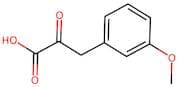
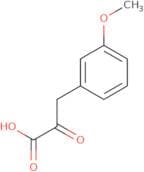
Acide 3-(3-méthoxyphényl)-2-oxopropanoïque, avec le numéro CAS 68262-20-4, est un composé organique caractérisé par sa structure, qui comprend un groupe acide propanoïque avec un groupe fonctionnel cétone et un groupe phényle substitué par un méthoxy. Ce composé présente généralement des propriétés associées à la fois aux fonctionnalités aromatiques et aux acides carboxyliques, telles qu'une solubilité modérée dans les solvants organiques et une réactivité potentielle dans diverses réactions chimiques, y compris l'esterification et l'acylation. La présence du groupe méthoxy peut influencer ses propriétés électroniques, améliorant potentiellement sa réactivité ou affectant son interaction avec les systèmes biologiques. De plus, des composés de ce type peuvent présenter une activité biologique, ce qui les rend intéressants dans la recherche pharmaceutique. La structure moléculaire suggère qu'il pourrait participer à des liaisons hydrogène en raison du groupe acide carboxylique, ce qui peut affecter ses propriétés physiques, telles que le point de fusion et le point d'ébullition. Dans l'ensemble, Acide 3-(3-méthoxyphényl)-2-oxopropanoïque est un composé d'intérêt tant en chimie organique synthétique qu'en chimie médicinale.
Formule :C10H10O4
InChI :InChI=1/C10H10O4/c1-14-8-4-2-3-7(5-8)6-9(11)10(12)13/h2-5H,6H2,1H3,(H,12,13)
SMILES :COc1cccc(c1)CC(=O)C(=O)O
Trier par
Degré de pureté (%)
0
100
|
0
|
50
|
90
|
95
|
100
3 produits concernés.
3-(3-Methoxyphenyl)-2-oxopropanoic acid
CAS :3-(3-Methoxyphenyl)-2-oxopropanoic acidDegré de pureté :97%Masse moléculaire :194.19g/mol2-hydroxy-3-(3-methoxyphenyl)prop-2-enoic acid
CAS :Degré de pureté :97%Masse moléculaire :194.1860046Ref: 10-F663973
1g492,00€5g1.309,00€10g2.617,00€2.5g1.150,00€50mg120,00€100mg160,00€250mg223,00€500mg410,00€3-(3-Methoxyphenyl)-2-oxopropanoic acid
CAS :Vanillic acid is a phenolic compound that can be found in vanilla and other plants. It is an important precursor for the synthesis of aromatic compounds such as ferulic acid, lignin, and coumarin. Vanillic acid has been shown to have a variety of biochemical and chemists properties, including the ability to aromatize, which means it can be used in the preparation of synthetic hormones. This compound also acts as an antioxidant by scavenging reactive oxygen species. Vanillic acid is found in two sources: pre-existing vanillin (from plants) and ferulic acid (from microbial metabolism). Vanillin is derived from coniferyl alcohol and coniferaldehyde, which are both found in poria. Ferulic acid is produced by polyporus fungi and can be converted into vanillic acid via decarboxylation.Formule :C10H10O4Degré de pureté :Min. 95%Masse moléculaire :194.18 g/mol