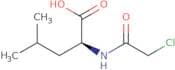
CAS 688-12-0
:N-(2-chloroacétyl)-L-leucine
Description :
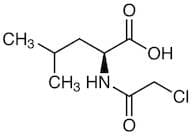
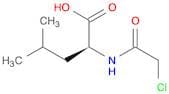
N-(2-chloroacétyl)-L-leucine, avec le numéro CAS 688-12-0, est un dérivé d'acide aminé caractérisé par la présence d'un groupe chloroacétile attaché à l'azote de la chaîne latérale de la leucine. Ce composé apparaît généralement sous forme de solide cristallin blanc à blanc cassé et est soluble dans des solvants polaires tels que l'eau et le méthanol, en raison de ses groupes fonctionnels amine et acide carboxylique. Le groupe chloroacétile introduit des caractéristiques électrophiles, le rendant réactif dans diverses réactions chimiques, en particulier dans les processus d'acylation. N-(2-chloroacétyl)-L-leucine suscite de l'intérêt en chimie médicinale et dans la synthèse peptidique, car il peut servir de bloc de construction pour des molécules plus complexes ou comme réactif dans la modification des peptides. Son activité biologique peut être influencée par la présence du groupe chloroacétile, qui peut affecter les interactions avec les cibles biologiques. Comme pour de nombreuses substances chimiques, la manipulation doit être effectuée avec précaution, en tenant compte des dangers potentiels associés à la fonctionnalité chloroacétile.
Formule :C8H14ClNO3
InChI :InChI=1S/C8H14ClNO3/c1-5(2)3-6(8(12)13)10-7(11)4-9/h5-6H,3-4H2,1-2H3,(H,10,11)(H,12,13)/t6-/m0/s1
Code InChI :InChIKey=VDUNMYRYEYROFL-LURJTMIESA-N
SMILES :[C@H](NC(CCl)=O)(CC(C)C)C(O)=O
Synonymes :- (2S)-2-(2-Chloroacetamido)-4-methylpentanoic acid
- (2S)-2-[(2-Chloroacetyl)amino]-4-methylpentanoic acid
- <span class="text-smallcaps">L</span>-Leucine, N-(2-chloroacetyl)-
- <span class="text-smallcaps">L</span>-Leucine, N-(chloroacetyl)-
- Chloroacetyl-<span class="text-smallcaps">L</span>-leucine
- Chloroacetyl-L-leucine
- D-Leucine, N-(2-chloroacetyl)-
- Leucine, N-(chloroacetyl)-, <span class="text-smallcaps">L</span>-
- N-(2-Chloroacetyl)-<span class="text-smallcaps">L</span>-leucine
- N-(chloroacetyl)-L-leucine
- N-(chloroacetyl)leucine
- N-Chloroacetyl-<span class="text-smallcaps">L</span>-leucine
- NSC 60158
- N-(2-Chloroacetyl)-L-leucine
- L-Leucine, N-(2-chloroacetyl)-
- L-Leucine, N-(chloroacetyl)-
- Voir plus de synonymes
Trier par
Degré de pureté (%)
0
100
|
0
|
50
|
90
|
95
|
100
5 produits concernés.
N-Chloroacetyl-L-leucine
CAS :Formule :C8H14ClNO3Degré de pureté :>99.0%(T)Couleur et forme :White to Almost white powder to crystalMasse moléculaire :207.65(S)-2-(2-Chloroacetamido)-4-methylpentanoic acid
CAS :Formule :C8H14ClNO3Degré de pureté :99.0%Couleur et forme :SolidMasse moléculaire :207.65472-[(2-chloroacetyl)amino]-4-methylpentanoic acid
CAS :2-[(2-chloroacetyl)amino]-4-methylpentanoic acidDegré de pureté :≥95%(2S)-2-[(chloroacetyl)amino]-4-methylpentanoic acid
CAS :Formule :C8H14ClNO3Degré de pureté :99.0%Masse moléculaire :207.65N-Chloroacetyl-L-leucine
CAS :N-Chloroacetyl-L-leucine is a chloromethyl ketone that is used as a pesticide and insecticide. It is effective against insects such as the Colorado potato beetle and the European corn borer, but not against snails or slugs. N-Chloroacetyl-L-leucine denatures proteins at high concentrations. This chemical has been shown to be toxic to the pancreas and can cause hepatitis in rats. N-Chloroacetyl-L-leucine can be used for pest control by disrupting the metabolism of an organism's nervous system. Techniques include thermal denaturation, metal ion uptake, and homogenization.Formule :C8H14ClNO3Degré de pureté :Min. 95%Masse moléculaire :207.65 g/mol


![2-[(2-chloroacetyl)amino]-4-methylpentanoic acid](/_next/image/?url=https%3A%2Fstatic.cymitquimica.com%2Fproducts%2F54%2Fthumb%2FOR28037.jpg&w=3840&q=75)

![(2S)-2-[(chloroacetyl)amino]-4-methylpentanoic acid](/_next/image/?url=https%3A%2Fstatic.cymitquimica.com%2Fproducts%2F10%2Fthumb%2FF349671.jpg&w=3840&q=75)