CAS 69003-01-6
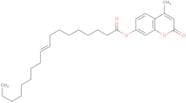
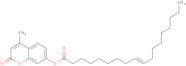
:4-Méthyl-2-oxo-2H-1-benzopyrane-7-yl (9E)-9-octadécénoate
Description :
4-Méthyl-2-oxo-2H-1-benzopyrane-7-yl (9E)-9-octadécénoate, identifié par son numéro CAS 69003-01-6, est un composé organique qui appartient à la classe des flavonoïdes, spécifiquement un type de dérivé de coumarine. Ce composé présente une structure de benzopyrane, caractérisée par un anneau de benzène et un anneau de pyrane fusionnés, contribuant à ses propriétés aromatiques. La présence d'un groupe méthyle et d'un groupe carbonyle à des positions spécifiques améliore sa réactivité et son activité biologique potentielle. Le fragment (9E)-9-octadécénoate indique qu'il contient un acide gras insaturé à chaîne longue, ce qui peut influencer sa solubilité et son interaction avec les membranes biologiques. Ce composé suscite de l'intérêt dans divers domaines, y compris la chimie médicinale et la recherche sur les produits naturels, en raison de ses potentielles propriétés antioxydantes et anti-inflammatoires. Sa structure unique peut également permettre des interactions spécifiques avec des enzymes ou des récepteurs, en faisant un candidat pour des études pharmacologiques supplémentaires. Dans l'ensemble, 4-Méthyl-2-oxo-2H-1-benzopyrane-7-yl (9E)-9-octadécénoate illustre la complexité et la diversité des composés organiques avec des applications potentielles en santé et nutrition.
Formule :C28H40O4
InChI :InChI=1S/C28H40O4/c1-3-4-5-6-7-8-9-10-11-12-13-14-15-16-17-18-27(29)31-24-19-20-25-23(2)21-28(30)32-26(25)22-24/h10-11,19-22H,3-9,12-18H2,1-2H3/b11-10+
Code InChI :InChIKey=NKQFKJYKCVDLPT-ZHACJKMWSA-N
SMILES :CC=1C=2C(=CC(OC(CCCCCCC/C=C/CCCCCCCC)=O)=CC2)OC(=O)C1
Synonymes :- 4-Methyl-2-oxo-2H-1-benzopyran-7-yl (9E)-9-octadecenoate
- 4-Methyl-2-oxo-2H-1-benzopyran-7-yl (E)-9-octadecenoate
- 4-Methylumbelliferone elaidate
- 9-Octadecenoic acid, 4-methyl-2-oxo-2H-1-benzopyran-7-yl ester, (9E)-
- 9-Octadecenoic acid, 4-methyl-2-oxo-2H-1-benzopyran-7-yl ester, (E)-
Trier par
Degré de pureté (%)
0
100
|
0
|
50
|
90
|
95
|
100
3 produits concernés.
4-Methylumbelliferyl elaidate
CAS :4-Methylumbelliferyl elaidateCouleur et forme :Off-White SolidMasse moléculaire :440.61g/mol4-Methylumbelliferyl elaidate
CAS :4-Methylumbelliferyl elaidate is a fluorogenic substrate for lipase. After enzymatic cleaveage, free 4-methylumbelliferone (also known as hymecromone) is released, exhibiting blue fluorescence upon excitation with UV light. The strongest fluorescence of 4-methylumbelliferone requires deprotonation of the hydroxyl group (thus requires alkaline pH), with a maximal fluorescence intensity obtained with excitation at 350 to 370 nm and emission at 440 to 470 nm. The use of 4-methylumbelliferyl elaidateas a substrate for measuring the lipase activity is used for assessment of lipase activity to identify pancreatitis.Formule :C28H40O4Degré de pureté :Min. 95%Couleur et forme :PowderMasse moléculaire :440.61 g/mol4-Methylumbelliferyl elaidate
CAS :4-Methylumbelliferone is a fluorescent probe that can be used to study the metabolism of fatty acids in plants. It is also used as a marker for radiation and significant cytotoxicity. 4-Methylumbelliferone binds to the DNA termini, specifically at the 5' phosphate group, and inhibits phosphatase activity. This process increases levels of p-nitrophenyl phosphate (a substrate), which produces protocatechuic acid (an intermediate). The disulfide bond is then broken by hydrogen peroxide, leading to an increase in fluorescence. The optimum pH for this process is 7.5.
Formule :C28H40O4Degré de pureté :Min. 95 Area-%Masse moléculaire :440.63 g/molRef: 3D-M-5535
Produit arrêté