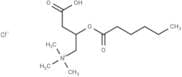
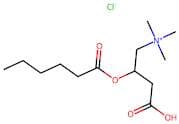
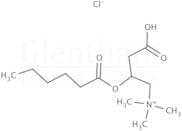
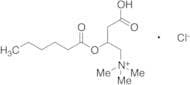
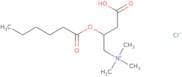
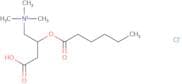
CAS 6920-35-0
:Chlorure d'hexanoylcarnitine
Description :
Chlorure d'hexanoylcarnitine, avec le numéro CAS 6920-35-0, est un dérivé de la carnitine, un composé d'ammonium quaternaire impliqué dans le transport des acides gras vers les mitochondries pour la production d'énergie. Cette substance se caractérise par son composant d'acide gras à chaîne longue, l'acide hexanoïque, qui contribue à ses propriétés hydrophobes. Chlorure d'hexanoylcarnitine apparaît généralement sous forme de poudre cristalline blanche à blanc cassé et est soluble dans l'eau en raison de la présence de l'ion chlorure, qui améliore son caractère ionique. Il joue un rôle dans les processus métaboliques et suscite un intérêt dans la recherche biochimique, en particulier dans les études liées au métabolisme des acides gras et à la production d'énergie. De plus, sa forme chlorurée indique qu'il peut participer à des interactions ioniques, ce qui le rend utile dans diverses applications biochimiques. Les données de sécurité doivent être consultées pour la manipulation et l'utilisation, comme pour toute substance chimique, afin de garantir que les précautions appropriées soient prises.
Formule :C13H26ClNO4
InChI :InChI=1/C13H25NO4.ClH/c1-5-6-7-8-13(17)18-11(9-12(15)16)10-14(2,3)4;/h11H,5-10H2,1-4H3;1H/p+1
Code InChI :InChIKey=DTHGTKVOSRYXOK-UHFFFAOYSA-N
SMILES :C(OC(CCCCC)=O)(C[N+](C)(C)C)CC(O)=O.[Cl-]
Synonymes :- (3-Carboxy-2-hydroxypropyl)trimethylammonium chloride hexanoate
- 1-Propanaminium, 3-carboxy-N,N,N-trimethyl-2-[(1-oxohexyl)oxy]-, chloride
- 1-Propanaminium, 3-carboxy-N,N,N-trimethyl-2-[(1-oxohexyl)oxy]-, chloride (1:1)
- 1-propanaminium, 3-carboxy-N,N,N-trimethyl-2-[(1-oxohexyl)oxy]-, hydrochloride
- Ammonium, (3-carboxy-2-hydroxypropyl)trimethyl-, chloride, hexanoate, (±)-
- Hexanoic acid, ester with (3-carboxy-2-hydroxypropyl)trimethylammonium chloride, (±)-
- Hexanoyl carnitine hydrochloride
- Hexanoyl-<span class="text-smallcaps">DL</span>-carnitine hydrochloride
- Hexanoylcarnitine chloride
- Zinc02517065
- Hexanoyl-L-carnitine HCl
- Hexanoyl-DL-carnitine chloride
- DL-CAPROYLCARNITINE CHLORIDE
- Voir plus de synonymes
Trier par
Degré de pureté (%)
0
100
|
0
|
50
|
90
|
95
|
100
7 produits concernés.
1-Propanaminium, 3-carboxy-N,N,N-trimethyl-2-[(1-oxohexyl)oxy]-, chloride (1:1)
CAS :Formule :C13H26ClNO4Degré de pureté :98%Couleur et forme :SolidMasse moléculaire :295.8028(±)-Hexanoylcarnitine chloride
CAS :(±)-Hexanoylcarnitine chloride is a fatty acid metabolite that breaks down fatty acids into small compounds that can be utilized by the body.Formule :C13H26ClNO4Degré de pureté :99.35%Couleur et forme :SolidMasse moléculaire :295.8(±)-Hexanoylcarnitine chloride
CAS :(±)-Hexanoylcarnitine chlorideDegré de pureté :≥98%Masse moléculaire :295.8g/mol(±)-Hexanoylcarnitine Chloride
CAS :Produit contrôléFormule :C13H26NO4•ClCouleur et forme :NeatMasse moléculaire :260.353545Hexanoyl-DL-carnitine chloride
CAS :Hexanoyl-DL-carnitine chloride (HCLC) is a diagnostic agent that is used to measure carnitine levels in the blood. It can be used to diagnose metabolic disorders, such as chronic oral or coronary heart diseases. HCLC inhibits carnitine uptake into cells by competitively inhibiting the carnitine transporter OCTN2. The inhibitory properties of HCLC are reversed by gamma-aminobutyric acid (GABA), which suggests that GABA may be involved in the regulation of cellular energy metabolism and neuronal excitability. Toxicological studies show that HCLC does not cause any adverse effects in humans when administered orally for up to 14 days.Formule :C13H26ClNO4Degré de pureté :Min. 95%Masse moléculaire :295.8 g/molHexanoyl-DL-carnitine chloride
CAS :Hexanoyl-DL-carnitine chloride is a useful scaffold, versatile building block, and reaction component. It can be used as a precursor in the synthesis of complex compounds, such as hexanoyl-L-carnitine and hexanoyl-D-carnitine. Hexanoyl-DL-carnitine chloride has been shown to have high quality and purity. This compound is a reagent for organic synthesis and can also be used as a research chemical or speciality chemical.Formule :C13H26ClNO4Masse moléculaire :295.80 g/molRef: 3D-H-1990
1gÀ demander50mgÀ demander100mgÀ demander250mgÀ demander500mgÀ demander-Unit-ggÀ demander
![1-Propanaminium, 3-carboxy-N,N,N-trimethyl-2-[(1-oxohexyl)oxy]-, chloride (1:1)](/_next/image/?url=https%3A%2Fstatic.cymitquimica.com%2Fproducts%2FIN%2Fthumb%2FDA001LG4.jpg&w=3840&q=75)