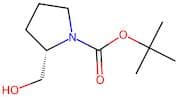
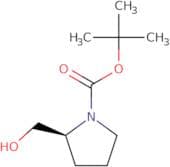
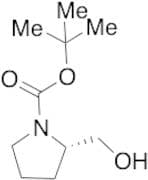
CAS 69610-40-8
:N-ALPHA-tert-Butoxycarbonyle-L-prolinol
Description :
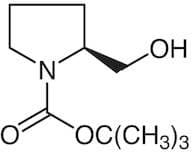
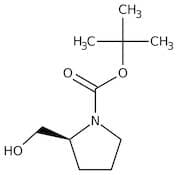
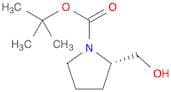
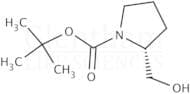
N-ALPHA-tert-Butoxycarbonyle-L-prolinol, avec le numéro CAS 69610-40-8, est un composé organique couramment utilisé dans la synthèse peptidique et comme groupe protecteur en chimie organique. Ce composé présente une structure de prolinol, qui est un aminoalcool dérivé de la proline, et est modifié avec un groupe tert-butoxycarbonyle (Boc). Le groupe Boc sert de moiety protectrice pour la fonction amino, permettant des réactions sélectives sans interférer avec la réactivité de l'amine. N-ALPHA-tert-Butoxycarbonyle-L-prolinol est typiquement un solide blanc à blanc cassé et est soluble dans des solvants organiques courants tels que le dichlorométhane et le méthanol. Sa stabilité dans diverses conditions en fait un intermédiaire précieux dans la synthèse de produits pharmaceutiques et de composés biologiquement actifs. De plus, la présence de la structure de prolinol confère des propriétés stéréochimiques uniques, qui peuvent influencer la conformation et l'activité biologique des peptides résultants. Une manipulation et un stockage appropriés sont essentiels, comme pour de nombreux composés organiques, afin de maintenir son intégrité et son efficacité dans les applications synthétiques.
Formule :C10H19NO3
InChI :InChI=1/C10H19NO3/c1-10(2,3)14-9(13)11-6-4-5-8(11)7-12/h8,12H,4-7H2,1-3H3/t8-/m1/s1
SMILES :CC(C)(C)OC(=O)N1CCC[C@@H]1CO
Synonymes :- BOC-L-Prolinol
- N-Boc-L-prolinol
- Boc-Pro-ol
- N-(tert-Butoxycarbonyl)-L-prolinol
- (S)-(-)-1-tert-Butoxycarbonyl-2-pyrrolidinemethanol
- Tert-Butyl 2-(Hydroxymethyl)Pyrrolidine-1-Carboxylate
- tert-butyl (2S)-2-(hydroxymethyl)pyrrolidine-1-carboxylate
- tert-butyl (2R)-2-(hydroxymethyl)pyrrolidine-1-carboxylate
- (S)-(-)-1-Boc-2-Pyrrolidinemethanol
- 1-Pyrrolidinecarboxylic acid, 2-(hydroxymethyl)-, 1,1-dimethylethyl ester, (2S)-
- 2-Hydroxymethylpyrrolidine-1-carboxylic acid tert butyl ester
- Voir plus de synonymes
Trier par
Degré de pureté (%)
0
100
|
0
|
50
|
90
|
95
|
100
8 produits trouvés.
N-(tert-Butoxycarbonyl)-L-prolinol
CAS :Formule :C10H19NO3Degré de pureté :>98.0%(GC)Couleur et forme :White to Almost white powder to crystalMasse moléculaire :201.27N-Boc-L-prolinol, 98+%
CAS :This Thermo Scientific Chemicals brand product was originally part of the Alfa Aesar product portfolio. Some documentation and label information may refer to the legacy brand. The original Alfa Aesar product / item code or SKU reference has not changed as a part of the brand transition to Thermo SciFormule :C10H19NO3Degré de pureté :98+%Couleur et forme :crystalline powder, WhiteMasse moléculaire :201.27tert-Butyl (S)-2-(hydroxymethyl)pyrrolidine-1-carboxylate
CAS :Formule :C10H19NO3Degré de pureté :98%Couleur et forme :SolidMasse moléculaire :201.2628(2S)-(+)-2-(Hydroxymethyl)pyrrolidine, N-BOC protected
CAS :(2S)-(+)-2-(Hydroxymethyl)pyrrolidine, N-BOC protectedFormule :C10H19NO3Degré de pureté :≥95%Couleur et forme : slightly yellow powderMasse moléculaire :201.26g/molN-Boc-L-prolinol
CAS :N-Boc-L-prolinol is a chiral proline derivative that has been modified with an allyl group. It is a potent nicotinic acetylcholine antagonist, and it has been shown to have immune functions in vitro. The synthesis of N-Boc-L-prolinol occurs through a three-step process involving the use of organocatalysts, asymmetric synthesis, and stereoselective reactions. This molecule is also useful for the study of apoptotic signaling pathways in cells.Formule :C10H19NO3Degré de pureté :Min. 95%Couleur et forme :White PowderMasse moléculaire :201.26 g/mol1-Boc-L-Prolinol
CAS :Formule :C10H19NO3Degré de pureté :97%Couleur et forme :SolidMasse moléculaire :201.266tert-Butyl (S)-2-(hydroxymethyl)pyrrolidine-1-carboxylate
CAS :Produit contrôléApplications tert-Butyl (S)-2-(hydroxymethyl)pyrrolidine-1-carboxylate, is a building block used foe the synthesis of novel nicotinic acetylcholine receptor ligands with cognition-enhancing properties. It can also be used in the synthesis of chiral β-amino sulfides and β-amino thiols.
References Elliiot, R. L., et al.: Bioorg. Med. Chem. Lett., 6, 2283 (1996); Abreo, M. A., et al.: J. Med. Chem., 39(4), 817 (1996);Formule :C10H19NO3Couleur et forme :NeatMasse moléculaire :201.26