CAS 699-83-2
:2',6'-Dihydroxyacétophénone
Description :
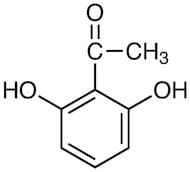
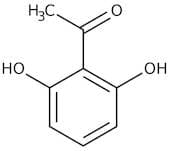
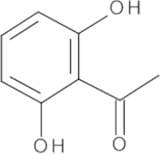
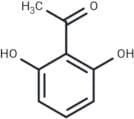
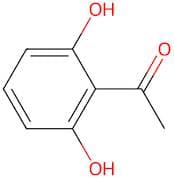
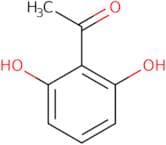
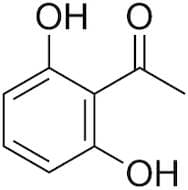
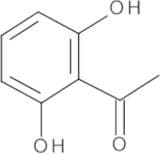
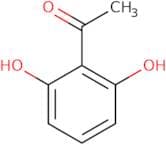
2',6'-Dihydroxyacétophénone, avec le numéro CAS 699-83-2, est un composé organique qui appartient à la classe des acétophénones. Il présente une structure phénolique avec deux groupes hydroxyles (-OH) situés aux positions 2 et 6 de l'anneau aromatique, et un groupe acétyle attaché à l'anneau de benzène. Ce composé est typiquement un solide cristallin blanc à blanc cassé et est soluble dans des solvants organiques tels que l'éthanol et l'acétone, mais a une solubilité limitée dans l'eau. Il présente des propriétés telles qu'une activité antioxydante et est souvent utilisé dans diverses applications, y compris comme réactif en synthèse organique et dans la formulation de certains produits pharmaceutiques et cosmétiques. La présence de groupes hydroxyles contribue à sa réactivité, lui permettant de participer à des liaisons hydrogène et à d'autres interactions chimiques. De plus, 2',6'-Dihydroxyacétophénone peut présenter des activités biologiques, ce qui le rend intéressant en chimie médicinale et en science des matériaux.
Formule :C8H8O3
InChI :InChI=1S/C8H8O3/c1-5(9)8-6(10)3-2-4-7(8)11/h2-4,10-11H,1H3
Code InChI :InChIKey=YPTJKHVBDCRKNF-UHFFFAOYSA-N
SMILES :C(C)(=O)C1=C(O)C=CC=C1O
Synonymes :- 1,3-Benzenediol, 2-acetyl-
- 1-(2,6-Dihydroxyphenyl)Ethanone
- 1-(2,6-Dihydroxyphenyl)ethan-1-one
- 2,6-Dihydroxyacetophenone
- 2-Acetylbenzene-1,3-diol
- 2-Acetylresorcinol
- Acetophenone, 2,6-dihydroxy-
- Ethanone, 1-(2,6-dihydroxyphenyl)-
- NSC 615
- γ-Resacetophenone
Trier par
Degré de pureté (%)
0
100
|
0
|
50
|
90
|
95
|
100
16 produits concernés.
2',6'-Dihydroxyacetophenone
CAS :Formule :C8H8O3Degré de pureté :>97.0%(T)Couleur et forme :White to Light yellow to Green powder to crystalMasse moléculaire :152.152',6'-Dihydroxyacetophenone, 98+%
CAS :This Thermo Scientific Chemicals brand product was originally part of the Alfa Aesar product portfolio. Some documentation and label information may refer to the legacy brand. The original Alfa Aesar product / item code or SKU reference has not changed as a part of the brand transition to Thermo SciFormule :C8H8O3Degré de pureté :98+%Couleur et forme :Pale cream to cream to yellow to pale brown, PowderMasse moléculaire :152.152-Acetylresorcinol (2-Acetylresorcinol; 1-(2,6-Dihydroxyphenyl)ethan-1-one)
CAS :Ketone-phenols and ketones with other oxygen functionFormule :C8H8O3Couleur et forme :Light Yellow SolidMasse moléculaire :152.047341-(2,6-Dihydroxyphenyl)ethanone
CAS :Formule :C8H8O3Degré de pureté :98%Couleur et forme :SolidMasse moléculaire :152.14732,6-Dihydroxyacetophenone
CAS :2,6-DihydroxyacetophenoneDegré de pureté :≥98%Masse moléculaire :152.15g/mol2'',6''-Dihydroxyacetophenone
CAS :Formule :C8H8O3Degré de pureté :(HPLC) ≥ 99.0%Couleur et forme :Light yellow to beige powderMasse moléculaire :152.15Sodium Cromoglicate EP Impurity A
CAS :Produit contrôléFormule :C8H8O3Couleur et forme :NeatMasse moléculaire :152.152,6-Dihydroxyacetophenone
CAS :Compound Fr16683 is a natural product for research related to life sciences. The catalog number is Fr16683 and the CAS number is 699-83-2.Formule :C8H8O3Degré de pureté :99.62% - 99.75%Couleur et forme :Yellowish-Beige PowderMasse moléculaire :152.152',6'-Dihydroxyacetophenone
CAS :2',6'-DihydroxyacetophenoneFormule :C8H8O3Degré de pureté :98%Couleur et forme : light yellow solidMasse moléculaire :152.15g/mol2,6-Dihydroxyacetophenone
CAS :2,6-Dihydroxyacetophenone is a molecule that belongs to the group of matrix-assisted laser desorption/ionization (MALDI) and is often used as a model system. This molecule has been shown to inhibit Toll-like receptor (TLR) signaling in bacteria by interfering with the production of reactive oxygen species. The skeleton of this molecule is stable in both water and organic solvents and can be prepared from plant material. The compound has also been shown to have antimicrobial properties against Gram-positive bacteria, such as Staphylococcus aureus, and Gram-negative bacteria, such as Escherichia coli. 2,6-Dihydroxyacetophenone also inhibits the growth of 3T3-L1 preadipocytes in vitro by reducing glucose uptake and increasing protocatechuic acid production. 2,6-Dihydroxyacetophenone was first isolated when it was found that protocatechuFormule :C8H8O3Degré de pureté :Min. 96 Area-%Couleur et forme :PowderMasse moléculaire :152.15 g/mol2′,6′-Dihydroxyacetophenone;
CAS :Formule :C8H8O3Degré de pureté :98%Couleur et forme :SolidMasse moléculaire :152.1492,6-Dihydroxyacetophenone extrapure, 99%
CAS :Formule :C8H8O3Degré de pureté :min. 99%Couleur et forme :Lemon - yellow, Crystalline powder, Clear & yellowMasse moléculaire :152.152',6'-Dihydroxyacetophenone
CAS :Produit contrôléApplications 2',6'-Dihydroxyacetophenone (cas# 699-83-2) is a compound useful in organic synthesis.
Formule :C8H8O3Couleur et forme :NeatMasse moléculaire :152.152,6-Dihydroxyacetophenone
CAS :2,6-Dihydroxyacetophenone is a high quality chemical that is used as a reagent in organic synthesis, as well as a useful intermediate. It can be used to create fine chemicals and research chemicals. This compound has been found to be versatile building block that can be used in the production of speciality chemicals. 2,6-Dihydroxyacetophenone is also an excellent reaction component that can be used in the production of many compounds.
Formule :C8H8O3Masse moléculaire :152.15 g/mol