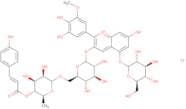
![1-Benzopyrylium, 3-[[6-O-[6-deoxy-4-O-[(2E)-3-(4-hydroxyphenyl)-1-oxo-2-propen-1-yl]-α-L-mannopyra…](/_next/image/?url=https%3A%2Fstatic.cymitquimica.com%2Fcas-image%2Fthumb-webp%2F388592-1-benzopyrylium-3-6-o-6-deoxy-4-o-2e-3-4-hydroxyphenyl-1-oxo-2-propen-1-yl-a-l-mannopyranosyl-b-d-glucopyranosyl-oxy-2-34-dihydroxy-5-methoxyphenyl-5-b-d-glucopyranosyloxy-7-hydroxy-chloride-1-1.webp&w=3840&q=75)
CAS 69915-09-9
:1-Benzopyrylium, 3-[[6-O-[6-désoxy-4-O-[(2E)-3-(4-hydroxyphényl)-1-oxo-2-propén-1-yl]-α-L-mannopyranosyl]-β-D-glucopyranosyl]oxy]-2-(3,4-dihydroxy-5-méthoxyphényl)-5-(β-D-glucopyranosyloxy)-7-hydroxy-, chlorure (1:1)
Description :
1-Benzopyrylium, 3-[[6-O-[6-désoxy-4-O-[(2E)-3-(4-hydroxyphényl)-1-oxo-2-propén-1-yl]-α-L-mannopyranosyl]-β-D-glucopyranosyl]oxy]-2-(3,4-dihydroxy-5-méthoxyphényl)-5-(β-D-glucopyranosyloxy)-7-hydroxy-, chlorure (1:1), avec le numéro CAS 69915-09-9, est un composé organique complexe caractérisé par sa structure polyphénolique et ses liaisons glycosidiques. Cette substance présente un noyau de benzopyrylium, qui contribue à son potentiel en tant que chromophore, la rendant utile dans diverses applications, y compris la production de colorants et de pigments. La présence de plusieurs groupes hydroxyles améliore sa solubilité dans les solvants polaires et peut lui conférer des propriétés antioxydantes. Les composants glycosidiques suggèrent qu'il pourrait présenter une activité biologique, influençant potentiellement les processus ou interactions cellulaires. De plus, l'ion chlorure indique qu'il pourrait exister sous forme de sel, ce qui peut affecter sa stabilité et sa réactivité. Dans l'ensemble, la structure complexe et les groupes fonctionnels de ce composé suggèrent une gamme de comportements chimiques et d'applications potentielles dans des domaines tels que la pharmacie, la science des matériaux et la biochimie.
Formule :C43H49O23·Cl
InChI :InChI=1S/C43H48O23.ClH/c1-16-39(66-29(48)8-5-17-3-6-19(45)7-4-17)35(54)38(57)41(60-16)59-15-28-32(51)34(53)37(56)43(65-28)63-26-13-21-23(61-40(26)18-9-22(47)30(49)25(10-18)58-2)11-20(46)12-24(21)62-42-36(55)33(52)31(50)27(14-44)64-42;/h3-13,16,27-28,31-39,41-44,50-57H,14-15H2,1-2H3,(H3-,45,46,47,48,49);1H/t16-,27+,28+,31+,32+,33-,34-,35-,36+,37+,38+,39-,41+,42+,43+;/m0./s1
Code InChI :InChIKey=DJFIFVQDAVMXSM-JMWCUXORSA-N
SMILES :O(C=1C(=[O+]C2=C(C1)C(O[C@@H]3O[C@H](CO)[C@@H](O)[C@H](O)[C@H]3O)=CC(O)=C2)C4=CC(OC)=C(O)C(O)=C4)[C@@H]5O[C@H](CO[C@H]6[C@H](O)[C@H](O)[C@@H](OC(/C=C/C7=CC=C(O)C=C7)=O)[C@H](C)O6)[C@@H](O)[C@H](O)[C@H]5O.[Cl-]
Synonymes :- 1-Benzopyrylium, 3-[[6-O-[6-deoxy-4-O-[(2E)-3-(4-hydroxyphenyl)-1-oxo-2-propenyl]-α-L-mannopyranosyl]-β-D-glucopyranosyl]oxy]-2-(3,4-dihydroxy-5-methoxyphenyl)-5-(β-D-glucopyranosyloxy)-7-hydroxy-, chloride
- Petanin
- 1-Benzopyrylium, 3-[[6-O-[6-deoxy-4-O-[3-(4-hydroxyphenyl)-1-oxo-2-propenyl]-α-L-mannopyranosyl]-β-D-glucopyranosyl]oxy]-2-(3,4-dihydroxy-5-methoxyphenyl)-5-(β-D-glucopyranosyloxy)-7-hydroxy-, chloride, (E)-
- 1-Benzopyrylium, 3-[[6-O-[6-deoxy-4-O-[(2E)-3-(4-hydroxyphenyl)-1-oxo-2-propen-1-yl]-α-L-mannopyranosyl]-β-D-glucopyranosyl]oxy]-2-(3,4-dihydroxy-5-methoxyphenyl)-5-(β-D-glucopyranosyloxy)-7-hydroxy-, chloride (1:1)
Trier par
Degré de pureté (%)
0
100
|
0
|
50
|
90
|
95
|
100
2 produits concernés.
1-Benzopyrylium, 3-[[6-O-[6-deoxy-4-O-[(2E)-3-(4-hydroxyphenyl)-1-oxo-2-propen-1-yl]-α-L-mannopyranosyl]-β-D-glucopyranosyl]oxy]-2-(3,4-dihydroxy-5-methoxyphenyl)-5-(β-D-glucopyranosyloxy)-7-hydroxy-, chloride (1:1)
CAS :Formule :C43H49ClO23Degré de pureté :PurpleMasse moléculaire :969.2884Petanin
CAS :Petanin is a natural compound isolated from the fruit of Lycium barbarum. It has been shown to have anti-inflammatory and antioxidant properties, as well as protective effects against UV radiation. Petanin is used in dietary supplements and works in synergy with other nutrients to help protect cells and repair skin damage.Degré de pureté :Min. 95%
![1-Benzopyrylium, 3-[[6-O-[6-deoxy-4-O-[(2E)-3-(4-hydroxyphenyl)-1-oxo-2-propen-1-yl]-α-L-mannopyra…](/_next/image/?url=https%3A%2Fstatic.cymitquimica.com%2Fproducts%2FIN%2Fthumb%2FDA01PG4G.jpg&w=3840&q=75)