CAS 70023-02-8
:glycine-acide aspartique-acide aspartique-acide aspartique-acide aspartique-lysine-B-naphtylamide
Description :
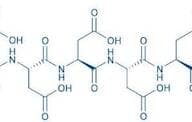
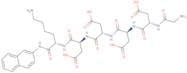
glycine-acide aspartique-acide aspartique-acide aspartique-acide aspartique-lysine-B-naphtylamide, également connu sous son numéro CAS 70023-02-8, est un peptide synthétique qui se compose d'une séquence d'acides aminés, spécifiquement de glycine (Gly), d'acide aspartique (Asp) et de lysine (Lys), liés à un groupe B-naftylamide. Ce composé se caractérise par sa structure unique, qui combine des composants peptidiques et aromatiques, influençant potentiellement son activité biologique et ses interactions. La présence de plusieurs résidus d'acide aspartique peut contribuer à sa capacité à former des liaisons hydrogène et à interagir avec divers cibles biologiques, tandis que le groupe B-naftylamide peut augmenter la lipophilie et faciliter la perméabilité membranaire. De telles caractéristiques en font un sujet d'intérêt dans la recherche biochimique, en particulier dans les études liées à la synthèse de peptides, à la conception de médicaments et à la reconnaissance moléculaire. Ses propriétés spécifiques, telles que la solubilité, la stabilité et la réactivité, dépendraient des conditions dans lesquelles il est étudié, y compris le pH et la température. Dans l'ensemble, ce composé illustre la complexité et la polyvalence des molécules basées sur des peptides en chimie médicinale.
Formule :C34H44N8O14
InChI :InChI=1/C34H44N8O14/c35-10-4-3-7-20(30(52)37-19-9-8-17-5-1-2-6-18(17)11-19)39-32(54)22(13-27(46)47)41-34(56)24(15-29(50)51)42-33(55)23(14-28(48)49)40-31(53)21(12-26(44)45)38-25(43)16-36/h1-2,5-6,8-9,11,20-24H,3-4,7,10,12-16,35-36H2,(H,37,52)(H,38,43)(H,39,54)(H,40,53)(H,41,56)(H,42,55)(H,44,45)(H,46,47)(H,48,49)(H,50,51)/t20-,21-,22?,23-,24-/m0/s1
SMILES :c1ccc2cc(ccc2c1)N=C([C@H](CCCCN)N=C(C(CC(=O)O)N=C([C@H](CC(=O)O)N=C([C@H](CC(=O)O)N=C([C@H](CC(=O)O)N=C(CN)O)O)O)O)O)O
Synonymes :- H-Gly-Asp-Asp-Asp-Asp-Lys-.beta.NA
- glycyl-L-alpha-aspartyl-L-alpha-aspartyl-L-alpha-aspartyl-alpha-aspartyl-N-naphthalen-2-yl-L-lysinamide
- Gly-Asp-Asp-Asp-Asp-Lys Beta-Naphthylamide
Trier par
Degré de pureté (%)
0
100
|
0
|
50
|
90
|
95
|
100
3 produits concernés.
H-Gly-Asp-Asp-Asp-Asp-Lys-βNA
CAS :GDDDDK-βNA, specific substrate for the determination of enteropeptidase (enterokinase), also used in histochemistry.Formule :C34H44N8O14Degré de pureté :98.1%Couleur et forme :WhiteMasse moléculaire :788.77Gly-L-Asp-L-Asp-L-Asp-L-Asp-L-Lys-beta-naphthylamide
CAS :Gly-L-Asp-L-Asp-L-Asp-L-Asp-L-Lys (GLAD) is a peptide that has been shown to inhibit the activity of protein kinases. GLAD binds to the ATP binding site and prevents ATP from binding to the kinase, which inhibits the phosphorylation of other proteins. GLAD may also activate certain protein kinases by binding to their ATP binding site. GLAD is a valuable research tool for studying protein interactions, as well as for identifying new receptor ligands and ion channels.Formule :C34H44N8O14Degré de pureté :Min. 95%Masse moléculaire :788.8 g/molH-Gly-Asp-Asp-Asp-Asp-Lys-bNA trifluoroacetic acid
CAS :H-Gly-Asp-Asp-Asp-Asp-Lys-bNA trifluoroacetic acid is a peptide that is used as a biocatalyst in the production of microspheres. It is also known as enterokinase, and cleaves proteins at their N termini. This enzyme has been immobilized on silica gel and then applied to the production of microspheres. The half life of this enzyme is 1 hour at 37°C, but it can be increased to 8 hours by immobilizing it on silica gel using glutaraldehyde. HGAASDAAKLysBNAtrifluoroacetic acid has been shown to have a high specific activity with an efficiency of 60% and a pH range between 4 and 10. It has been shown to have high protein cleavage rates at 30°C, 37°C, and 40°C, with bovine serum albumin being the
Formule :C38H45N8O16F3Degré de pureté :Min. 95%Masse moléculaire :788.76 g/mol