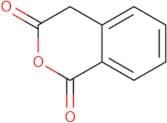
CAS 703-59-3
:Anhydride homophtalique
Description :
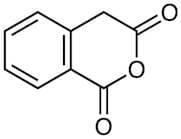
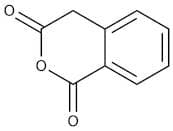
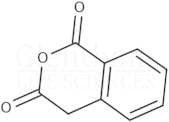
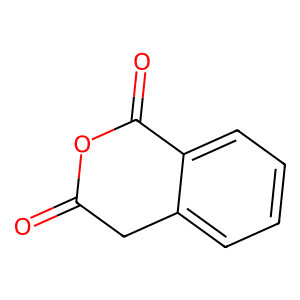
Anhydride homophtalique, avec le numéro CAS 703-59-3, est un composé organique caractérisé par son groupe fonctionnel anhydride dérivé de l'acide homophthalique. Il se présente sous la forme d'un solide cristallin blanc à jaune clair et est connu pour son point de fusion élevé et sa faible solubilité dans l'eau, mais il est soluble dans des solvants organiques tels que l'acétone et l'acétate d'éthyle. Ce composé est principalement utilisé dans la synthèse de divers polymères, en particulier dans la production de résines époxy et comme durcisseur dans les revêtements et les adhésifs. Anhydride homophtalique présente une réactivité typique des anhydrides, subissant facilement une hydrolyse pour former de l'acide homophthalique en présence d'eau. Il est également connu pour ses applications potentielles dans la fabrication de colorants et de produits pharmaceutiques. Les considérations de sécurité incluent le maniement avec précaution, car il peut être irritant pour la peau, les yeux et le système respiratoire. Des mesures de sécurité appropriées, y compris l'utilisation d'équipements de protection individuelle, sont recommandées lors de la manipulation de ce produit chimique.
Formule :C9H6O3
InChI :InChI=1/C9H6O3/c10-8-5-6-3-1-2-4-7(6)9(11)12-8/h1-4H,5H2
Code InChI :InChIKey=AKHSBAVQPIRVAG-UHFFFAOYSA-N
SMILES :O=C1C=2C(CC(=O)O1)=CC=CC2
Synonymes :- 1,3-Isochromandione
- 1H-2-Benzopyran-1,3(4H)-dione
- 1H-isochromene-1,3(4H)-dione
- 3,4-Dihydro-1H-2-benzopyran-1,3-dione
- Benzeneacetic acid, 2-carboxy-, cyclic anhydride
- Benzoglutaric Anhydride
- Homophtalic anhydride
- Homophthalic acid anhydride
- NSC 2825
- NSC 401693
- o-Carboxyphenylacetic acid cyclic anhydride~1,3-Isochromanedione
- o-Toluic acid, α-carboxy-, cyclic anhydride
- 3,4-2H-Isocoumarin-3-one
- Homophthalic anhydride, 98+%
- 2-CARBOXYPHENYLACETIC ANHYDRIDE
- HOMOPHTHALIC ANHYDRIDE
- HOMOPHTHALIC ANHYDRIDE, TECH.
- 1,3-isochromanedione
- CarboxyphenylaceticAnhydride
- Isochroman-1,3-dione
- HomoPhthalicAnhydrideOr
- 1,3-Isochromandione, 2-Carboxyphenylacetic anhydride
- Homophthalic anhydride, 97+%
- o-Carboxyphenylaceticacidcyclicanhydride
- Voir plus de synonymes
Trier par
Degré de pureté (%)
0
100
|
0
|
50
|
90
|
95
|
100
8 produits concernés.
Homophthalic Anhydride
CAS :Formule :C9H6O3Degré de pureté :>98.0%(GC)Couleur et forme :White to Orange to Green powder to crystalMasse moléculaire :162.14Homophthalic anhydride, 97+%
CAS :It is used as a chemical and organic intermediates. This Thermo Scientific Chemicals brand product was originally part of the Alfa Aesar product portfolio. Some documentation and label information may refer to the legacy brand. The original Alfa Aesar product / item code or SKU reference has not chaFormule :C9H6O3Degré de pureté :97+%Couleur et forme :Crystals or powder or crystalline powder, Pale cream to cream to pale brown to pale grayMasse moléculaire :162.14Homophthalic anhydride
CAS :Formule :C9H6O3Degré de pureté :95%Couleur et forme :SolidMasse moléculaire :162.1421Homophthalic anhydride (2-Carboxyphenylacetic anhydride)
CAS :Formule :C9H6O3Degré de pureté :≥ 95.0%Couleur et forme :Off-white to light yellow or light brown crystalline powderMasse moléculaire :162.14Homophthalic anhydride
CAS :Homophthalic anhydrideFormule :C9H6O3Degré de pureté :≥95%Couleur et forme : white crystalline powderMasse moléculaire :162.14214g/molIsochroman-1,3-dione
CAS :Formule :C9H6O3Degré de pureté :95%Couleur et forme :SolidMasse moléculaire :162.144o-Carboxyphenylacetic acid cyclic anhydride
CAS :The o-carboxyphenylacetic acid cyclic anhydride (OCPA) is a compound that has been shown to have antimicrobial activity. It inhibits the growth of bacteria by binding to the receptor site of bacterial enzymes and blocking the synthesis of fungal cell walls. OCPA can also be used in the treatment of inflammatory diseases, such as cancer and arthritis. The mode of action for OCPA is not well understood but it is believed that it may interfere with amine metabolism or act as a hydrogen bond acceptor. Analysis of OCPA has been done using analytical methods such as gas chromatography mass spectrometry (GCMS), nuclear magnetic resonance (NMR), and infrared spectroscopy (IR).Formule :C9H6O3Degré de pureté :Min. 95%Couleur et forme :PowderMasse moléculaire :162.14 g/mol