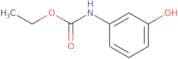
CAS 7159-96-8
:Carbamate d'éthyle 3-hydroxyphényl
Description :
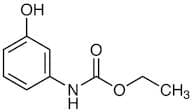
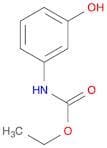
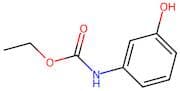
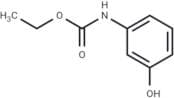
Carbamate d'éthyle 3-hydroxyphényl, avec le numéro CAS 7159-96-8, est un composé organique caractérisé par son groupe fonctionnel carbamate et une structure phénolique. Il apparaît généralement sous forme de solide blanc à blanc cassé ou de poudre cristalline. Ce composé est connu pour ses applications potentielles dans les produits pharmaceutiques et les agrochimiques, servant souvent d'intermédiaire dans la synthèse de diverses molécules bioactives. Carbamate d'éthyle 3-hydroxyphényl présente une solubilité modérée dans les solvants organiques, tandis que sa solubilité dans l'eau peut varier en fonction du pH et de la température. La présence du groupe hydroxyle contribue à sa réactivité et à sa capacité à former des liaisons hydrogène, influençant son activité biologique et ses interactions avec d'autres substances. De plus, ce composé peut posséder des propriétés antioxydantes, ce qui le rend intéressant dans la recherche liée à la santé et à la prévention des maladies. Comme pour de nombreuses substances chimiques, une manipulation appropriée et des précautions de sécurité sont essentielles en raison de la toxicité potentielle ou de l'impact environnemental.
Formule :C9H11NO3
InChI :InChI=1/C9H11NO3/c1-2-13-9(12)10-7-4-3-5-8(11)6-7/h3-6,11H,2H2,1H3,(H,10,12)
Code InChI :InChIKey=KCLZXXMMEDEBMF-UHFFFAOYSA-N
SMILES :N(C(OCC)=O)C1=CC(O)=CC=C1
Synonymes :- (3-Hydroxy-Phenyl)-Carbamic Acid Ethyl Ester
- (3-Hydroxyphenyl)carbamic acid ethyl ester
- 3-(Ethoxycarbonylamino)phenol
- 3-Carbethoxyaminophenol
- 3-Ethyloxycarbonylaminophenol
- Carbamic acid, (3-hydroxyphenyl)-, ethyl ester
- Carbamic acid, N-(3-hydroxyphenyl)-, ethyl ester
- Carbanilic acid, m-hydroxy-, ethyl ester
- Carbanilic acid, m-hydroxy-, ethyl esters
- Ethyl (m-hydroxyphenyl)carbamate
- Ethyl 3-hydroxycarbanilate
- Ethyl 3-hydroxyphenylcarbamate
- Ethyl N-(3-hydroxyphenyl)carbamate
- NSC 222551
- m-(Ethoxycarbonylamino)phenol
- Ethyl (3-hydroxyphenyl)carbamate
- Ethyl-3-hydroxyphenolcarbamate
- (3-hydroxyphenyl)-carbamicaciethylester
- ethyln-(3-hydroxyphenyl)carbamate
- ethylm-hydroxycarbanilate
- N-(3-Hydroxyphenyl)carbamic acid ethyl ester
- (3-Hydroxy-Phenyl)-carbanicacid ethyl ester
- m-hydroxy-carbanilicaciethylester
- ethyl3-hydroxycarbanilate
- AKOS BBS-00008072
- Voir plus de synonymes
Trier par
Degré de pureté (%)
0
100
|
0
|
50
|
90
|
95
|
100
6 produits trouvés.
Ethyl (3-Hydroxyphenyl)carbamate
CAS :Formule :C9H11NO3Degré de pureté :>97.0%(GC)Couleur et forme :White to Light yellow powder to crystalMasse moléculaire :181.19Ethyl (3-hydroxyphenyl)carbamate
CAS :Formule :C9H11NO3Degré de pureté :%Couleur et forme :SolidMasse moléculaire :181.1885Ethyl 3-Hydroxyphenylcarbamate
CAS :Ethyl 3-HydroxyphenylcarbamateDegré de pureté :99%Masse moléculaire :181.18854g/molEthyl (3-hydroxyphenyl)carbamate
CAS :Ethyl (3-hydroxyphenyl)carbamate is a bioactive chemical.Formule :C9H11NO3Degré de pureté :98%Couleur et forme :SolidMasse moléculaire :181.19Ethyl (3-hydroxyphenyl)carbamate
CAS :Formule :C9H11NO3Degré de pureté :95+%Couleur et forme :SolidMasse moléculaire :181.191Ethyl (3-Hydroxyphenyl)carbamate
CAS :Ethyl (3-Hydroxyphenyl)carbamate is a carbonyl group that is produced by the hydrolysis of triticum aestivum. This product has been shown to have a synergistic interaction with retroflexus and bioassay, an imaging technique used to measure the photosynthetic activity of plants. Ethyl (3-Hydroxyphenyl)carbamate has low light fluorescence properties, which are useful for the detection of sugarbeet in low light conditions. The symptoms of ethyl (3-hydroxyphenyl)carbamate exposure include a constant and acceptor, which is a molecule or atom that accepts electrons from an electron donor in chemical reactions. Ethyl (3-hydroxyphenyl)carbamate can react with proton to form arvensis, a sugar found in sugarbeets.
Formule :C9H11NO3Degré de pureté :Min. 95%Masse moléculaire :181.19 g/mol