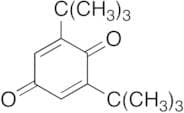
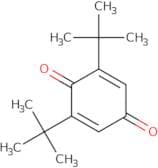
CAS 719-22-2
:2,6-Di-tert-butyl-1,4-benzoquinone
Description :
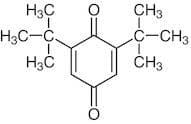
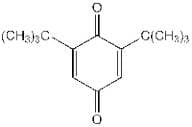
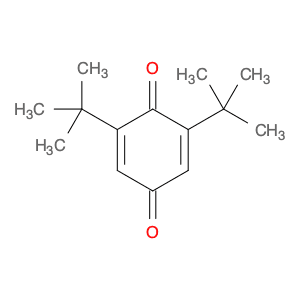
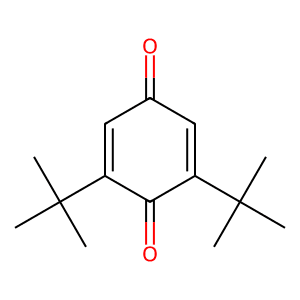
2,6-Di-tert-butyl-1,4-benzoquinone est un composé organique caractérisé par sa structure de quinone, qui présente deux groupes tert-butyle aux positions 2 et 6 de l'anneau benzénique. Ce composé est connu pour ses fortes propriétés antioxydantes, ce qui le rend utile dans diverses applications, y compris comme stabilisateur dans les polymères et comme réactif dans la synthèse organique. Il est généralement un solide jaune à orange à température ambiante et est soluble dans des solvants organiques tels que l'acétone et le chloroforme, mais a une solubilité limitée dans l'eau. La présence des volumineux groupes tert-butyle contribue à son encombrement stérique, influençant sa réactivité et sa stabilité. De plus, 2,6-Di-tert-butyl-1,4-benzoquinone peut subir des réactions redox, lui permettant de participer à des processus de transfert d'électrons. Des précautions de sécurité doivent être prises lors de la manipulation de ce composé, car il peut présenter des risques pour la santé s'il est inhalé ou ingéré. Dans l'ensemble, ses caractéristiques structurelles uniques et ses propriétés en font un composé précieux tant dans les milieux industriels que de recherche.
Formule :C14H20O2
InChI :InChI=1/C14H20O2/c1-13(2,3)10-7-9(15)8-11(12(10)16)14(4,5)6/h7-8H,1-6H3
Code InChI :InChIKey=RDQSIADLBQFVMY-UHFFFAOYSA-N
SMILES :C(C)(C)(C)C=1C(=O)C(C(C)(C)C)=CC(=O)C1
Synonymes :- 2,5-Cyclohexadiene-1,4-dione, 2,6-bis(1,1-dimethylethyl)-
- 2,6-Bis(1,1-dimethylethyl)-2,5-cyclohexadiene-1,4-dione
- 2,6-Bis[1,1-dimethyl ethyl]quinone
- 2,6-Di-Tert-Butyl-P-Benzoquinon
- 2,6-Di-Tert-Butylcyclohexa-2,5-Diene-1,4-Dione
- 2,6-Di-tert-butyl-1,4-benzoquinone
- 2,6-Di-tert-butyl-2,5-cyclohexadien-1,4-dione
- 2,6-Di-tert-butyl-2,5-cyclohexadiene-1,4-dione
- 2,6-Di-tert-butyl-p-quinone
- 2,6-Di-tert-butylbenzoquinone
- 2,6-Di-tert-butylquinone
- 2,6-Ditert-butylcyclohexa-2,5-diene-1,4-dione
- 3,5-Di-tert-butyl-p-benzoquinone
- 3,5-Di-tert-butylquinone
- Dibutylpbenzoquinone
- NSC 14448
- p-Benzoquinone, 2,6-di-tert-butyl-
- DBQ
- 2,5-Cyclohexadiene-1,4-dione,2,6-
- 2,6-Di-tert-butyl-p-benzoquinone, 98+%
- 2,6-DI(TERT-BUTYL)BENZO-1,4-QUINONE
- 4-dione,2,6-bis(1,1-dimethylethyl)-5-cyclohexadiene-1
- 2,6-DI-T-BUTYL-1,4-BENZOQUINONE
- 2,6-di-tert-Butyl-p-benzoquino
- p-Benzoquinone, 2,6-bis-(1,1-dimethylethyl)
- 2,6-DI-T-BUTYL-P-BENZOQUINONE
- 2,6-DI-TERT-BUTYL-P-BENZOQUINONE
- Benzoquinone, 2,6-di-(1,1-dimethylethyl)
- Voir plus de synonymes
Trier par
Degré de pureté (%)
0
100
|
0
|
50
|
90
|
95
|
100
8 produits concernés.
2,6-Di-tert-butyl-1,4-benzoquinone
CAS :Formule :C14H20O2Degré de pureté :>98.0%(GC)Couleur et forme :Light yellow to Yellow to Orange powder to crystalMasse moléculaire :220.312,6-Di-tert-butyl-p-benzoquinone, 98+%
CAS :2,6-Di-tert-butyl-1,4-benzoquinone was used as an antioxidant to study the elimination rate of micro pollutant from storm and waste water. It was also used as a metabolite of butylated hydroxytoluene. It is used as a treatment agent to improve germination and plant health. This Thermo Scientific CheFormule :C14H20O2Degré de pureté :98+%Couleur et forme :Orange, Crystals or crystalline powderMasse moléculaire :220.312,6-Di-tert-butylcyclohexa-2,5-diene-1,4-dione
CAS :Formule :C14H20O2Degré de pureté :98%Couleur et forme :SolidMasse moléculaire :220.30742,6-di(tert-butyl)benzo-1,4-quinone
CAS :2,6-di(tert-butyl)benzo-1,4-quinoneFormule :C14H20O2Degré de pureté :98%Couleur et forme : yellow solidMasse moléculaire :220.31g/mol2,6-Di-tert-butyl-p-benzoquinone
CAS :Applications 2.6-Di-tert-butyl-p-benzoquinone was used as a treatment agent to improve germination, plant health and yield.
Formule :C14H20O2Couleur et forme :NeatMasse moléculaire :220.312,6-Di-tert-butylcyclohexa-2,5-diene-1,4-dione
CAS :Formule :C14H20O2Degré de pureté :98%Couleur et forme :Solid, Reddish yellow to yellow red powderMasse moléculaire :220.3122,6-Di-tert-butylcyclohexa-2,5-diene-1,4-dione
CAS :2,6-Di-tert-butylcyclohexa-2,5-diene-1,4-dione (BHT) is a chemical compound that is used as an oxygenation catalyst and analytical method. The molecular structure of BHT contains a hydroxyl group with a redox potential of 0.3 V and a thermal expansion coefficient of 7 x 10 K. This compound has been shown to be toxic in mice, causing lung damage and oxidative DNA damage. BHT also inhibits the transcriptional regulation of genes by binding to amines in the cell membrane. It can act as an antioxidant because it binds to reactive oxygen species and prevents them from oxidizing other molecules in the cell. These properties make it useful for protecting cells from oxidative stress caused by reactive oxygen species or peroxides.Formule :C14H20O2Degré de pureté :Min. 95%Masse moléculaire :220.31 g/mol