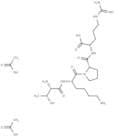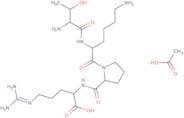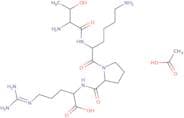
CAS 72103-53-8
:acétate de tuftsin
Description :
acétate de tuftsin, avec le numéro CAS 72103-53-8, est un peptide synthétique dérivé du modulateur immunitaire naturel tuftsin, qui est un fragment de la molécule d'immunoglobuline G (IgG). Ce composé est connu pour ses propriétés immunostimulantes, améliorant l'activité des macrophages et favorisant la réponse immunitaire. acétate de tuftsin est généralement caractérisé par sa capacité à moduler les fonctions immunitaires, ce qui le rend intéressant en immunologie et pour des applications thérapeutiques potentielles. Il est souvent étudié pour son rôle dans l'amélioration de la phagocytose et de la production de cytokines, ce qui peut être bénéfique dans diverses conditions médicales, y compris les infections et le cancer. La forme acétate indique qu'il s'agit d'un sel ou d'un ester dérivé de l'acide acétique, ce qui peut influencer sa solubilité et sa stabilité. Dans l'ensemble, acétate de tuftsin représente un domaine de recherche significatif dans le développement de thérapies immunitaires et la compréhension de la modulation du système immunitaire.
Formule :C23H44N8O8
InChI :InChI=1/C21H40N8O6.C2H4O2/c1-12(30)16(23)18(32)27-13(6-2-3-9-22)19(33)29-11-5-8-15(29)17(31)28-14(20(34)35)7-4-10-26-21(24)25;1-2(3)4/h12-16,30H,2-11,22-23H2,1H3,(H,27,32)(H,28,31)(H,34,35)(H4,24,25,26);1H3,(H,3,4)
SMILES :CC(C(C(=NC(CCCCN)C(=O)N1CCCC1C(=NC(CCCNC(=N)N)C(=O)O)O)O)N)O.CC(=O)O
Synonymes :- L-Arginine, N2-(1-(N2-L-threonyl-L-lysyl)-L-prolyl)-, diacetate (salt)4
- L-threonyl-L-lysyl-L-prolyl-N~5~-(diaminomethylidene)-L-ornithine acetate (1:2)
- threonyllysylprolyl-N~5~-(diaminomethylidene)ornithine acetate (1:1)
- Tuftsin Acetate Salt
- tuftsin acetate
- THR-LYS-PRO-ARG ACETATE SALT
- tuftsin acetate salt hydrate
- H-THR-LYS-PRO-ARG-OH ACETATE SALT
- H-THR-LYS-PRO-ARG-OH ACOH
- Tuftsin diacetate
- TUFTSIN
- Voir plus de synonymes
Trier par
Degré de pureté (%)
0
100
|
0
|
50
|
90
|
95
|
100
3 produits concernés.
Tuftsin diacetate
CAS :Tuftsin diacetate, Thr-Lys-Pro-Arg, activates macrophages/microglia; it's in immunoglobulin G's Fc and boosts immunity.Formule :C25H48N8O10Degré de pureté :98%Couleur et forme :SolidMasse moléculaire :620.7Tuftsin
CAS :Produit contrôléTuftsin is a cyclic peptide that has been shown to have various biological properties, including anti-inflammatory and immunosuppressive activity. Tuftsin has been shown to inhibit the production of proinflammatory cytokines such as IL-10 by T cells in vitro. Tuftsin also inhibits the activation of toll-like receptors (TLR) and may have a role in inhibiting mycobacterial infection. This drug was found to be well tolerated in humans with congestive heart failure, and is currently being evaluated for its potential use as an adjunct therapy for inflammatory bowel disease. It has also been shown to be effective against opportunistic fungal infections, such as Candida albicans, Cryptococcus neoformans, and Aspergillus fumigatus. Tuftsin can be measured using analytical methods such as titration calorimetry or polymerase chain reaction (PCR).Formule :C21H40N8O6•2CH3COOH•4H2ODegré de pureté :Min. 95%Masse moléculaire :692.75 g/molTuftsin diacetate
CAS :Produit contrôléTuftsin diacetate is a synthetic peptide derivative, which is a modified form of the natural tetrapeptide tuftsin. This product originates from the enzymatic action on the Fc region of the gamma heavy chain of immunoglobulin G. Tuftsin diacetate functions by enhancing the phagocytic activity of macrophages and neutrophils, leading to an amplified immune response. Its mode of action involves binding to specific cell surface receptors, which stimulates these immune cells and promotes pathogen clearance.Formule :C23H44N8O8Degré de pureté :Min. 95%Masse moléculaire :560.6 g/mol