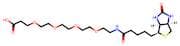
![4,7,10,13-Tetraoxa-16-azaheneicosanoicacid, 21-[(3aS,4S,6aR)-hexahydro-2-oxo-1H-thieno[3,4-d]imida…](/_next/image/?url=https%3A%2Fstatic.cymitquimica.com%2Fcas-image%2Fthumb-webp%2F307440-471013-tetraoxa-16-azaheneicosanoicacid-21-3as-4s-6ar-hexahydro-2-oxo-1h-thieno-34-d-imidazol-4-yl-17-oxo.webp&w=3840&q=75)
CAS 721431-18-1
:acide 4,7,10,13-tétraoxa-16-azaheneicosanoïque, 21-[(3aS,4S,6aR)-hexahydro-2-oxo-1H-thièno[3,4-d]imidazol-4-yl]-17-oxo-
Description :
L'acide 4,7,10,13-tétraoxa-16-azaheneicosanoïque, avec le numéro CAS 721431-18-1, est un composé organique complexe caractérisé par ses caractéristiques structurelles uniques, y compris plusieurs atomes d'oxygène et d'azote dans son cadre moléculaire. Ce composé contient une longue chaîne de carbone, ce qui contribue à ses propriétés hydrophobes, tandis que la présence de groupes fonctionnels de tétraoxa et d'acide azaheneicosanoïque confère hydrophilie et réactivité potentielle. La partie thieno[3,4-d]imidazole suggère une activité biologique, indiquant peut-être son rôle en chimie médicinale ou comme pharmacophore. La stéréochimie, indiquée par la configuration spécifique du groupe hexahydro-2-oxo, peut influencer ses interactions biologiques et son efficacité. Dans l'ensemble, la structure complexe de ce composé suggère des applications potentielles dans le développement de médicaments, en particulier dans le ciblage de voies ou de fonctions biologiques spécifiques. D'autres études seraient nécessaires pour élucider son comportement chimique complet, sa stabilité et ses utilisations thérapeutiques potentielles.
Formule :C21H37N3O8S
Synonymes :- 15-[D(+)-Biotinylamino]-4,7,10,13-Tetraoxapentadecanoic Acid
Trier par
Degré de pureté (%)
0
100
|
0
|
50
|
90
|
95
|
100
9 produits concernés.
Biotin-PEG4-propionic Acid
CAS :Formule :C21H37N3O8SDegré de pureté :>98.0%(T)Couleur et forme :White to Light yellow powder to crystalMasse moléculaire :491.6015-[D-(+)-Biotinylamino]-4,7,10,13-tetraoxapentadecanoic acid
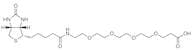
CAS :Formule :C21H37N3O8SDegré de pureté :97%Couleur et forme :SolidMasse moléculaire :491.5988Ref: IN-DA005JT7
5gÀ demander10gÀ demander50gÀ demander25mg51,00€50mg63,00€100mg75,00€250mg111,00€1g245,00€Biotin-PEG4-acid
CAS :Biotin-PEG4-acid is a PEG-based linker for PROTACs which joins two essential ligands, crucial for forming PROTAC molecules.Formule :C21H37N3O8SCouleur et forme :SolidMasse moléculaire :491.6Biotin-PEG4-propionic acid
CAS :Biotin-PEG4-propionic acid is a PEG compound with two different functional groups (also known as heterobifunctional). Unlike homobifunctional PEG compounds (same functional group on both ends), this type of compounds are more versatile as have two different anchor points. Biotin-PEG4-propionic acid is used as a linker and spacer to add a PEG moiety, via pegylation (a bioconjugation technique) to proteins, peptides, oligonucleotides, small molecules and nanoparticles.Formule :C21H37N3O8SDegré de pureté :Min. 95%Couleur et forme :PowderMasse moléculaire :491.6 g/moldPEG®24-Biotin Acid
CAS :dPEG®24-Biotin Acid is a PEG compound with two different functional groups (also known as heterobifunctional). Unlike homobifunctional PEG compounds (same functional group on both ends), this type of compounds are more versatile as have two different anchor points. dPEG®24-Biotin Acid is used as a linker and spacer to add a PEG moiety, via pegylation (a bioconjugation technique) to proteins, peptides, oligonucleotides, small molecules and nanoparticles.Formule :C61H117N3O28SDegré de pureté :Min. 95%Masse moléculaire :1,325.6 g/moldPEG®4 Biotin Acid
CAS :dPEG®4 Biotin Acid is a PEG compound with two different functional groups (also known as heterobifunctional). Unlike homobifunctional PEG compounds (same functional group on both ends), this type of compounds are more versatile as have two different anchor points. dPEG®4 Biotin Acid is used as a linker and spacer to add a PEG moiety, via pegylation (a bioconjugation technique) to proteins, peptides, oligonucleotides, small molecules and nanoparticles.
Degré de pureté :Min. 95%Masse moléculaire :491.6 g/moldPEG®48-Biotin Acid
CAS :dPEG®48-Biotin Acid is a PEG compound with two different functional groups (also known as heterobifunctional). Unlike homobifunctional PEG compounds (same functional group on both ends), this type of compounds are more versatile as have two different anchor points. dPEG®48-Biotin Acid is used as a linker and spacer to add a PEG moiety, via pegylation (a bioconjugation technique) to proteins, peptides, oligonucleotides, small molecules and nanoparticles.Formule :C112H218N4O53SDegré de pureté :Min. 95%Masse moléculaire :2,500.99 g/mol

![15-[D-(+)-Biotinylamino]-4,7,10,13-tetraoxapentadecanoic acid](/_next/image/?url=https%3A%2Fstatic.cymitquimica.com%2Fproducts%2FIN%2Fthumb%2FDA005JT7.jpg&w=3840&q=75)