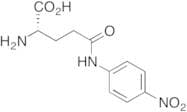
CAS 7300-59-6
:γ-Glutamyl-p-nitroanilide
Description :
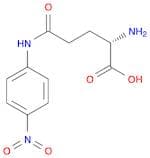
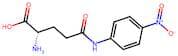
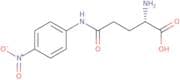
γ-Glutamyl-p-nitroanilide est un composé synthétique couramment utilisé dans les essais biochimiques, en particulier pour la détection d'enzymes telles que la γ-glutamyltransférase. Il se caractérise par sa structure, qui comprend un groupe γ-glutamyle lié à un moiety de p-nitroaniline. Ce composé est typiquement un solide cristallin jaune, reflétant son composant de p-nitroaniline, qui contribue à ses propriétés chromogéniques. Dans des solutions aqueuses, il peut subir une hydrolyse, libérant de la p-nitroaniline, qui peut être mesurée quantitativement en raison de son changement de couleur distinctif. Le composé est soluble dans des solvants organiques et a une solubilité limitée dans l'eau, ce qui le rend adapté à diverses applications de laboratoire. Son utilisation dans les essais enzymatiques repose sur le principe selon lequel la clivage enzymatique de la liaison γ-glutamyle entraîne une augmentation mesurable de l'absorbance, permettant la quantification de l'activité enzymatique. Des précautions de sécurité doivent être prises lors de la manipulation de ce composé, car la p-nitroaniline est connue pour être toxique et potentiellement cancérigène.
Formule :C11H13N3O5
InChI :InChI=1S/C11H13N3O5/c12-9(11(16)17)5-6-10(15)13-7-1-3-8(4-2-7)14(18)19/h1-4,9H,5-6,12H2,(H,13,15)(H,16,17)/t9-/m0/s1
Code InChI :InChIKey=WMZTYIRRBCGARG-VIFPVBQESA-N
SMILES :N(=O)(=O)C1=CC=C(NC(CC[C@@H](C(O)=O)N)=O)C=C1
Synonymes :- (2S)-2-Azaniumyl-5-(4-nitroanilino)-5-oxopentanoate
- (S)-2-Amino-5-((4-nitrophenyl)amino)-5-oxopentanoic acid
- (S)-2-Amino-5-((4-nitrophenyl)amino)-5-oxopentanoicacid
- <span class="text-smallcaps">L</span>-Glutamic acid γ-p-nitroanilide
- <span class="text-smallcaps">L</span>-Glutamine, N-(4-nitrophenyl)-
- <span class="text-smallcaps">L</span>-Glutamyl-4-nitroanilide
- <span class="text-smallcaps">L</span>-γ-Glutamyl-p-nitroanilide
- Ccris 8420
- Gamma-L-Glutamyl-4-Nitroanilide
- Glutaranilic acid, 2-amino-4′-nitro-, <span class="text-smallcaps">L</span>-
- L-2-Amino-4'-nitroglutaranilic acid
- L-Glutamine, N-(4-nitrophenyl)-
- L-gamma-Glutamyl-p-nitroanilide
- N-(4-Nitrophenyl)-<span class="text-smallcaps">L</span>-glutamine
- N-(4-Nitrophenyl)-L-glutamine
- gamma-Glutamine-4-nitroanilide
- γ-<span class="text-smallcaps">L</span>-Glu-p-nitroanilide
- γ-<span class="text-smallcaps">L</span>-Glutamyl-p-nitroanilide
- γ-Glutamyl-p-nitroanilide
- Glutaranilic acid, 2-amino-4′-nitro-, L-
- Voir plus de synonymes
Trier par
Degré de pureté (%)
0
100
|
0
|
50
|
90
|
95
|
100
7 produits concernés.
(S)-2-Amino-5-((4-nitrophenyl)amino)-5-oxopentanoic acid
CAS :Formule :C11H13N3O5Degré de pureté :98%Couleur et forme :SolidMasse moléculaire :267.2380γ-L-Glutamyl-4-Nitroanilide
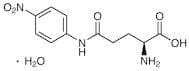
CAS :γ-L-Glutamyl-4-NitroanilideDegré de pureté :98%Masse moléculaire :267.24g/molL-γ-Glutamyl-p-nitroanilide Monohydrate
CAS :Formule :C11H13N3O5·H2ODegré de pureté :>98.0%(T)(HPLC)Couleur et forme :White to Light yellow powder to crystalMasse moléculaire :285.26H-Glu(pNA)-OH
CAS :Gamma-GPNA is a highly specific and sensitive substrate commonly employed for assessing gamma-glutamyl transferase activity in both serum and tissues, particularly through automated colorimetric methods. In this context, the dipeptide Gly-Gly serves as the glutamyl acceptor, facilitating the enzymatic reaction and subsequent detection of gamma-glutamyl transferase activity. This substrate has been widely utilized in enzymatic assays due to its specificity and sensitivity, allowing for accurate determination of gamma-glutamyl transferase levels in various biological samples.Formule :C11H13N3O5Degré de pureté :Min. 95%Couleur et forme :PowderMasse moléculaire :267.24 g/molL-Glutamic Acid γ-p-Nitroanilide-d4
CAS :Produit contrôléFormule :C11D4H9N3O5Couleur et forme :NeatMasse moléculaire :271.263L-Glutamic Acid γ-p-Nitroanilide
CAS :Produit contrôléApplications L-Glutamic Acid γ-p-Nitroanilide is a substrate for γ-glutamyltransferase (GGT), which is an important enzyme with wide applications in biocatalysis and clinical diagnosis.
References Li, Zh., et al.: J. Zh. Univer. Sci., 12, 180 (2011); Qin, D., et al.: Huagong Xuebao , 62, 378 (2011);Formule :C11H13N3O5Couleur et forme :NeatMasse moléculaire :267.24