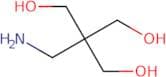
CAS 7332-39-0
:2-(Aminométhyl)-2-(hydroxyméthyl)-1,3-propanediol
Description :
2-(Aminométhyl)-2-(hydroxyméthyl)-1,3-propanediol, communément connu sous le nom de tris(hydroxyméthyl)aminométhane ou simplement TRIS, est un composé organique avec la formule moléculaire C4H11NO3. Il est caractérisé par ses trois groupes hydroxyméthyles et un groupe amino, qui contribuent à sa solubilité dans l'eau et à sa capacité à agir comme agent tampon. Le TRIS est largement utilisé en biochimie et en biologie moléculaire comme tampon pour maintenir des niveaux de pH stables dans diverses réactions et processus biochimiques. Il a une valeur de pKa d'environ 8,1, ce qui le rend efficace dans la plage de pH physiologique. Le composé est typiquement un solide cristallin blanc à température ambiante et est stable dans des conditions normales. Le TRIS est non toxique et a une faible volatilité, ce qui le rend adapté aux applications de laboratoire. De plus, il est souvent utilisé dans la préparation de gels d'électrophorèse et dans les milieux de culture cellulaire. Sa capacité à former des complexes stables avec des ions métalliques améliore également son utilité dans divers essais biochimiques.
Formule :C5H13NO3
InChI :InChI=1S/C5H13NO3/c6-1-5(2-7,3-8)4-9/h7-9H,1-4,6H2
Code InChI :InChIKey=QHQZEEGNGSZBOL-UHFFFAOYSA-N
SMILES :C(CN)(CO)(CO)CO
Synonymes :- 2-(Aminomethyl)-2-(hydroxymethyl)-1,3-propanediol
- 1,1,1-Tris(hydroxymethyl)aminoethane
- 1,3-Propanediol, 2-(aminomethyl)-2-(hydroxymethyl)-
- 2,2,2-Tris(hydroxymethyl)ethylamine
- 2-(Aminomethyl)-2-(hydroxymethyl)propane-1,3-diol
Trier par
Degré de pureté (%)
0
100
|
0
|
50
|
90
|
95
|
100
1 produits concernés.
2-(Aminomethyl)-2-(hydroxymethyl)propane-1,3-diol
CAS :2-(Aminomethyl)-2-(hydroxymethyl)propane-1,3-diol (DMAPP) is a plant amino acid that is an intermediate in the synthesis of aminobutyric acid. It is also involved in the synthesis of ethylene, which is important for fruit ripening. DMAPP has been shown to be a precursor for the α-subunit of carbonic anhydrase and it has been detected in urine samples and assays. The uptake of DMAPP from water by plants has been studied using gas chromatography and ultracentrifugation. DMAPP has also been used as a biochemical marker for plant physiology studies.Formule :C5H13NO3Degré de pureté :Min. 95%Masse moléculaire :135.16 g/mol