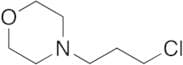
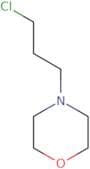
CAS 7357-67-7
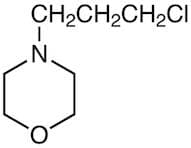
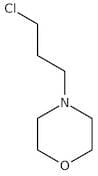
:4-(3-chloropropyl)morpholine
- 1-(3-Chloropropyl)Morpholine
- 1-Chloro-3-morpholinopropane
- 3-(Morpholin-4-yl)propyl chloride
- 3-Chloro-1-(morpholin-4-yl)propane
- 3-Morpholinopropyl chloride
- Morpholine, 4-(3-chloropropyl)-
- N-(3-Chloropropyl)morpholine
- NSC 28831
- NSC 38889
- 4-(3-Chloropropyl)morpholine
- 4-(3-CHLOROPROPYL)-MORPHOLINE HYDROCHLORIDE
- N-(3-CHLOROPROPYL)MORPHOLINE HCL
- IFLAB-BB F2108-0002
- 4-(3-CHLOROPROPYL)MORPHOLINE HCL
- 4-(3-chloropropyl)-morpholin
- 3-morpholinopropylchloride
- 4-(3-CHLORO-PROPYL)-MORPHOLINE
- Voir plus de synonymes
4-(3-Chloropropyl)morpholine
CAS :Formule :C7H14ClNODegré de pureté :>98.0%(GC)(T)Couleur et forme :Colorless to Light yellow clear liquidMasse moléculaire :163.654-(3-Chloropropyl)morpholine, 95%
CAS :This Thermo Scientific Chemicals brand product was originally part of the Alfa Aesar product portfolio. Some documentation and label information may refer to the legacy brand. The original Alfa Aesar product / item code or SKU reference has not changed as a part of the brand transition to Thermo SciFormule :C7H14ClNODegré de pureté :95%Couleur et forme :Liquid, Clear colorless to pale yellowMasse moléculaire :163.654-(3-Chloropropyl)morpholine
CAS :Formule :C7H14ClNODegré de pureté :98%Couleur et forme :LiquidMasse moléculaire :163.6452Gefitinib Impurity 59
CAS :Formule :C7H14ClNOCouleur et forme :Colorless LiquidMasse moléculaire :163.651-Chloro-3-(morpholin-4-yl)propane
CAS :1-Chloro-3-(morpholin-4-yl)propaneFormule :C7H14ClNODegré de pureté :≥95%Couleur et forme : clear. almost colourless liquidMasse moléculaire :163.65g/mol4-(3-Chloropropyl)morpholine
CAS :Produit contrôléApplications Gefitinib intermediate.
References Kelly, L., et al.: Cancer Cell., 1, 421 (2002), Pandey, A., et al.: J. Med. Chem., 45, 3772 (2002), Ciardiello, F., et al.: Exp. Opin Emerg. Drugs, 8, 501 (2003), Caponigro, F., et al.: Curr. Opin Oncol., 16, 225 (2004),Formule :C7H14ClNOCouleur et forme :NeatMasse moléculaire :163.654-(3-Chloro-propyl)-morpholine
CAS :Formule :C7H14ClNODegré de pureté :97%Couleur et forme :LiquidMasse moléculaire :163.654-(3-Chloropropyl)morpholine
CAS :4-(3-Chloropropyl)morpholine is a hydrochloride salt of the potent inhibitor 4-(3-chloropropyl)morpholine. It has an inhibitory effect on cancer, and is used in chromatographic science to separate amines from aliphatic hydrocarbons. 4-(3-Chloropropyl)morpholine inhibits epidermal growth factor (EGF) and has been shown to have a potent inhibitory effect on EGF receptor tyrosine kinase activity. It also inhibits the proliferation of cells by inhibiting DNA synthesis. This compound causes cell death through the inhibition of protein synthesis, which may be due to its ability to inhibit nucleophilic reactions that are involved in protein synthesis. 4-(3-Chloropropyl)morpholine can also fluoresce under UV light, which makes it useful for research purposes.
Formule :C7H14ClNODegré de pureté :Min. 95%Couleur et forme :Clear LiquidMasse moléculaire :163.64 g/mol