CAS 736088-02-1
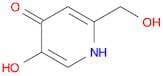
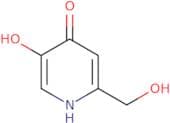
:5-hydroxy-2-(hydroxyméthyl)pyridin-4(1H)-one
Description :
5-hydroxy-2-(hydroxyméthyl)pyridin-4(1H)-one, avec le numéro CAS 736088-02-1, est un composé chimique caractérisé par sa structure en anneau de pyridine, qui est un anneau aromatique à six membres contenant un atome d'azote. Ce composé présente deux groupes hydroxyles, l'un en position 5 et l'autre en position 2, contribuant à son potentiel en tant qu'agent chélatant et à son activité biologique. La présence du groupe hydroxyméthyle en position 2 améliore sa solubilité et sa réactivité. Il est souvent étudié pour ses applications potentielles en chimie médicinale, en particulier dans le développement de médicaments en raison de sa capacité à interagir avec des ions métalliques et des systèmes biologiques. Le composé peut présenter des propriétés antioxydantes et a été étudié pour son rôle dans diverses voies biochimiques. Comme pour de nombreux dérivés de la pyridine, il est important de considérer sa stabilité, sa solubilité dans différents solvants et sa réactivité dans diverses conditions lors de l'évaluation de ses applications pratiques en recherche et en industrie.
Formule :C6H7NO3
InChI :InChI=1/C6H7NO3/c8-3-4-1-5(9)6(10)2-7-4/h1-2,8,10H,3H2,(H,7,9)
SMILES :c1c(CO)[nH]cc(c1=O)O
Trier par
Degré de pureté (%)
0
100
|
0
|
50
|
90
|
95
|
100
3 produits concernés.
6-(hydroxymethyl)pyridine-3,4-diol
CAS :Formule :C6H7NO3Degré de pureté :95.0%Masse moléculaire :141.1266-(Hydroxymethyl)pyridine-3,4-diol
CAS :6-(Hydroxymethyl)pyridine-3,4-diol is a ligand that binds to the opioid receptor and is used as a tool for studying opioid receptors. The ligand has been shown to bind specifically to the mu-, delta-, and kappa-opioid receptors in rat brain membranes and is an agonist for these receptor types. 6-(Hydroxymethyl)pyridine-3,4-diol has also been shown to be an antagonist for the nociceptin receptor. This compound has been analyzed using quantum chemistry tools to determine its electronic structure and geometry. The energies of these molecules have been calculated using quantum chemistry calculations. Geometric parameters were optimized by minimizing the energy of the molecule using molecular mechanics calculations. Parameters such as solvation, complex formation, and chelate constants have also been determined with quantum chemistry calculations. The binding constants are then analyzed with quantum chemistry methods to optimize the parameters of structures in order to find those structures withFormule :C6H7NO3Degré de pureté :Min. 95%Masse moléculaire :141.12 g/mol