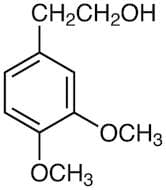
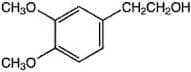
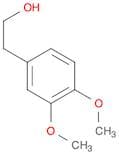
CAS 7417-21-2
:2-(3,4-Diméthoxyphényl)éthanol
Description :
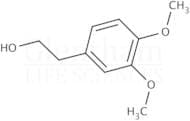
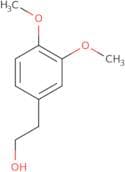
2-(3,4-Diméthoxyphényl)éthanol, avec le numéro CAS 7417-21-2, est un composé organique caractérisé par sa structure phénolique et la présence de deux groupes méthoxy sur l'anneau aromatique. Ce composé présente un groupe hydroxyle (-OH) attaché à une chaîne éthyle de deux carbones, ce qui contribue à sa classification en tant qu'alcool. Les groupes méthoxy améliorent la solubilité du composé dans les solvants organiques et peuvent influencer sa réactivité et son activité biologique. En général, des composés comme celui-ci présentent une polarité modérée en raison du groupe hydroxyle, permettant la formation de liaisons hydrogène. La présence des substituants méthoxy peut également affecter les propriétés électroniques du composé, impactant potentiellement ses interactions dans les systèmes biologiques. 2-(3,4-Diméthoxyphényl)éthanol peut susciter de l'intérêt dans divers domaines, y compris la chimie médicinale et la science des matériaux, en raison de ses propriétés pharmacologiques potentielles et de ses applications dans la synthèse de molécules plus complexes. Sa stabilité, sa réactivité et ses caractéristiques de solubilité en font un composé précieux pour de futures recherches et développements.
Formule :C10H14O3
InChI :InChI=1/C10H14O3/c1-12-9-4-3-8(5-6-11)7-10(9)13-2/h3-4,7,11H,5-6H2,1-2H3
Code InChI :InChIKey=SRQAJMUHZROVHW-UHFFFAOYSA-N
SMILES :O(C)C1=C(OC)C=CC(CCO)=C1
Synonymes :- 1,2-Dimethoxy-4-(2-hydroxyethyl)benzene
- 1-(2-Hydroxyethyl)-3,4-dimethoxybenzene
- 2-(3,4-Dimethoxyphenyl)ethan-1-ol
- 2-(3,4-Dimethoxyphenyl)ethanol
- 3,4-Dimethoxy-β-phenethyl alcohol
- 3,4-Dimethoxybenzeneethanol
- 3,4-Dimethoxyphenethanol
- 3,4-Dimethoxyphenyl ethanol
- 3,4-Dimethyoxyphenethyl Alcohol
- Af 821
- Benzeneethanol, 3,4-dimethoxy-
- Homoveratryl alcohol
- NSC 101852
- NSC 179202
- Phenethyl alcohol, 3,4-dimethoxy-
- AKOS 222-31
- 3,4-DIMETHOXYPHENETHYL ALCOHOL 98%
- 3,4-Dimethoxybenzeneethanol, 3,4-Dimethoxyphenethyl alcohol, Homoveratryl alcohol
- 3,4-DIMETHOXYPHENETHYL ALCOHOL
- 3,4-DIAMETHOXYBENZYL METHANOL
- Voir plus de synonymes
Trier par
Degré de pureté (%)
0
100
|
0
|
50
|
90
|
95
|
100
8 produits concernés.
2-(3,4-Dimethoxyphenyl)ethanol
CAS :Formule :C10H14O3Degré de pureté :>98.0%(GC)Couleur et forme :White to Light yellow to Light orange powder to crystalMasse moléculaire :182.222-(3,4-Dimethoxyphenyl)ethanol, 98%
CAS :This Thermo Scientific Chemicals brand product was originally part of the Alfa Aesar product portfolio. Some documentation and label information may refer to the legacy brand. The original Alfa Aesar product / item code or SKU reference has not changed as a part of the brand transition to Thermo SciFormule :C10H14O3Degré de pureté :98%Couleur et forme :White to pale yellow or pale cream, Powder or chunksMasse moléculaire :182.222-(3,4-Dimethoxyphenyl)ethanol
CAS :Formule :C10H14O3Degré de pureté :98%Couleur et forme :SolidMasse moléculaire :182.21643,4-Dimethoxyphenethyl alcohol
CAS :3,4-Dimethoxyphenethyl alcoholFormule :C10H14O3Degré de pureté :≥95%Couleur et forme : white to faint yellow. viscous liquidMasse moléculaire :182.22g/mol3,4-Dimethoxyphenyl ethanol
CAS :3,4-Dimethoxyphenyl ethanol is a product of the asymmetric synthesis of 3,4-dimethoxyphenylacetic acid. It has been shown to have high redox potentials and hydrochloric acid resistance. 3,4-Dimethoxyphenyl ethanol has been used in the delignification of cellulose fibers and has also been shown to have photophysical and photochemical properties. This compound binds with hydroxyl groups on proteins, which may be due to its ability to undergo acylation reactions. The binding of 3,4-dimethoxyphenyl ethanol with human liver microsomes was found to be rapid and reversible. Kinetic analysis showed that this binding can be explained by substrate binding or acylation reaction.Formule :C10H14O3Degré de pureté :Min. 95%Couleur et forme :White PowderMasse moléculaire :182.22 g/mol3,4-Dimethoxyphenethyl alcohol
CAS :Formule :C10H14O3Degré de pureté :98%Couleur et forme :SolidMasse moléculaire :182.219