CAS 74411-65-7
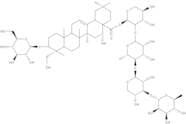
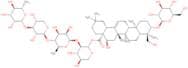
:O-6-Désoxy-α-L-mannopyranosyl-(1→3)-O-β-D-xylopyranosyl-(1→4)-O-6-désoxy-α-L-mannopyranosyl-(1→2)-β-D-xylopyranosyl (3β,4α,16α)-3-(β-D-glucopyranosyloxy)-16,23-dihydroxyoléane-12-en-28-oate
Description :
O-6-Désoxy-α-L-mannopyranosyl-(1→3)-O-β-D-xylopyranosyl-(1→4)-O-6-désoxy-α-L-mannopyranosyl-(1→2)-β-D-xylopyranosyl (3β,4α,16α)-3-(β-D-glucopyranosyloxy)-16,23-dihydroxyoléane-12-en-28-oate, avec le numéro CAS 74411-65-7, est un composé triterpénoïde glycosylé complexe. Cette substance présente plusieurs unités de sucre, y compris des unités α-L-mannopyranosyl et β-D-xylopyranosyl, qui contribuent à sa complexité structurelle et à son activité biologique potentielle. La présence de dérivés de l'acide oléanoïque suggère qu'elle pourrait présenter diverses propriétés pharmacologiques, y compris des effets anti-inflammatoires et antioxydants. Ses liaisons glycosidiques complexes peuvent influencer sa solubilité, sa stabilité et son interaction avec les systèmes biologiques. La stéréochimie du composé, indiquée par les configurations spécifiques à divers centres carbonés, est cruciale pour sa fonction biologique et son activité. Dans l'ensemble, cette substance représente une classe unique de produits naturels qui pourrait avoir des applications en chimie médicinale et en pharmacologie, justifiant une enquête plus approfondie sur ses propriétés et ses utilisations thérapeutiques potentielles.
Formule :C58H94O26
InChI :InChI=1S/C58H94O26/c1-23-34(64)37(67)40(70)48(77-23)82-45-28(62)21-75-47(43(45)73)81-44-24(2)78-49(42(72)39(44)69)83-46-35(65)27(61)20-76-51(46)84-52(74)58-16-15-53(3,4)17-26(58)25-9-10-31-54(5)13-12-33(80-50-41(71)38(68)36(66)29(19-59)79-50)55(6,22-60)30(54)11-14-56(31,7)57(25,8)18-32(58)63/h9,23-24,26-51,59-73H,10-22H2,1-8H3/t23-,24-,26-,27+,28+,29+,30+,31+,32+,33-,34-,35-,36+,37+,38-,39-,40+,41+,42+,43+,44-,45-,46+,47-,48-,49-,50-,51-,54-,55-,56+,57+,58+/m0/s1
Code InChI :InChIKey=WNGIVKPPGCCJNP-XSFLSGEHSA-N
SMILES :C(O[C@H]1[C@H](O[C@H]2[C@H](O)[C@H](O)[C@@H](O[C@H]3[C@H](O)[C@@H](O[C@H]4[C@H](O)[C@H](O)[C@@H](O)[C@H](C)O4)[C@H](O)CO3)[C@H](C)O2)[C@@H](O)[C@H](O)CO1)(=O)[C@]56[C@](C=7[C@@](C)(C[C@H]5O)[C@@]8(C)[C@](CC7)([C@]9(C)[C@@](CC8)([C@@](CO)(C)[C@@H](O[C@@H]%10O[C@H](CO)[C@@H](O)[C@H](O)[C@H]%10O)CC9)[H])[H])(CC(C)(C)CC6)[H]
Synonymes :- Chrysantellin B
- O-6-Deoxy-α-<span class="text-smallcaps">L</smallcap>-mannopyranosyl-(1→3)-O-β-<smallcap>D</smallcap>-xylopyranosyl-(1→4)-O-6-deoxy-α-<smallcap>L</smallcap>-mannopyranosyl-(1→2)-β-<smallcap>D</smallcap>-xylopyranosyl (3β,4α,16α)-3-(β-<smallcap>D</span>-glucopyranosyloxy)-16,23-dihydroxyolean-12-en-28-oate
- Olean-12-en-28-oic acid, 3-(beta-D-glucopyranosyloxy)-16,23-dihydroxy-, O-6-deoxy-alpha-l-mannopyranosyl-(1.3)-O-beta-D-xylopyranosyl-(1.4)-O-6-deoxy-alpha-l-mannopyranosyl-(1.2)-beta-D-xylopyranosyl ester, (3beta,4alpha,16alpha)-
- Olean-12-en-28-oic acid, 3-(β-<span class="text-smallcaps">D</smallcap>-glucopyranosyloxy)-16,23-dihydroxy-, O-6-deoxy-α-<smallcap>L</smallcap>-mannopyranosyl-(1→3)-O-β-<smallcap>D</smallcap>-xylopyranosyl-(1→4)-O-6-deoxy-α-<smallcap>L</smallcap>-mannopyranosyl-(1→2)-β-<smallcap>D</span>-xylopyranosyl ester, (3β,4α,16α)-
- [(2S,3R,4S,5R)-3-[(2R,3R,4S,5R,6S)-5-[(2S,3R,4S,5R)-3,5-dihydroxy-4-[(2R,3R,4R,5R,6S)-3,4,5-trihydroxy-6-methyl-tetrahydropyran-2-yl]oxy-tetrahydropyran-2-yl]oxy-3,4-dihydroxy-6-methyl-tetrahydropyran-2-yl]oxy-4,5-dihydroxy-tetrahydropyran-2-yl] (4aR,5R,6aS,6aR,6bR,8aR,9R,10S,12aR,14bR)-5-hydroxy-9-(hydroxymethyl)-2,2,6a,6b,9,12a-hexamethyl-10-[(2R,3R,4S,5S,6R)-3,4,5-trihydroxy-6-(hydroxymethyl)tetrahydropyran-2-yl]oxy-1,3,4,5,6,6a,7,8,8a,10,11,12,13,14b-tetradecahydropicene-4a-carboxylate
- O-6-Deoxy-α-L-mannopyranosyl-(1→3)-O-β-D-xylopyranosyl-(1→4)-O-6-deoxy-α-L-mannopyranosyl-(1→2)-β-D-xylopyranosyl (3β,4α,16α)-3-(β-D-glucopyranosyloxy)-16,23-dihydroxyolean-12-en-28-oate
- Olean-12-en-28-oic acid, 3-(β-D-glucopyranosyloxy)-16,23-dihydroxy-, O-6-deoxy-α-L-mannopyranosyl-(1→3)-O-β-D-xylopyranosyl-(1→4)-O-6-deoxy-α-L-mannopyranosyl-(1→2)-β-D-xylopyranosyl ester, (3β,4α,16α)-
Trier par
Degré de pureté (%)
0
100
|
0
|
50
|
90
|
95
|
100
2 produits concernés.
Chrysanthellin B
CAS :Chrysanthellin B analytical standard provided with w/w absolute assay, to be used for quantitative titration.Formule :C58H94O26Degré de pureté :(HPLC) ≥97%Couleur et forme :PowderMasse moléculaire :1207.37Chrysanthellin B
CAS :Chrysanthellin B is a bioactive compound, which is a secondary metabolite isolated from the plant Chrysanthemum indicum, known for its potential therapeutic properties. This product originates from the Asteraceae family, which is a rich source of pharmacologically active substances. The mode of action of Chrysanthellin B involves modulation of lipid metabolism and antioxidant activity, which can contribute to hepatoprotective effects. Specifically, it interacts with biochemical pathways to inhibit lipid peroxidation and promote hepatic health. Chrysanthellin B is primarily studied for its use in reducing lipid levels and protecting liver function. It has shown promise in the context of experimental models of hyperlipidemia and hepatic disorders, providing insights into potential applications in treating metabolic syndrome and related conditions. Further research is ongoing to elucidate its mechanisms and efficacy in clinical contexts.Formule :C58H94O26Degré de pureté :Min. 95%Masse moléculaire :1,207.35 g/mol