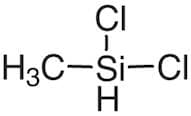
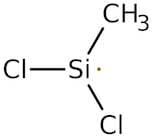
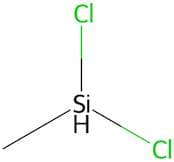
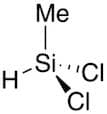
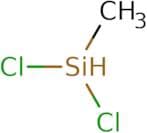
CAS 75-54-7
:Méthyldichlorosilane
- Dichlor(methyl)silan
- Dichloro(Methyl)Silane
- Dichloro(Methyl)Silyl
- Dichlorohydridomethylsilicon
- Dicloro(Metil)Silano
- Ls 50
- Methyldichloro Silane
- Methyldichlorosilane
- Methylhydrodichlorosilane
- Methylsilicon dichloride
- Monomethyldichlorosilane
- Silane, dichloromethyl-
- Voir plus de synonymes
Dichloromethylsilane
CAS :Formule :CH4Cl2SiDegré de pureté :>98.0%(GC)(T)Couleur et forme :Colorless to Almost colorless clear liquidMasse moléculaire :115.03Dichloromethylsilane, 97+%
CAS :A monomer (‘building block’) in the production of silicone polymers. An intermediate (starting material) in the production of other organic and inorganic chemicals. In the electronics industry for the production of ultra-pure polysilicon and in the manufacture of semiconductors and photovoltaics.Formule :CH4Cl2SiDegré de pureté :97+%Couleur et forme :Clear colorless, LiquidMasse moléculaire :115.03Methyldichlorosilane, min. 97%
CAS :Methyldichlorosilane, min. 97%
Formule :CH3SiCl2HDegré de pureté :min. 97%Couleur et forme :colorless liq.Masse moléculaire :115.05METHYLDICHLOROSILANE
CAS :Tri-substituted Silane Reducing Agent
Organosilanes are hydrocarbon-like and possess the ability to serve as both ionic and free-radical reducing agents. These reagents and their reaction by-products are safer and more easily handled and disposed than many other reducing agents. The metallic nature of silicon and its low electronegativity relative to hydrogen lead to polarization of the Si-H bond yielding a hydridic hydrogen and a milder reducing agent compared to aluminum-, boron-, and other metal-based hydrides. A summary of some key silane reductions are presented in Table 1 of the Silicon-Based Reducing Agents brochure.
Methyldichlorosilane; Dichloromethylsilane
Viscosity: 0.60 cStΔHcomb: 163 kJ/molΔHvap: 29.3 kJ/molDipole moment: 1.91 debyeCoefficient of thermal expansion: 1.0 x 10⁻³Specific heat: 0.8 J/g/°CVapor pressure, 24 °C: 400 mmCritical temperature: 215-8 °CCritical pressure: 37.7 atmProvides better diastereoselective reductive aldol reaction between an aldehyde and an acrylate ester than other silanesForms high-boiling polymeric by-products upon aqueous work-upExtensive review of silicon based reducing agents: Larson, G.; Fry, J. L. "Ionic and Organometallic-Catalyzed Organosilane Reductions", Wipf, P., Ed.; Wiley, 2007Formule :CH4Cl2SiDegré de pureté :97%Couleur et forme :Straw LiquidMasse moléculaire :115.03Dichloromethylsilane
CAS :Dichloromethylsilane (DCS) is a chemical compound that is used in the synthesis of silicone rubber, silicone elastomers, and silicone sealants. It can also be used as a cross-linking agent for polymers such as polyurethane, epoxy resin, and silicone. The synthesis of DCS is achieved by reacting chlorosilanes with methyl alcohol or methyl chloride in the presence of an acid catalyst. DCS exhibits high chemical stability and can be activated at room temperature. This product has been shown to be useful for fabricating medical devices that are implanted into the human body because it does not react with water or blood.
Formule :CH4Cl2SiDegré de pureté :Min. 95%Masse moléculaire :115.03 g/mol