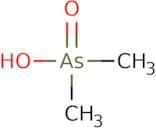
CAS 75-60-5
:Acide diméthylarsinique
Description :
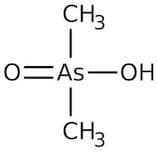
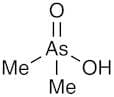
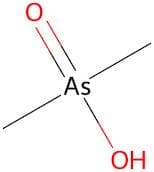
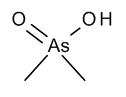
Acide diméthylarsinique (DMAA) est un composé organo-arsénique caractérisé par ses deux groupes méthyles attachés à un atome d'arsenic, ainsi qu'un groupe fonctionnel acide carboxylique. Il est généralement rencontré sous forme de liquide incolore à jaune pâle ou solide, selon sa forme et sa pureté. Le DMAA est soluble dans l'eau et dans des solvants organiques polaires, ce qui facilite son utilisation dans diverses applications, y compris comme réactif en synthèse organique et dans des études liées au métabolisme de l'arsenic. Ce composé suscite de l'intérêt en raison de sa toxicité potentielle et de son impact environnemental, l'arsenic étant un cancérogène connu. Dans les systèmes biologiques, Acide diméthylarsinique peut subir des transformations métaboliques, conduisant à la formation d'autres espèces d'arsenic. Sa présence dans l'environnement, en particulier dans les sources d'eau contaminées, soulève des préoccupations concernant la santé humaine et les effets écologiques. Des mesures de sécurité sont essentielles lors de la manipulation du DMAA, car l'exposition peut entraîner des effets néfastes sur la santé. Dans l'ensemble, Acide diméthylarsinique constitue un composé significatif tant dans la recherche chimique que dans les études environnementales liées aux composés d'arsenic.
Formule :C2H7AsO2
InChI :InChI=1/C2H7AsO2/c1-3(2,4)5/h1-2H3,(H,4,5)
Code InChI :InChIKey=OGGXGZAMXPVRFZ-UHFFFAOYSA-N
SMILES :[As](C)(C)(=O)O
Synonymes :- Acide dimethylarsinique
- Acido Dimetilarsinico
- Ansar 138
- Arsan
- Arsine oxide, hydroxydimethyl-
- Arsinic Acid, Dimethyl-
- Arsinic acid, As,As-dimethyl-
- As,As-Dimethylarsinic acid
- Dimethylarsenic acid
- Dimethylarsinic acid
- Dimethylarsinsaure
- Dimethylarsonic acid
- Hydroxydimethylarsine oxide
- Kakodylsaeure
- Nsc 103115
- Nsc 71157
- Nsc 71158
- Phytar
- Silvisar 510
- Sylvicor
- Cacodylic acid
- agentblue
- Cacodylie acid
- Ansar
- DIMETHYLHYDROXYARSINE OXIDE
- Acide cacodylique
- Agent blue
- RAD-E-CATE 35(R)
- SILVISAR(R)
- alkargen
- acidecacodylique(french)
- PHYTAR(R)
- ANSAR(R)
- acidedimethylarsinique
- acidedimethylarsenique(french)
- Voir plus de synonymes
Trier par
Degré de pureté (%)
0
100
|
0
|
50
|
90
|
95
|
100
6 produits concernés.
Cacodylic acid, 98%
CAS :A useful arsenic acid for proteomics research. It a good substitute for phosphate in applications to avoid phosphates. Cacodylic Acid is useful for some DNA applications and is also popular in microscopy. This Thermo Scientific Chemicals brand product was originally part of the Alfa Aesar productFormule :C2H7AsO2Degré de pureté :98%Couleur et forme :White, Crystals or powder or crystalline powderMasse moléculaire :138.00Dimethylarsinic acid (Cacodylic acid), 98%
CAS :Dimethylarsinic acid (Cacodylic acid), 98%
Formule :(CH3)2AsOOHDegré de pureté :98%Couleur et forme :white pwdr.Masse moléculaire :138.00Cacodylic Acid
CAS :Applications Cacodylic acid is used for dermatologic treatment in cronic eczema, anemia and as a tonic.
Not a dangerous good if item is equal to or less than 1g/ml and there is less than 100g/ml in the package
References Mandal, B., et al.: Talanta, 58, 201 (2002), Naranmandura, H., et al.: Chem. Res. Toxicol., 20, 616 (2007), Naranmandura, H., et al.: Toxicol. Appl. Pharmacol., 227, 390 (2008), Violin, J., et al.: J. Biol. Chem., 283, 2949 (2008),Formule :C2H7AsO2Couleur et forme :NeatMasse moléculaire :138.00Cacodylic acid
CAS :Cacodylic acid is a white to brown crystalline powder that is soluble in water. It has been used as an analytical reagent, polymerase chain reaction (PCR) inhibitor, and skin cancer treatment. Cacodylic acid inhibits the activity of the bacterial enzyme activities in humans and other mammals. The mechanism of action of cacodylic acid is not completely understood but it appears that it binds to inorganic iron and blocks its availability for use by bacterial enzymes such as dihydropteroate synthase, which is required for DNA synthesis. This leads to cell death. Cacodylic acid has also been shown to inhibit the growth of human HL-60 cells in vitro, suggesting that it may have carcinogenic potential.Formule :C2H7AsO2Degré de pureté :Min. 95%Couleur et forme :PowderMasse moléculaire :138 g/mol