CAS 7518-17-4
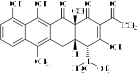
:4-Épianhydrotétracycline
Description :
4-Épianhydrotétracycline est un dérivé semi-synthétique de la tétracycline, un antibiotique à large spectre. Il se caractérise par sa structure tétracyclique, qui est essentielle à son activité biologique. Ce composé présente des propriétés antibactériennes en inhibant la synthèse des protéines dans les bactéries, ce qui le rend efficace contre une variété d'organismes à Gram positif et à Gram négatif. La formule chimique de 4-Épianhydrotétracycline comprend plusieurs groupes fonctionnels, contribuant à sa solubilité et à sa réactivité. Il est généralement administré sous forme de sel hydrochlorique pour améliorer la stabilité et la biodisponibilité. La substance est connue pour sa stabilité modérée à élevée dans des conditions acides, mais peut se dégrader dans des environnements alcalins. De plus, elle a été étudiée pour ses applications potentielles au-delà de l'utilisation antibiotique, y compris des propriétés anti-inflammatoires et anticancéreuses. Comme d'autres tétracyclines, elle peut provoquer des effets secondaires tels que des troubles gastro-intestinaux et une photosensibilité. Des conditions de manipulation et de stockage appropriées sont essentielles pour maintenir son efficacité et son profil de sécurité.
Formule :C22H22N2O7
InChI :InChI=1S/C22H22N2O7/c1-8-9-5-4-6-12(25)13(9)17(26)14-10(8)7-11-16(24(2)3)18(27)15(21(23)30)20(29)22(11,31)19(14)28/h4-6,11,16,25-27,31H,7H2,1-3H3,(H2,23,30)/t11-,16+,22-/m0/s1
Code InChI :InChIKey=CXCVEERYMJZMMM-WPINSWFRSA-N
SMILES :O[C@]12[C@]([C@@H](N(C)C)C(O)=C(C(N)=O)C1=O)(CC=3C(C2=O)=C(O)C=4C(C3C)=CC=CC4O)[H]
Synonymes :- (4R)-Anhydrotetracycline
- (4R,4aS,12aS)-4-(Dimethylamino)-1,4,4a,5,12,12a-hexahydro-3,10,11,12a-tetrahydroxy-6-methyl-1,12-dioxo-2-naphthacenecarboxamide
- (4R,4aS,12aS)-4-(Dimethylamino)-3,10,11,12a-tetrahydroxy-6-methyl-1,12-dioxo-1,4,4a,5,12,12a-hexahydrotetracene-2-carboxamide
- (4R,4aS,12aS)-4-(dimethylamino)-3,10,11,12a-tetrahydroxy-6-methyl-1,12-dioxo-4a,5-dihydro-4H-tetracene-2-carboxamide
- 2-Naphthacenecarboxamide, 4-(dimethylamino)-1,4,4a,5,12,12a-hexahydro-3,10,11,12a-tetrahydroxy-6-methyl-1,12-dioxo-, 4-epimer
- 2-Naphthacenecarboxamide, 4-(dimethylamino)-1,4,4a,5,12,12a-hexahydro-3,10,11,12a-tetrahydroxy-6-methyl-1,12-dioxo-, [4R-(4α,4aβ,12aβ)]-
- 2-naphthacenecarboxamide, 4-(dimethylamino)-1,4,4a,5,12,12a-hexahydro-3,10,11,12a-tetrahydroxy-6-methyl-1,12-dioxo-, (4R,4aS,12aS)-
- 4-Epianhydrotetracycline
- 4-epi-5a,6-Anhydrotetracycline
- 4-epi-Anhydrotetracycline
- Anhydro-4-epitetracycline
- Anhydroepitetracycline
- Epianhydrotetracycline
- Voir plus de synonymes
Trier par
Degré de pureté (%)
0
100
|
0
|
50
|
90
|
95
|
100
4 produits concernés.
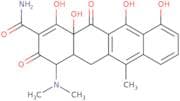
Tetracycline EP Impurity D (Chlortetracycline EP Impurity I, Lymecycline EP Impurity D, 4-Epianhydrotetracycline)
CAS :Formule :C22H22N2O7Masse moléculaire :426.434-Epianhydrotetracycline
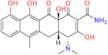
CAS :4-Epianhydrotetracycline is a chemical compound that is a derivative of tetracycline, a well-known antibiotic. It is primarily a byproduct arising from the chemical degradation of tetracycline antibiotics, occurring under acidic or basic conditions. The source of this compound is the structural transformation of tetracycline, resulting in an altered molecular configuration.
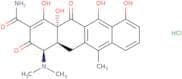
Formule :C22H22N2O7Degré de pureté :Min. 95%Masse moléculaire :426.4 g/mol4-Epianhydrotetracycline hydrochloride hydrate
CAS :4-Epianhydrotetracycline hydrochloride hydrate is a chemical compound that inhibits the activation of protein kinase C (PKC) and blocks the apoptosis pathway. It has been shown to induce apoptosis in prostate cancer cells and also inhibits the proliferation of human microvessel endothelial cells. 4-Epianhydrotetracycline hydrochloride hydrate is stable in both human serum and wastewater, which makes it an ideal drug for treating many types of cancers. It is also used in pharmaceutical drugs as a cytochalasin, which are used to treat angina pectoris by reducing oxygen uptake by erythrocytes, thereby inhibiting oxidative phosphorylation. 4-Epianhydrotetracycline hydrochloride hydrate prevents mitochondrial cytochrome c release, thus blocking the apoptotic pathway in cells. This chemical compound may act as a regulatory molecule that affects energy metabolism and epidermal growth factor (EGF)Formule :C22H23ClN2O7Degré de pureté :Min. 95%Masse moléculaire :462.88 g/mol