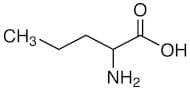
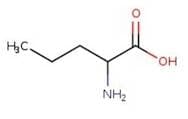
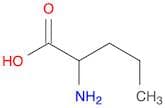
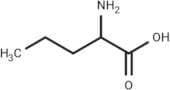
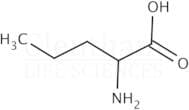
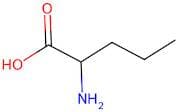
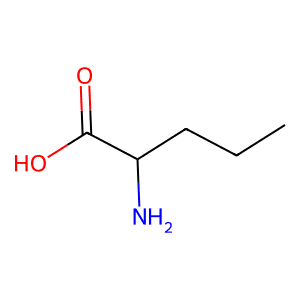
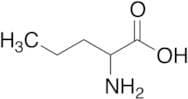
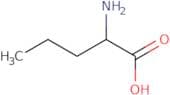
CAS 760-78-1
:(±)-Norvaline
Description :
(±)-Norvaline est un acide aminé classé comme un acide aminé non protéinogène, ce qui signifie qu'il n'est pas incorporé dans les protéines lors de la traduction. C'est un dérivé de la valine, présentant un atome de carbone supplémentaire dans sa chaîne latérale, ce qui lui confère des propriétés uniques. Le composé existe sous forme de mélange racémique, contenant à la fois les formes D et L, qui peuvent présenter différentes activités biologiques. (±)-Norvaline est connu pour son rôle dans divers processus biochimiques, y compris son potentiel à inhiber l'arginase, une enzyme qui régule la production d'oxyde nitrique. Cette inhibition peut avoir des implications pour la santé cardiovasculaire et le métabolisme musculaire. La substance est généralement blanche à blanc cassé en apparence et est soluble dans l'eau, ce qui la rend adaptée à diverses applications en recherche et en supplémentation. Son numéro CAS, 760-78-1, est utilisé pour l'identification dans les bases de données chimiques. Comme de nombreux acides aminés, (±)-Norvaline peut participer à diverses réactions chimiques, ce qui le rend intéressant tant en chimie synthétique qu'en chimie biologique.
Formule :C5H11NO2
InChI :InChI=1S/C5H11NO2/c1-2-3-4(6)5(7)8/h4H,2-3,6H2,1H3,(H,7,8)
Code InChI :InChIKey=SNDPXSYFESPGGJ-UHFFFAOYSA-N
SMILES :C(CCC)(C(O)=O)N
Synonymes :- (±)-2-Aminopentanoic acid
- 2-Amino-pentanoic acid
- 20: PN: WO2005055994 PAGE: 50 claimed protein
- <span class="text-smallcaps">DL</span>-2-Aminovaleric acid
- <span class="text-smallcaps">DL</span>-Norvaline
- <span class="text-smallcaps">DL</span>-α-Aminovaleric acid
- DL-2-Aminovaleric acid
- H-DL-Nva-OH
- NSC 7904
- Norvaline
- Norvaline, <span class="text-smallcaps">DL</span>-
- α-<span class="text-smallcaps">DL</span>-Aminopentanoic acid
- DL-Norvaline
- DL-α-Aminovaleric acid
- Voir plus de synonymes
Trier par
Degré de pureté (%)
0
100
|
0
|
50
|
90
|
95
|
100
10 produits concernés.
DL-Norvaline
CAS :Formule :C5H11NO2Degré de pureté :>98.0%(T)Couleur et forme :White to Almost white powder to crystalMasse moléculaire :117.15DL-Norvaline, 98%
CAS :DL-Norvaline is a neurotransmitter. This Thermo Scientific Chemicals brand product was originally part of the Alfa Aesar product portfolio. Some documentation and label information may refer to the legacy brand. The original Alfa Aesar product / item code or SKU reference has not changed as a part oFormule :C5H11NO2Degré de pureté :98%Couleur et forme :Crystals or powder or crystalline powder, WhiteMasse moléculaire :117.15DL-Norvaline
CAS :Formule :C5H11NO2Degré de pureté :97%Couleur et forme :SolidMasse moléculaire :117.1463DL-Norvaline
CAS :DL-Norvaline (2-Aminopentanoic acid) is a non-competitive inhibitor of arginase.Formule :C5H11NO2Degré de pureté :99.89%Couleur et forme :SolidMasse moléculaire :117.15DL-norvaline
CAS :Applications Norvaline, a hydrogen analogs of an amino acid, was found to be racemates from the Murchison meteorite show. Norvaline was used in chiral separation by electrokinetic chromatography.
References Cronin, J., et al.: Science, 275, 951 (1997); Pizzarello, S., et al.: Geochim. Cosmochim. Acta., 64, 329 (2000); Gerabe, S., et al.: J. Chromatogr., 480, 403 (1989);Formule :C5H11NO2Couleur et forme :NeatMasse moléculaire :117.15DL-Norvaline
CAS :Formule :C5H11NO2Degré de pureté :97%Couleur et forme :Off-white solidMasse moléculaire :117.148DL-Norvaline
CAS :DL-Norvaline is a non-proteinogenic amino acid that can be synthesized in the laboratory. It has been shown to inhibit bacterial growth by binding to the polymerase chain reaction and preventing the synthesis of RNA. DL-Norvaline binds to the ribosome and inhibits protein synthesis, which is necessary for bacterial cell division. DL-Norvaline also binds to glutamate and may inhibit energy metabolism. DL-Norvaline is used as an antimicrobial agent against a number of bacteria, such as Escherichia coli and Staphylococcus aureus. The antimicrobial activity of DL-norvaline may be due to its ability to bind to hydrophobic regions on bacterial cells.Formule :C5H11NO2Degré de pureté :Min. 95%Couleur et forme :White PowderMasse moléculaire :117.15 g/mol