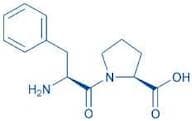
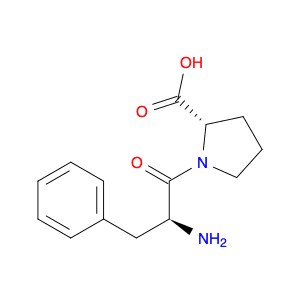
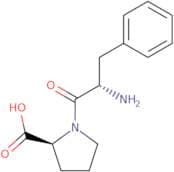
CAS 7669-65-0
:L-Phénylalanil-L-proline
- 26: PN: WO2021055880 SEQID: 27 claimed protein
- <span class="text-smallcaps">L</smallcap>-Phenylalanyl-<smallcap>L</span>-proline
- <span class="text-smallcaps">L</smallcap>-Proline, 1-<smallcap>L</span>-phenylalanyl-
- <span class="text-smallcaps">L</smallcap>-Proline, <smallcap>L</span>-phenylalanyl-
- H-Phe-Pro-OH
- Proline, 1-(3-phenyl-<span class="text-smallcaps">L</smallcap>-alanyl)-, <smallcap>L</span>-
- Proline, 1-(3-phenyl-<span class="text-smallcaps">L</span>-alanyl)-
- Proline, 1-(3-phenyl-L-alanyl)-
- L-Phenylalanyl-L-proline
- Proline, 1-(3-phenyl-L-alanyl)-, L-
- L-Proline, 1-L-phenylalanyl-
- Voir plus de synonymes
H-Phe-Pro-OH
CAS :Substrate for skin fibroblast prolidase.Formule :C14H18N2O3Degré de pureté :> 99%Couleur et forme :White PowderMasse moléculaire :262.31H-Phe-pro-oh
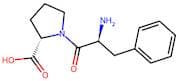
CAS :Formule :C14H18N2O3Degré de pureté :98%Couleur et forme :SolidMasse moléculaire :262.3043(S)-1-((S)-2-Amino-3-phenylpropanoyl)pyrrolidine-2-carboxylic acid
CAS :(S)-1-((S)-2-Amino-3-phenylpropanoyl)pyrrolidine-2-carboxylic acidDegré de pureté :98%Masse moléculaire :262.31g/mol(S)-1-((S)-2-Amino-3-phenylpropanoyl)pyrrolidine-2-carboxylic acid
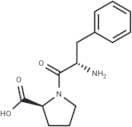
CAS :(S)-1-((S)-2-Amino-3-phenylpropanoyl)pyrrolidine-2-carboxylic acid, with catalog number T65393 and CAS number 7669-65-0, is an important organic compound used in life sciences research.Formule :C14H18N2O3Couleur et forme :SolidMasse moléculaire :262.309H-Phe-Pro-OH
CAS :H-Phe-Pro-OH is a cyclic peptide that is a structural mimic of the natural amino acid gamma-aminobutyric acid (GABA) and has been shown to be an effective inhibitor of the p450 enzymes responsible for carcinogen activation. The peptide binds to response elements in DNA and RNA, which prevents transcription of genes that are involved in cancer development. H-Phe-Pro-OH also inhibits collagen production and has hemolytic activity due to hydrogen bonding with erythrocytes. This peptide can be used as an antimicrobial agent against Gram negative bacteria, including Pseudomonas aeruginosa, Klebsiella pneumoniae, Escherichia coli, and Salmonella typhimurium. In addition, it has been shown to inhibit the growth of Gram positive bacteria such as Staphylococcus aureus and Clostridium perfringens. The mechanism by which this compound inhibits bacterial growth is
Formule :C14H18N2O3Degré de pureté :Min. 95%Couleur et forme :PowderMasse moléculaire :262.3 g/mol