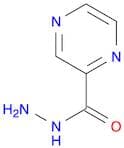
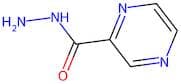
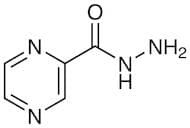
CAS 768-05-8
:Acide 2-pyrazinecarboxylique, hydrazide
- 2-(Hydrazinocarbonyl)pyrazine
- 2-Pyrazinecarboxylic acid, hydrazide
- 2-Pyrazinoyl hydrazide
- Idv 128
- NSC 8810
- NSC 88100
- Pyrazine-2-carbohydrazide
- Pyrazine-2-carboxylic hydrazide
- Pyrazinecarbohydrazide
- Pyrazinecarboxylic acid, hydrazide
- Pyrazinic acid hydrazide
- Pyrazinylcarbonylhydrazine
- Voir plus de synonymes
Pyrazinoic acid hydrazide
CAS :Formule :C5H6N4ODegré de pureté :95%Couleur et forme :SolidMasse moléculaire :138.1273Pyrazinoic acid hydrazide
CAS :Pyrazinoic acid hydrazideDegré de pureté :97%Masse moléculaire :138.13g/molPyrazine-2-carbohydrazide
CAS :Formule :C5H6N4ODegré de pureté :>97.0%(GC)(T)Couleur et forme :White to Light yellow powder to crystalMasse moléculaire :138.13Pyrazine-2-carbohydrazide
CAS :Pyrazine-2-carbohydrazide is a chemical compound with significant cytotoxicity. It has been used as an antimicrobial agent, but is not effective against all types of human pathogens. Pyrazine-2-carbohydrazide forms stable complexes with metal ions, such as carbon disulphide and pyrazine-2-carboxylic acid. Magnetic resonance spectroscopy has shown that the active analogs of pyrazine-2-carbohydrazide are pyrazinoic acid and other compounds containing this functional group. Pyrazinoic acid is synthesized from pyrazine-2-carboxylic acid by oxidation with hydrogen peroxide or a strong oxidizing agent. The antimicrobial resistance of bacteria to these compounds can be attributed to the hydrogen bond between the hydroxyl group of pyrazinoic acid and the amino group of bacterial peptidoglycan (a component of bacterial cell walls).
Formule :C5H6N4ODegré de pureté :Min. 95%Couleur et forme :PowderMasse moléculaire :138.13 g/molPyrazine-2-carboxylic acid hydrazide
CAS :Formule :C5H6N4ODegré de pureté :97%Couleur et forme :Liquid, No data available.Masse moléculaire :138.13