CAS 76880-29-0
:N(alpha)-boc-S-(3-nitro-2-pyridylthio)-L-cystéine
Description :
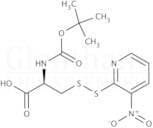
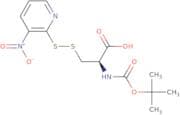
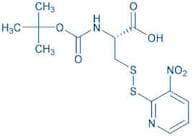
N(alpha)-boc-S-(3-nitro-2-pyridylthio)-L-cystéine est un dérivé de l'acide aminé L-cystéine, caractérisé par la présence d'un groupe protecteur tert-butyloxycarbonyl (Boc) sur le groupe amino et d'un moiety 3-nitro-2-pyridylthio attaché à l'atome de soufre. Ce composé est généralement utilisé dans la synthèse peptidique et la chimie médicinale en raison de sa capacité à former des liaisons disulfure et à participer à diverses réactions biochimiques. Le groupe Boc sert à protéger le groupe amino pendant la synthèse, permettant des réactions sélectives sur d'autres sites fonctionnels. Le groupe 3-nitro-2-pyridylthio améliore la réactivité du composé et peut faciliter les interactions avec des cibles biologiques, ce qui le rend intéressant dans le développement de médicaments. La présence du groupe nitro introduit également des caractéristiques d'attraction des électrons, ce qui peut influencer la réactivité globale et la solubilité du composé. Comme de nombreux composés contenant du soufre, il peut présenter des propriétés uniques telles qu'une plus grande nucléophilicité et un potentiel pour des réactions redox. Des conditions de manipulation et de stockage appropriées sont essentielles en raison de la réactivité potentielle du groupe thiol.
Formule :C13H17N3O6S2
InChI :InChI=1/C13H17N3O6S2/c1-13(2,3)22-12(19)15-8(11(17)18)7-23-24-10-9(16(20)21)5-4-6-14-10/h4-6,8H,7H2,1-3H3,(H,15,19)(H,17,18)/t8-/m0/s1
SMILES :CC(C)(C)OC(=N[C@@H](CSSc1c(cccn1)N(=O)=O)C(=O)O)O
Synonymes :- Boc-Cys(Npys)-OH
- N-(tert-butoxycarbonyl)-3-[(3-nitropyridin-2-yl)disulfanyl]-L-alanine
Trier par
Degré de pureté (%)
0
100
|
0
|
50
|
90
|
95
|
100
6 produits concernés.
L-Alanine, N-[(1,1-dimethylethoxy)carbonyl]-3-[(3-nitro-2-pyridinyl)dithio]-
CAS :Formule :C13H17N3O6S2Degré de pureté :98%Couleur et forme :SolidMasse moléculaire :375.4206Boc-Cys(Npys)-OH
CAS :Formule :C13H17N3O6S2Degré de pureté :98%Couleur et forme :SolidMasse moléculaire :375.41Boc-cys(Npys)-oh
CAS :Boc-cys(Npys)-oh is an active substance that inhibits the growth of mouse tumors and has been shown to inhibit a number of different biological processes. It is a cross-linking agent for amino acids and has been shown to have an inhibitory effect on the synthesis of proteins by blocking the formation of disulfide bonds. This compound belongs to the class of chemicals known as sulfonamides, which are used in the treatment of bacterial infections. Boc-cys(Npys)-oh also specifically binds to antigen sites on cells, inhibiting their growth, and can be used as an antitumor agent. The molecule can be chemically linked with other molecules such as trifluoroacetic acid (TFA), resulting in a product with different properties than those found in Boc-cys(Npys)-oh. The chemical ligation process is used to produce subcutaneous tumors in mice that are then treated with hydrogen fluoride (Formule :C13H17N3O6S2Degré de pureté :Min. 95%Couleur et forme :Off-White PowderMasse moléculaire :375.42 g/molBoc-Cys(NPys)-OH
CAS :Npys allows site-directed disulfide bond formation, as it is cleaved by thiols. Galande and Spatola obtained disulfide heterodimers of peptides via coupling Boc-Cys(NPys)-OH together with Fmoc-Cys(Mmt)-OH to MBHA-resin followed by Mmt removal with 1% TFA in dichloromethane. Mourier et al. used BCNP for the identification of T-cell epitopes in Cys and/or Cyt-containing proteins.Formule :C13H17N3O6S2Degré de pureté :> 99%Couleur et forme :Yellow PowderMasse moléculaire :375.43
![L-Alanine, N-[(1,1-dimethylethoxy)carbonyl]-3-[(3-nitro-2-pyridinyl)dithio]-](/_next/image/?url=https%3A%2Fstatic.cymitquimica.com%2Fproducts%2FIN%2Fthumb%2FDA003OG3.jpg&w=3840&q=75)