CAS 77439-76-0
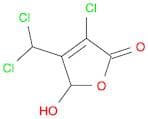
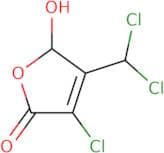
:3-Chloro-4-(dichlorométhyl)-5-hydroxy-2(5H)-furanone
Description :
3-Chloro-4-(dichlorométhyl)-5-hydroxy-2(5H)-furanone, avec le numéro CAS 77439-76-0, est un composé organique synthétique caractérisé par sa structure de furanone, qui comprend un cycle de furanone avec divers substituants. Ce composé présente un atome de chlore en position 3, un groupe diclorométhyle en position 4 et un groupe hydroxyle en position 5 du cycle de furanone. La présence de ces groupes fonctionnels contribue à sa réactivité et à ses applications potentielles dans divers processus chimiques. Il est connu pour son rôle dans la synthèse d'autres entités chimiques et peut présenter une activité biologique, ce qui le rend intéressant pour la recherche pharmaceutique. Le composé est généralement manipulé avec précaution en raison de sa nature halogénée, qui peut conférer toxicité et préoccupations environnementales. Comme de nombreux furanones, il peut également participer à des réactions telles que des substitutions nucléophiles ou des cycloadditions, selon les conditions de réaction et la présence d'autres réactifs. Des mesures de sécurité appropriées doivent être observées lors de la manipulation de ce composé dans des environnements de laboratoire.
Formule :C5H3Cl3O3
InChI :InChI=1S/C5H3Cl3O3/c6-2-1(3(7)8)4(9)11-5(2)10/h3-4,9H
Code InChI :InChIKey=WNTRMRXAGJOLCU-UHFFFAOYSA-N
SMILES :C(Cl)(Cl)C1=C(Cl)C(=O)OC1O
Synonymes :- 2(5H)-Furanone, 3-chloro-4-(dichloromethyl)-5-hydroxy-
- 3-Chloro-4-(dichloromethyl)-5-hydroxy-2,5-dihydrofuran-2-one
- 3-chloro-4-(dichloromethyl)-5-hydroxy-*2(5H)-fura
- MX (bacterial mutagen)
- Mutagen X
- 3-Chloro-4-(dichloromethyl)-5-hydroxy-2(5H)-furanone
- MX
Trier par
Degré de pureté (%)
0
100
|
0
|
50
|
90
|
95
|
100
3 produits concernés.
3-Chloro-4-(dichloromethyl)-5-hydroxyfuran-2(5H)-one
CAS :Formule :C5H3Cl3O3Couleur et forme :LiquidMasse moléculaire :217.43453-Chloro-4-(dichloromethyl)-5-hydroxy-2(5H)-furanone
CAS :Produit contrôléApplications Mutagen X (MX) is a chlorinated furanone that accounts for more of the mutagenic activity of drinking water than any other disinfection byproduct. DNA damages provoked by the six mutagens (furylframide, MX, 4-nitroquinoline N-oxide, sodium azide, 1-nitropyrene, and captan) used in the present study have been known to subject to the nucleotide excision repair system.
Not a dangerous good if item is equal to or less than 1g/ml and there is less than 100g/ml in the package
References Hakulinen, P., et al.: Toxicol. Lett., 151, 439 (2004), Richardson, S., et al.: Mutat. Res., 636, 178 (2007), Kim, J., et al.: Environ. Toxicol., 23, 319 (2008),Formule :C5H3Cl3O3Couleur et forme :NeatMasse moléculaire :217.433-Chloro-4-(dichloromethyl)-5-hydroxy-2(5H)-furanone
CAS :3-Chloro-4-(dichloromethyl)-5-hydroxy-2(5H)-furanone belongs to the class of polymerase chain inhibitors. It inhibits DNA synthesis by binding to the enzyme DNA polymerase and blocking the progression of DNA synthesis. 3-Chloro-4-(dichloromethyl)-5-hydroxy-2(5H)-furanone has significant cytotoxicity in mammalian cells and is genotoxic, which may be due to its mutagenicity. The mechanism of its mutagenicity is not known, but it has been shown that this compound reacts with effector proteins such as thiols and sulfhydryls. 3-Chloro-4-(dichloromethyl)-5-hydroxy-2(5H)-furanone can react with chlorine in water to form a chlorinated derivative that is more stable than the parent compound. This chemical stability has been usedFormule :C5H3Cl3O3Degré de pureté :(%) Min. 95%Couleur et forme :PowderMasse moléculaire :217.43 g/mol