CAS 7770-78-7
:(-)-Arctigénine
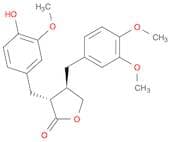
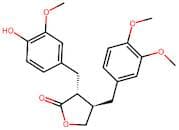
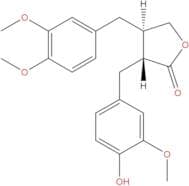
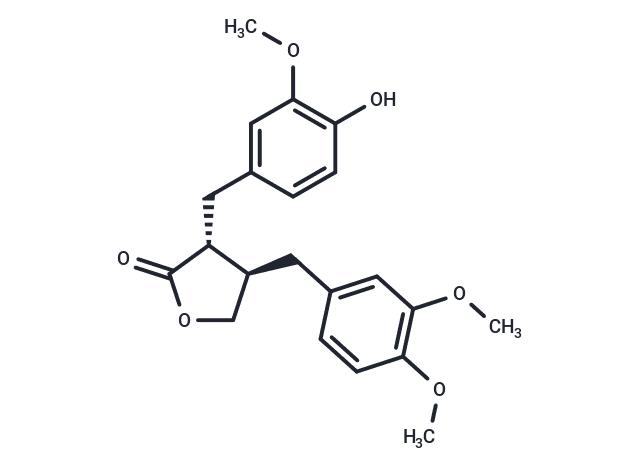
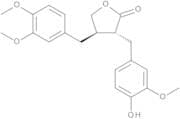
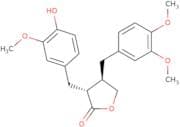
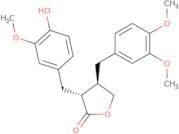
- (3R,4R)-4-(3,4-dimethoxybenzyl)-3-(4-hydroxy-3-methoxybenzyl)dihydrofuran-2(3H)-one
- (3R,4R)-4-[(3,4-Dimethoxyphenyl)methyl]dihydro-3-[(4-hydroxy-3-methoxyphenyl)methyl]-2(3H)-furanone
- 2(3H)-Furanone, 4-((3,4-dimethoxyphenyl)methyl)dihydro-3-((4-hydroxy-3-methoxyphenyl)methyl)-, (3R,4R)-
- 2(3H)-Furanone, 4-((3,4-dimethoxyphenyl)methyl)dihydro-3-((4-hydroxy-3-methoxyphenyl)methyl)-, (3R-trans)-
- 4-(3,4-dimethoxybenzyl)-3-(4-hydroxy-3-methoxybenzyl)dihydrofuran-2(3H)-one
- Arctidine
- (-)-Arctigenin
- (-)-Arctigenin
- Arctigenin
- dihydro-3-[(4-hydroxy-3-methoxyphenyl)methyl]-,(3R,4R)-
- (3R,4R)-3-(3-Methoxy-4-hydroxybenzyl)-4-(3,4-dimethoxybenzyl)tetrahydrofuran-2-one
- 2(3H)-FURANONE,4-[(3,4-DIMETHOXYPHENYL)METHYL]DIHYDRO-3-[(4-HYDROXY-3-METHOXYPHENYL)METHYL]
- 2(3H)-Furanone,4-[(3,4-dimethoxyphenyl) methyl]
- ARCTIGENIN:2(3H)-FURANONE,4-[(3,4-DIMETHOXYPHENYL)METHYL]DIHYDRO-3-[(4-HYDROXY-3-METHOXYPHENYL)METHYL]-,(3R,4R)
- ARCTIGENIN(P)
- (3R,4R)-4-[(3,4-Dimethoxyphenyl)methyl]-3-[(4-hydroxy-3-methoxyphenyl)methyl]tetrahydrofuran-2-one
- (3R)-3α-(3-Methoxy-4-hydroxybenzyl)-4β-(3,4-dimethoxybenzyl)-4,5-dihydrofuran-2(3H)-one
- Voir plus de synonymes
ARCTIGENIN
CAS :Formule :C21H24O6Degré de pureté :98%Couleur et forme :SolidMasse moléculaire :372.4117Arctigenin
CAS :Arctigenin, naturally occurring in Bardanae fructus, Saussurea medusa, Arctium lappa L., Torreya nucifera and Ipomea cairica, is a phenylpropanoid dibenzylbutyrolactone lignan with antioxidant and anti-inflammatory activities, it can potently inhibit the activity of MKK1 in vitro with the IC(50) value of 1 nM, and inhibit activation of MAP kinases including ERK1/2, p38 kinase and JNK through the inhibition of MKK activities, leading to AP-1 inactivation, which might, at least in part, contribute to the inhibition of TNF-α production, inhibits expression via suppressing JAK-pathway in macrophages.[1,2]Formule :C21H24O6Degré de pureté :95%~99%Couleur et forme :PowderMasse moléculaire :372.417(-)-Arctigenin
CAS :Formule :C21H24O6Degré de pureté :>95.0%(GC)Couleur et forme :White to Light yellow powder to crystalMasse moléculaire :372.42Arctigenin
CAS :(-)-Arctigenin ((-)-Arctigenin) is found in burdock.Formule :C21H24O6Degré de pureté :98% - 99.51%Couleur et forme :SolidMasse moléculaire :372.41Arctigenin
CAS :LactoneFormule :C21H24O6Degré de pureté :≥ 98.0 % (HPLC)Couleur et forme :PowderMasse moléculaire :372.42Arctigenin
CAS :Produit contrôléApplications Arctigenin is a plant ligan associated with anticancer and antioxidant properties.
References Heinonen, S., et al.: J. Agric. Food Chem., 49, 3178-3186 (2001); Cai, Y., et al.: Life Sci., 78, 2877-2888 (2006)Formule :C21H24O6Couleur et forme :NeatMasse moléculaire :372.41(-)-Arctigenin
CAS :(-)-Arctigenin is a lignan compound, which is naturally derived from certain plant species, primarily found in the seeds of Arctium lappa, commonly known as burdock. The compound exhibits a diverse mode of action, primarily noted for its ability to inhibit the proliferation of cancer cells through apoptosis induction, cell cycle arrest, and modulation of various signaling pathways. Additionally, it exerts antiviral effects by targeting viral replication processes and exhibits anti-inflammatory properties by downregulating pro-inflammatory cytokines.
Formule :C21H24O6Degré de pureté :Min. 94.0 Area-%Masse moléculaire :372.41 g/molRef: 3D-Q-100825
-Unit-ggÀ demander1gÀ demander5gÀ demander250mgÀ demander500mgÀ demander2500mgÀ demander(-)-Arctigenin
CAS :(-)-Arctigenin is a natural lignan, which is an active compound isolated from plants such as Arctium lappa (greater burdock) and other members of the Asteraceae family. It acts via several biochemical pathways, notably by inhibiting cellular proliferation and inducing apoptosis in certain cancer cell lines. Additionally, (-)-Arctigenin can modulate immune responses and possesses anti-inflammatory and antiviral properties by interfering with viral replication processes.Formule :C21H24O6Degré de pureté :Min. 95%Couleur et forme :White PowderMasse moléculaire :372.41 g/mol