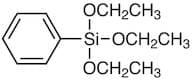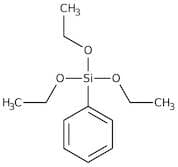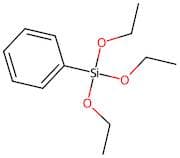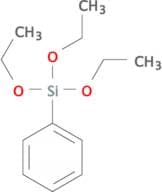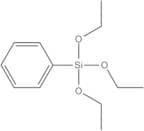
CAS 780-69-8
:Phényltriéthoxysilane
- (Triethoxysilyl)benzene
- Benzene, (triethoxysilyl)-
- Benzeneorthosiliconic acid, triethyl ester
- Dynasil 9265
- Dynasylan 9265
- Kbe 103
- Kbm 202Ls4480
- Kh 162
- Kh 651
- Ls 4480
- Ls 4800
- Nsc 77115
- P 0320
- Phenyltriethoxysilane
- Pts 32
- Sip 6821.0
- Tri(ethoxo)(phenyl)silane
- Triethoxy(phenyl)silan
- Triethoxy(phenyl)silane
- Triethoxyphenylsilane
- Trietoxi(Fenil)Silano
- Tsl 8178
- Voir plus de synonymes
Triethoxyphenylsilane
CAS :Formule :C12H20O3SiDegré de pureté :>99.0%(GC)Couleur et forme :Colorless to Almost colorless clear liquidMasse moléculaire :240.37Phenyltriethoxysilane, 98%
CAS :Phenyltriethoxysilane is an important raw material and intermediate used in organic synthesis, pharmaceuticals, agrochemicals and dyestuff fields. This Thermo Scientific Chemicals brand product was originally part of the Alfa Aesar product portfolio. Some documentation and label information may refFormule :C12H20O3SiDegré de pureté :98%Couleur et forme :Clear colorless, Liquid or viscous liquidMasse moléculaire :240.37Phenyltriethoxysilane
CAS :S13700 - Phenyltriethoxysilane
Formule :C12H20O3SiDegré de pureté :95%Couleur et forme :Liquid, Colourless liquidMasse moléculaire :240.374PHENYLTRIETHOXYSILANE
CAS :Arylsilane Cross-Coupling Agent
The cross-coupling reaction is a highly useful methodology for the formation of carbon-carbon bonds. It involves two reagents, with one typically being a suitable organometallic reagent - the nucleophile - and the other a suitable organic substrate, normally an unsaturated halide, tosylate or similar - the electrophile.
Aromatic Silane - Conventional Surface Bonding
Aliphatic, fluorinated aliphatic or substituted aromatic hydrocarbon substituents are the hydrophobic entities which enable silanes to induce surface hydrophobicity. The organic substitution of the silane must be non-polar. The hydrophobic effect of the organic substitution can be related to the free energy of transfer of hydrocarbon molecules from an aqueous phase to a homogeneous hydrocarbon phase. A successful hydrophobic coating must eliminate or mitigate hydrogen bonding and shield polar surfaces from interaction with water by creating a non-polar interphase. Although silane and silicone derived coatings are in general the most hydrophobic, they maintain a high degree of permeability to water vapor. This allows coatings to breathe and reduce deterioration at the coating interface associated with entrapped water. Since ions are not transported through non-polar silane and silicone coatings, they offer protection to composite structures ranging from pigmented coatings to rebar reinforced concrete. A selection guide for hydrophobic silanes can be found on pages 22-31 of the Hydrophobicity, Hydrophilicity and Silane Surface Modification brochure.
Phenyltriethoxysilane; Triethoxysilylbenzene; Triethoxy(phenyl)silane
Viscosity, 25 °C: 1.7 cStDipole moment: 1.85 debyeSurface tension: 28 mN/mDielectric constant: 4.12Vapor pressure, 75 °C: 1 mmCoefficient of thermal expansion: 0.9 x 10⁻³Improves photoresist adhesion to silicon nitrideElectron donor component of polyolefin polymerization catalyst complexesEffective treatment for organic-grafted claysPhenylates allyl benzoatesCross-couples with aryl bromides without amine or phosphineligandsPhenylates allyl acetatesβ-phenylates enones under aqueous base conditionsExtensive review of silicon based cross-coupling agents: Denmark, S. E. et al. "Organic Reactions, Volume 75"Denmark, S. E. ed., John Wiley and Sons, 233, 2011Formule :C12H20O3SiDegré de pureté :97%Couleur et forme :Straw LiquidMasse moléculaire :240.37