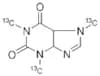
CAS 78072-66-9
:caféine-triméthyl-13C3
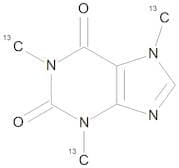
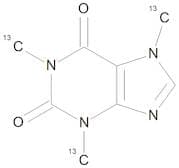
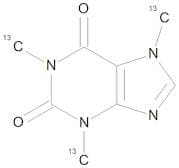
- 1,3,7-tris[(~13~C)methyl]-3,7-dihydro-1H-purine-2,6-dione
Caffeine-13C3 (Pentoxifylline EP Impurity F-13C3, Theophylline EP Impurity A-13C3, Theophylline-Ethylenediamine EP Impurity A-13C3)
CAS :Formule :C513C3H10N4O2Couleur et forme :White To Off-White SolidMasse moléculaire :197.16Caffeine 13C3 (trimethyl 13C3) 100 µg/mL in Acetonitrile
CAS :Formule :C3C5H10N4O2Couleur et forme :Single SolutionMasse moléculaire :197.17Caffeine-13C3
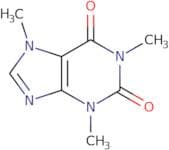
CAS :Applications Caffeine-13C3 is a labelled analogue of Caffeine (C080100), a bitter, white crystalline xanthine alkaloid that acts as a stimulant drug and a reversible acetylcholinesterase inhibitor. Caffeine is found in varying quantities in the seeds, leaves, and fruit of some plants, where it acts as a natural pesticide that paralyzes and kills certain insects feeding on the plants. In humans, caffeine acts as a central nervous system stimulant, temporarily warding off drowsiness and restoring alertness. Caffeine is a cardiac and respiratory stimulant; diuretic. Caffeine is toxic at sufficiently high doses.A study at Johns Hopkins University indicates that caffeine can improve pattern separation memory.
References Zubair, U.M., et al.: Anal. Profiles Drug Subs., 15, 71 (1986); Cherrah, Y., et al.: Biochem. Pharmacol., 37, 1311 (1988); Chem. and Eng. News p.34, Jan. 20, (2014)Formule :C3C5H10N4O2Couleur et forme :White To Off-WhiteMasse moléculaire :197.17Caffeine-13C3
CAS :Produit contrôléThe enantioselective method of caffeine-13C3 is a new technique to measure the amount of caffeine in wastewater. The method uses the enantioselective properties of the synthetic compound, caffeine-13C3, which has a chiral center that is not present in natural caffeine. The method relies on high performance liquid chromatography and mass spectrometry. It can be used to test wastewater samples for levels of caffeine over a period of time and compare them with different populations. This method can also be used to detect traces of other psychoactive substances such as amphetamines, cocaine, and ecstasy.Formule :C8H10N4O2Degré de pureté :Min. 95%Masse moléculaire :197.17 g/mol