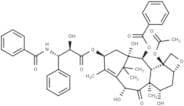
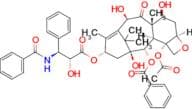
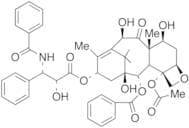
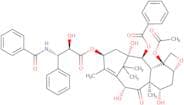
CAS 78432-77-6
:10-Désacétyltaxol
Description :
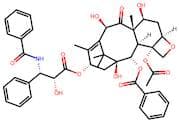
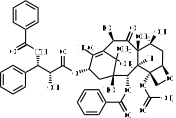
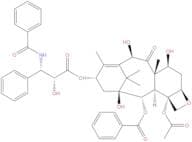
10-Désacétyltaxol, avec le numéro CAS 78432-77-6, est un dérivé du produit naturel taxol, connu pour ses propriétés anticancéreuses. Ce composé se caractérise par l'absence d'un groupe acétyle à la position C10, ce qui le distingue du taxol. Il présente une structure polycyclique complexe typique des taxanes, avec un noyau de taxane qui contribue à son activité biologique. 10-Désacétyltaxol est principalement reconnu pour sa capacité à stabiliser les microtubules, inhibant ainsi la division cellulaire, qui est un mécanisme crucial dans le traitement du cancer. Le composé est souvent étudié pour ses applications thérapeutiques potentielles et peut présenter différents degrés de cytotoxicité contre différentes lignées cellulaires cancéreuses. De plus, sa solubilité et sa stabilité dans les systèmes biologiques peuvent influencer son efficacité en tant qu'agent thérapeutique. Dans l'ensemble, 10-Désacétyltaxol représente un composé important dans le domaine de la chimie médicinale, en particulier dans le développement d'agents chimiothérapeutiques.
Formule :C45H49NO13
InChI :InChI=1S/C45H49NO13/c1-24-29(57-41(54)35(50)33(26-15-9-6-10-16-26)46-39(52)27-17-11-7-12-18-27)22-45(55)38(58-40(53)28-19-13-8-14-20-28)36-43(5,37(51)34(49)32(24)42(45,3)4)30(48)21-31-44(36,23-56-31)59-25(2)47/h6-20,29-31,33-36,38,48-50,55H,21-23H2,1-5H3,(H,46,52)/t29-,30-,31+,33-,34+,35+,36-,38-,43+,44-,45+/m0/s1
Code InChI :InChIKey=TYLVGQKNNUHXIP-MHHARFCSSA-N
SMILES :O(C(C)=O)[C@]12[C@]3([C@H](OC(=O)C4=CC=CC=C4)[C@@]5(O)C(C)(C)C([C@@H](O)C(=O)[C@]3(C)[C@@H](O)C[C@]1(OC2)[H])=C(C)[C@@H](OC([C@@H]([C@@H](NC(=O)C6=CC=CC=C6)C7=CC=CC=C7)O)=O)C5)[H]
Synonymes :- (2alpha,5beta,7beta,10beta,13alpha)-4-(acetyloxy)-13-{[(2R,3S)-3-(benzoylamino)-2-hydroxy-3-phenylpropanoyl]oxy}-1,7,10-trihydroxy-9-oxo-5,20-epoxytax-11-en-2-yl benzoate
- 10-Deacetylpaclitaxel
- 10-Deacetyltaxol
- 10-Deacetyltaxol A
- 10-Desacetylpaclitaxel
- 10-Desacetyltaxol
- 10-O-Deacetyltaxol
- 7,11-Methano-1H-cyclodeca[3,4]benz[1,2-b]oxete, benzenepropanoic acid deriv.
- 7-Epi-10-deacetyl paclitaxel
- Benzenepropanoic acid, β-(benzoylamino)-α-hydroxy-, (2aR,4S,4aS,6R,9S,11S,12S,12aR,12bS)-12b-(acetyloxy)-12-(benzoyloxy)-2a,3,4,4a,5,6,9,10,11,12,12a,12b-dodecahydro-4,6,11-trihydroxy-4a,8,13,13-tetramethyl-5-oxo-7,11-methano-1H-cyclodeca[3,4]benz[1,2-b]oxet-9-yl ester, (αR,βS)-
- Benzenepropanoic acid, β-(benzoylamino)-α-hydroxy-, 12b-(acetyloxy)-12-(benzoyloxy)-2a,3,4,4a,5,6,9,10,11,12,12a,12b-dodecahydro-4,6,11-trihydroxy-4a,8,13,13-tetramethyl-5-oxo-7,11-methano-1H-cyclodeca[3,4]benz[1,2-b]oxet-9-yl ester, [2aR-[2aα,4β,4aβ,6β,9α(αR*,βS*),11α,12α,12aα,12bα]]-
- Voir plus de synonymes
Trier par
Degré de pureté (%)
0
100
|
0
|
50
|
90
|
95
|
100
10 produits concernés.
10-Deacetyltaxol
CAS :Formule :C45H49NO13Degré de pureté :≥ 98.0%Couleur et forme :White to off-white powderMasse moléculaire :811.88Paclitaxel EP Impurity G (10-Desacetyl Paclitaxel)
CAS :Formule :C45H49NO13Couleur et forme :Pink SolidMasse moléculaire :811.8810-Deacetyltaxol
CAS :10-Deacetyltaxol and cephalomannine have cytotoxicity in human glial and neuroblastoma cell-lines, the tumors of the central and peripheral nervous system are sensitive to 10-deacetyltaxol and cephalomannine and these drugs are less toxic than taxol but remain within a therapeutic range.Formule :C45H49NO13Degré de pureté :95%~99%Masse moléculaire :811.88110-Deacetyltaxol
CAS :10-Deacetyltaxol (10-DAT) is extracted from Taxus brevifolia barks.Formule :C45H49NO13Degré de pureté :94.63% - 99.93%Couleur et forme :SolidMasse moléculaire :811.8710-Desacetyl Paclitaxel
CAS :Impurity Paclitaxel - impurity G
Applications A semi-synthetic precursor of Paclitaxel. Paclitaxel - impurity G.Formule :C45H49NO13Couleur et forme :White To Off-WhiteMasse moléculaire :811.8710-Desacetyl paclitaxel
CAS :10-Desacetyl paclitaxel is a form of paclitaxel that has been modified chemically. It is soluble in water and can be injected intravenously. 10-Desacetyl paclitaxel is used to treat inflammatory diseases, such as rheumatoid arthritis and psoriasis. This drug binds to the hydroxyl groups on the surface of the bacterial cell wall and prevents the formation of covalent linkages with polysaccharides, which leads to its increased patency in bacterial cells. 10-Desacetyl paclitaxel has also been shown to inhibit the activity of certain enzymes that are involved in synthesis of DNA, RNA, and proteins. This inhibition results in cell death by apoptosis or necrosis. The increase in viability after treatment with 10-desacetyl paclitaxel was observed for both gram-positive bacteria (e.g., Bacillus subtilis) and gram-negative bacteria (e.g., EscherFormule :C45H49NO13Degré de pureté :Min. 95%Couleur et forme :White PowderMasse moléculaire :811.87 g/mol