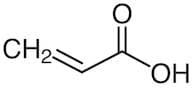
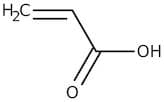
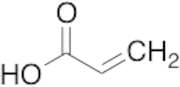
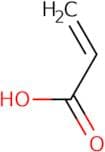
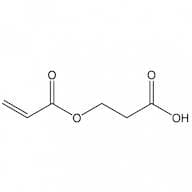
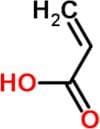
CAS 79-10-7
:Acide acrylique
- 2-Propenoic acid
- 2-acrylsyre
- 2-propénoïque, acide
- 2-プロペン酸
- Acide acrylique
- Acido 2-Propenoico
- Acido Acrilico
- Acroleic acid
- Acrylic Acid Anhydrous
- Acrylic Acid Glacial
- Acrylsaeure
- Acrylsaure
- Acrylsyre
- B 60-1
- Ethylenecarboxylic acid
- Glacial Acrylic Acid
- Hf 3050
- LX 300 (crosslinking agent)
- Liroudan FR-RV
- Lx 300
- Nsc 4765
- Prop-2-ensäure
- Propenoic acid
- Ra 238
- Relugan FR-RV
- Tm 1202
- Vinylformic acid
- アクリル酸
- Voir plus de synonymes
Acrylic Acid (stabilized with MEHQ)
CAS :Formule :C3H4O2Degré de pureté :>99.0%(GC)Couleur et forme :White or Colorless powder to lump to clear liquidMasse moléculaire :72.06Acrylic acid, 97%, stab. with ca 200ppm 4-methoxyphenol
CAS :Acrylic acid acts as a precursor in the production of 3-hydroxypropionic acid. It is used in the preparation of water-absorbent resins. It reacts with alcohols to prepare the corresponding esters. Its esters are used as raw materials for synthetic resins, rubbers, coating adhesives, water-based pai
Formule :C3H4O2Degré de pureté :97%Couleur et forme :Clear colorless, LiquidMasse moléculaire :72.06Acrylic acid, low water content, 99.5%, stab. with ca 200ppm 4-methoxyphenol
CAS :Acrylic acid acts as a precursor in the production of 3-hydroxypropionic acid. It is used in the preparation of water-absorbent resins. It reacts with alcohols to prepare the corresponding esters. Its esters are used as raw materials for synthetic resins, rubbers, coating adhesives, water-based paiFormule :C3H4O2Degré de pureté :99.5%Couleur et forme :Liquid, Clear colorlessMasse moléculaire :72.06Atracurium Impurity 13
CAS :Formule :C3H4O2Couleur et forme :Colorless LiquidMasse moléculaire :72.06Acrylic Acid (stabilized with MEHQ)
CAS :Stability Light Sensitive, Volatile
Applications An antibacterial agent.
Not a dangerous good if item is equal to or less than 1g/ml and there is less than 100g/ml in the package
References Kind, T., et al.: Anal. Biochem., 363, 185 (2007), Spratlin, J., et al.: Clin. Cancer Res., 15, 431 (2009),Formule :C3H4O2Couleur et forme :NeatMasse moléculaire :72.06Acrylic acid - stabilised with MEHQ
CAS :Acrylic acid is a chemical compound that is naturally found in the environment. It is a colorless liquid with a pungent odor. Acrylic acid has been studied for its antimicrobial properties and has shown high activity against Aerobacter aerogenes. It also has been used as an intermediate in the manufacture of acrylic, acrylate, and methyl ethyl methacrylate. Acrylic acid has been used to produce glycol ethers and other chemicals, such as sodium carbonate and hydrogen bonding interactions. Acrylic acid can be manufactured using the industrial process of neutralization of trifluoroacetic acid with sodium carbonate or sodium hydroxide. The production process is highly dependent on the purity of starting materials, which can cause variations in product quality and chemical stability.
Formule :C3H4O2Degré de pureté :Min. 95%Couleur et forme :PowderMasse moléculaire :72.06 g/molAcrylic Acid (Stabilized) pure, 99%
CAS :Formule :C3H4O2Degré de pureté :min. 99%Couleur et forme :Clear, Colourless to pale yellow, LiquidMasse moléculaire :72.04