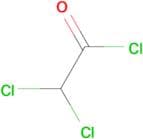
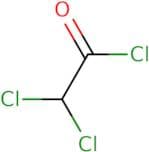
CAS 79-36-7
:Chlorure de dichloroacétyle
Description :
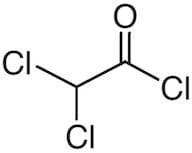
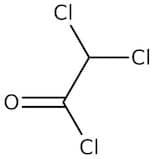
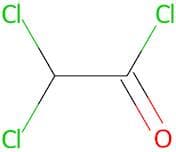
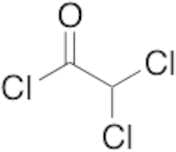
Chlorure de dichloroacétyle, avec le numéro CAS 79-36-7, est un composé organique caractérisé par sa nature réactive et ses propriétés chimiques distinctes. C'est un liquide incolore à jaunâtre avec une odeur âcre, couramment utilisé comme agent acylant dans la synthèse organique. Le composé présente deux atomes de chlore et un groupe fonctionnel de chlorure d'acétyle, ce qui le rend hautement réactif, en particulier avec les nucléophiles. Il est soluble dans des solvants organiques mais réagit vigoureusement avec l'eau, produisant de l'acide chlorhydrique et de l'acide dichloroacétique. En raison de sa réactivité, il est important de manipuler Chlorure de dichloroacétyle avec précaution, car il peut provoquer de graves brûlures et une irritation respiratoire par contact ou inhalation. En termes d'applications, il est utilisé dans la synthèse de divers produits pharmaceutiques, agrochimiques et autres intermédiaires chimiques. Un stockage approprié dans un endroit frais et sec, à l'abri de l'humidité et des substances incompatibles, est essentiel pour maintenir sa stabilité et prévenir les réactions dangereuses.
Formule :C2HCl3O
InChI :InChI=1S/C2HCl3O/c3-1(4)2(5)6/h1H
Code InChI :InChIKey=FBCCMZVIWNDFMO-UHFFFAOYSA-N
SMILES :C(C(Cl)=O)(Cl)Cl
Synonymes :- 2,2-Dichloroacetyl chloride
- Acetyl chloride, 2,2-dichloro-
- Acetyl chloride, dichloro-
- Chlorure de dichloroacetyle
- Cloruro De Dicloroacetilo
- Dichloracetyl chloride
- Dichloracetylchlorid
- Dichloressigsaeurechlorid
- Dichloro Acetyl Chloride
- Dichloroacetic acid chloride
- Dichloroethanoyl chloride
- α,α-Dichloroacetyl chloride
- chloridkyselinydichloroctove
- 2,2-dichloroacetylchloride[qr]
- 2,2-dichloroacetyl
- DICHLOROACETYL CHLORIDE
- alpha,alpha-dichloroacetylchloride[qr]
- Chlorure de dichloracetyle
- chlorurededichloracetyle[french][qr]
- dichloroethanoylchloride[qr]
- alpha,alpha-dichloroacetyl chloride
- CHCl2COCl
- Chlorid kyseliny dichloroctove
- dichloro-acetylchlorid
- acetylchloride,dichloro-[qr]
- chlorurededichloracetyle
- Dichloroacetylchloride,97%
- Voir plus de synonymes
Trier par
Degré de pureté (%)
0
100
|
0
|
50
|
90
|
95
|
100
6 produits concernés.
Dichloroacetyl Chloride
CAS :Formule :C2HCl3ODegré de pureté :>98.0%(GC)(T)Couleur et forme :Colorless to Light yellow clear liquidMasse moléculaire :147.38Dichloroacetyl chloride, 97%
CAS :This Thermo Scientific Chemicals brand product was originally part of the Alfa Aesar product portfolio. Some documentation and label information may refer to the legacy brand. The original Alfa Aesar product / item code or SKU reference has not changed as a part of the brand transition to Thermo Sci
Formule :C2HCl3ODegré de pureté :97%Couleur et forme :Liquid, Clear colorless to pale yellowMasse moléculaire :147.38Dichloroacetyl chloride
CAS :Dichloroacetyl chlorideFormule :C2HCl3ODegré de pureté :97%Couleur et forme : clear. colourless liquidMasse moléculaire :147.38774g/molDichloroacetyl Chloride
CAS :Produit contrôléApplications Dichloroacetyl Chloride is a reagent used in the synthesis of substituted benzothiazoles exhibiting antitumor and anticancer activity.
References Chua, M. et al.: J. Med. Chem., 42, 381 (1999);Formule :C2H3Cl3OCouleur et forme :NeatMasse moléculaire :147.39Dichloroacetyl chloride
CAS :Dichloroacetyl chloride is a reactive chlorine compound that is used in the synthesis of pharmaceuticals, dyes, and pesticides. It reacts with hydrochloric acid to produce hydrochloric acid and dichloroacetic acid. Dichloroacetyl chloride can react with zirconium oxide to produce chlorides and zirconates. This reaction can be conducted at room temperature. The reaction mechanism for this reaction is not well understood; however, it has been shown that the hydroxyl group on the dichloroacetyl chloride molecule plays a significant role in this process. The phase transition temperature of dichloroacetyl chloride is -60°C. This compound has physiological activities such as reducing inflammation and fighting autoimmune diseases.Formule :C2HCl3ODegré de pureté :Min. 95%Masse moléculaire :147.39 g/mol