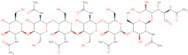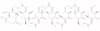
CAS 79127-58-5
:hepta-N-acétylchitoheptaose
Description :
hepta-N-acétylchitoheptaose est un oligosaccharide complexe composé de sept unités de N-acétylglucosamine (GlcNAc) liées entre elles, formant une structure de chito-oligosaccharide. Ce composé est dérivé de la chitine, un biopolymère que l'on trouve dans les exosquelettes des crustacés et dans les parois cellulaires des champignons. Les groupes N-acétyles contribuent à sa solubilité et à son activité biologique. hepta-N-acétylchitoheptaose présente diverses caractéristiques, y compris son potentiel en tant que prébiotique, favorisant la croissance de bactéries intestinales bénéfiques. Il peut également jouer un rôle dans l'immunomodulation et a des applications en biomédecine et en biotechnologie. La structure de l'oligosaccharide influence son interaction avec les systèmes biologiques, ce qui en fait un sujet d'intérêt dans la recherche liée à la glycosciences et à la chimie des glucides. Son numéro CAS, 79127-58-5, sert d'identifiant unique à des fins réglementaires et commerciales. Dans l'ensemble, hepta-N-acétylchitoheptaose est significatif tant dans les processus naturels que dans les applications thérapeutiques potentielles en raison de ses propriétés structurelles uniques et de ses fonctions biologiques.
Formule :C56H93N7O36
InChI :InChI=1/C56H93N7O36/c1-16(72)57-23(8-64)37(80)45(24(79)9-65)94-52-32(59-18(3)74)40(83)47(26(11-67)89-52)96-54-34(61-20(5)76)42(85)49(28(13-69)91-54)98-56-36(63-22(7)78)44(87)50(30(15-71)93-56)99-55-35(62-21(6)77)43(86)48(29(14-70)92-55)97-53-33(60-19(4)75)41(84)46(27(12-68)90-53)95-51-31(58-17(2)73)39(82)38(81)25(10-66)88-51/h8,23-56,65-71,79-87H,9-15H2,1-7H3,(H,57,72)(H,58,73)(H,59,74)(H,60,75)(H,61,76)(H,62,77)(H,63,78)/t23-,24+,25+,26+,27+,28+,29+,30+,31+,32+,33+,34+,35+,36+,37+,38+,39+,40+,41+,42+,43+,44+,45+,46+,47+,48+,49+,50+,51-,52-,53-,54-,55-,56-/m0/s1
Synonymes :- (Glcnac)7
- D-Glucose, O-2-(acetylamino)-2-deoxy-beta-D-glucopyranosyl-(1-4)-O-2-(acetylamino)-2-deoxy-beta-D-glucopyranosyl-(1-4)-O-2-(acetylamino)-2-deoxy-beta-D-glucopyranosyl-(1-4)-O-2-(acetylamino)-2-deoxy-beta-D-glucopyranosyl-(1-4)-O-2-(acetylamino)-2-deoxy-beta-D-glucopyranosyl-(1-4)-O-2-(acetylamino)-2-deoxy-beta-D-glucopyranosyl-(1-4)-2-(acetylamino)-2-deoxy-
- 2-(acetylamino)-2-deoxy-beta-D-glucopyranosyl-(1->4)-2-(acetylamino)-2-deoxy-beta-D-glucopyranosyl-(1->4)-2-(acetylamino)-2-deoxy-beta-D-glucopyranosyl-(1->4)-2-(acetylamino)-2-deoxy-beta-D-glucopyranosyl-(1->4)-2-(acetylamino)-2-deoxy-beta-D-glucopyranosyl-(1->4)-2-(acetylamino)-2-deoxy-beta-D-glucopyranosyl-(1->4)-2-(acetylamino)-2-deoxy-D-glucose
Trier par
Degré de pureté (%)
0
100
|
0
|
50
|
90
|
95
|
100
1 produits concernés.
N,N',N'',N''',N'''',N''''',N''''''-Heptaacetylchitoheptaose
CAS :Chitinases are enzymes that hydrolyze chitin, a polysaccharide found in the exoskeleton of insects, fungi and other invertebrates. Chitohexaose is a sugar that has been shown to have anti-inflammatory properties. It is a carbohydrate with six acetyl groups attached to it. When this sugar reacts with ammonium bicarbonate (NH4HCO3) in an acidic environment, it produces N,N',N'',N''',N'''',N''''',N''''''-heptaacetylchitoheptaose. This reaction system can be used as a chitinase preparation for investigating the biological effects of chitohexaose. The magnetic resonance spectroscopy was used to study the reaction system and revealed that the product is a hexamer with six acetyl groups on each monomer.
Formule :C56H93N7O36Degré de pureté :Min. 95%Couleur et forme :PowderMasse moléculaire :1,440.36 g/mol