CAS 8049-97-6
:Mélanines
Description :
Mélanines sont un groupe de biopolymères complexes qui sont principalement responsables de la pigmentation chez divers organismes, y compris les humains. Ils sont produits par la polymérisation oxydative de composés phénoliques, en particulier de la tyrosine, et sont caractérisés par leur couleur brun foncé à noire. Mélanines sont insolubles dans l'eau et les solvants organiques, ce qui contribue à leur stabilité et à leur résistance à la dégradation. Ils présentent un degré élevé d'hétérogénéité structurelle, avec des variations de poids moléculaire et de composition selon la source et les conditions environnementales. Mélanines jouent des rôles cruciaux dans les systèmes biologiques, y compris la protection contre les radiations UV, la capture des radicaux libres et la contribution à la coloration de la peau, des cheveux et des yeux. De plus, ils ont des applications potentielles dans divers domaines, y compris la médecine, les cosmétiques et la science des matériaux, en raison de leurs propriétés uniques telles que la biocompatibilité et l'activité antioxydante. Le numéro CAS 8049-97-6 fait spécifiquement référence à un type de mélanine, soulignant son importance tant dans des contextes biologiques qu'industriels.
Formule :Unspecified
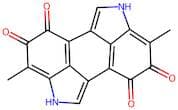
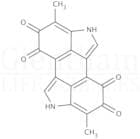
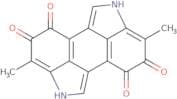
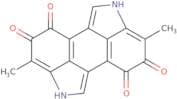
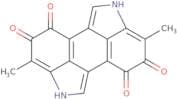
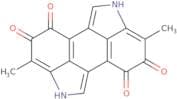
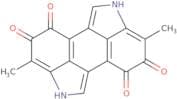
InChI :InChI=1/C18H10N2O4/c1-5-13-9-7(3-19-13)12-10-8(11(9)17(23)15(5)21)4-20-14(10)6(2)16(22)18(12)24/h3-4,19-20H,1-2H3
SMILES :Cc1c2c3c(c[nH]2)c2c4c(c[nH]c4c(C)c(=O)c2=O)c3c(=O)c1=O
Synonymes :- 3,8-Dimethyl-2,7-Dihydrobenzo[1,2,3-Cd:4,5,6-C'D']Diindole-4,5,9,10-Tetrone
- Melanin
- Melanin From Sepia Officinalis
- Melanins
- Melanoids
- MeSH ID: D008543
- Melanines
Trier par
Degré de pureté (%)
0
100
|
0
|
50
|
90
|
95
|
100
8 produits concernés.
Melanin
CAS :Degré de pureté :≥ 99.0%Couleur et forme :Brown, dark-brown or black powderMasse moléculaire :-Melanin
CAS :Melanin is a multifunctional biotin and a powerful cation chelator with antimicrobial, antioxidant and antiradiation activities.Formule :C18H10N2O4Couleur et forme :SolidMasse moléculaire :318.288Melanin - fungal (Ganoderma lucidum)
CAS :Melanin - fungal (Ganoderma lucidum) is a high-molecular-weight polymer, which is derived from the fruiting body and mycelium of the Ganoderma lucidum mushroom. This compound is a biopolymer formed through the oxidative polymerization of phenolic and/or indolic compounds, a process catalyzed by tyrosinase. The mode of action of this melanin involves its ability to absorb harmful ultraviolet (UV) radiation and scavenge reactive oxygen species (ROS), thereby acting as a potent antioxidant and protective agent.Formule :C18H10N2O4Couleur et forme :PowderMasse moléculaire :318.28 g/molMelanin, from Sepia officinalis
CAS :Melanin is a natural pigment, which is derived from Sepia officinalis, commonly known as the common cuttlefish. This pigment is a complex biopolymer sourced from the ink sac of the cuttlefish, a cephalopod that produces ink as a defense mechanism. The mode of action of melanin involves its unique ability to absorb a broad range of the electromagnetic spectrum, providing effective protection against ultraviolet radiation. Additionally, it exhibits remarkable antioxidant properties due to its free radical scavenging abilities.Formule :C18H10N2O4Masse moléculaire :318.28 g/molMelanin - insect (Hermetia illucens)
CAS :Melanin is a substance that plays a crucial role in the human body. It is responsible for the color of our hair, skin, and eyes. Melanin acts as a natural sunscreen, protecting our skin from harmful UV radiation. It also helps in the synthesis of vitamin D and acts as an antioxidant, protecting our cells from damage caused by free radicals. Gadolinium-based synthetic melanin has been developed to mimic the natural melanin pigment. This synthetic melanin has various applications in industries such as cosmetics, paints, and plastics. It can be used to create vibrant colors and provide UV protection in these products. Researchers have also discovered that certain natural products can enhance melanogenesis, the process of melanin production in the body. These natural pigments have shown antioxidant properties and can inhibit tyrosinase, an enzyme involved in melanin synthesis. By promoting the production of eumelanin (dark brown/black pigment) and inhibiting pheomelanin (yellow/red pigmentFormule :C18H10N2O4Masse moléculaire :318.28 g/molMelanin - plant (Osmanthus fragrans)
CAS :Melanin is a substance that plays a crucial role in the human body. It is responsible for the color of our hair, skin, and eyes. Melanin acts as a natural sunscreen, protecting our skin from harmful UV radiation. It also helps in the synthesis of vitamin D and acts as an antioxidant, protecting our cells from damage caused by free radicals. Gadolinium-based synthetic melanin has been developed to mimic the natural melanin pigment. This synthetic melanin has various applications in industries such as cosmetics, paints, and plastics. It can be used to create vibrant colors and provide UV protection in these products. Researchers have also discovered that certain natural products can enhance melanogenesis, the process of melanin production in the body. These natural pigments have shown antioxidant properties and can inhibit tyrosinase, an enzyme involved in melanin synthesis. By promoting the production of eumelanin (dark brown/black pigment) and inhibiting pheomelanin (yellow/red pigmentFormule :C18H10N2O4Masse moléculaire :318.28 g/molMelanin, synthetic
CAS :Melanin, synthetic, is a bioengineered pigment that mimics the natural biopolymer found in organisms. It is derived from controlled chemical synthesis or microbial processes, designed to replicate the structure and properties of naturally occurring melanin.
Formule :C18H10N2O4Couleur et forme :PowderMasse moléculaire :318.28 g/mol