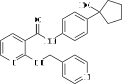
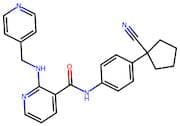
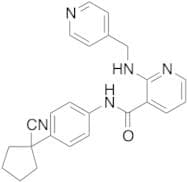
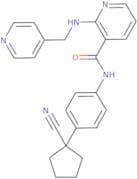
![N-[4-(1-Cyanocyclopentyl)phenyl]-2-[(4-pyridinylmethyl)amino]-3-pyridinecarboxamide](/_next/image/?url=https%3A%2Fstatic.cymitquimica.com%2Fcas-image%2Fthumb-webp%2F302981-n-4-1-cyanocyclopentyl-phenyl-2-4-pyridinylmethyl-amino-3-pyridinecarboxamide.webp&w=3840&q=75)
CAS 811803-05-1
:N-[4-(1-Cyanocyclopentyl)phényl]-2-[(4-pyridinylméthyl)amino]-3-pyridinecarboxamide
- 3-Pyridinecarboxamide, N-[4-(1-cyanocyclopentyl)phenyl]-2-[(4-pyridinylmethyl)amino]-
- Apatinib
- Apatinib (YN968D1)
- Apatinib mesylate
- Aptinib
- N-[4-(1-Cyanocyclopentyl)phenyl]-2-[(4-pyridinylmethyl)amino]-3-pyridinecarboxamide
- N-[4-(1-cyanocyclopentyl)phenyl]-2-[(pyridin-4-ylmethyl)amino]pyridine-3-carboxamide
- Rivoceranib
- Yn 968D1
- N-[4-(1-Cyanocyclopentyl)phenyl]-2-[(4-pyridinylmethyl)amino]pyridine-3-carboxamide
N-(4-(1-Cyanocyclopentyl)phenyl)-2-((pyridin-4-ylmethyl)amino)nicotinamide
CAS :N-(4-(1-Cyanocyclopentyl)phenyl)-2-((pyridin-4-ylmethyl)amino)nicotinamideDegré de pureté :99%Masse moléculaire :397.48g/molApatinib
CAS :Produit contrôléApplications Apatinib is an orally available, small molecule multitargeted tyrosine kinase inhibitor. Apatinib selectively inhibits the vascular endothelial growth factor receptor-2 (VEGFR2). Apatinib functions by inhibiting VEGF-mediated endothelial cell migration and proliferation thus blocking new blood vessel formation in tumor tissue. Recent studies have shown that Apatinib enhances the efficacy of conventional chemotherapeutical drugs in side population (SP) cells and ABCB1-overexpressing leukemia cells.
Not a dangerous good if item is equal to or less than 1g/ml and there is less than 100g/ml in the package
References Mi, Y. et al.: Cancer Res., 70, 7981 (2010); Tong, X.Z. et al.: Biochem. Pharmacol., 83, 586 (2012); Ding, J, et al.: J. Chrom B Anal. Technol. Biomed. Life Sci., 895, 108 (2012);Formule :C24H23N5O·CH4O3SCouleur et forme :NeatMasse moléculaire :493.58Apatinib-d8
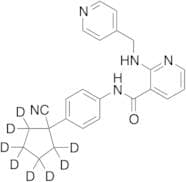
CAS :Produit contrôléApplications Apatinib-d8 is an intermediate used in the synthesis of Apatinib-d8 Hydrochloride (A726152), which is a labelled Apatinib (A726150). Apatinib is an orally available, small molecule multitargeted tyrosine kinase inhibitor. Apatinib selectively inhibits the vascular endothelial growth factor receptor-2 (VEGFR2). Apatinib functions by inhibiting VEGF-mediated endothelial cell migration and proliferation thus blocking new blood vessel formation in tumor tissue. Recent studies have shown that Apatinib enhances the efficacy of conventional chemotherapeutical drugs in side population (SP) cells and ABCB1-overexpressing leukemia cells.
References Mi, Y. et al.: Cancer Res., 70, 7981 (2010); Tong, X.Z. et al.: Biochem. Pharmacol., 83, 586 (2012); Ding, J, et al.: J. Chrom B Anal. Technol. Biomed. Life Sci., 895, 108 (2012);Formule :C24H15D8N5OCouleur et forme :NeatMasse moléculaire :405.53Apatinib
CAS :Apatinib, also known as rivoceranib, is an inhibitor of the vascular endothelial growth factor receptor 2 (VEGFR2) tyrosine kinase. Apatinib targets VEGFR2 with its action and has proven to have strong anti-tumor effects in human cancers. In studies in mice, apatinib acted as an Inhibitor of VEGFR2 and played an antiangiogenic effect. Apatinib has been suggested for the treatment of ischemia-induced proliferative retinopathy and neovascular age-related macular degeneration.
Formule :C24H23N5ODegré de pureté :Min. 95%Couleur et forme :PowderMasse moléculaire :397.47 g/mol