CAS 81552-34-3
:Concanamycine C
Description :
Concanamycine C est un produit naturel appartenant à la classe des antibiotiques macrolides, dérivé spécifiquement de la fermentation de la bactérie *Streptomyces griseus*. Il est connu pour ses puissants effets inhibiteurs sur l'ATPase vacuolaire (V-ATPase), une enzyme critique pour divers processus cellulaires, y compris la régulation du pH et le transport des nutriments. Cette inhibition entraîne des effets biologiques significatifs, faisant de Concanamycine C un composé précieux dans la recherche, en particulier dans les études liées au métabolisme cellulaire et à l'apoptose. La substance présente une structure moléculaire complexe caractérisée par plusieurs cycles et groupes fonctionnels, contribuant à son activité biologique. Concanamycine C est généralement utilisé dans des environnements de laboratoire pour explorer les mécanismes de mort cellulaire et pour enquêter sur les applications thérapeutiques potentielles dans le cancer et d'autres maladies. Sa stabilité et sa solubilité dans des solvants organiques le rendent adapté à diverses conditions expérimentales. Cependant, comme pour de nombreux composés bioactifs, une manipulation soigneuse et une prise en compte des protocoles de sécurité sont essentielles en raison de ses puissants effets biologiques.
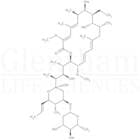
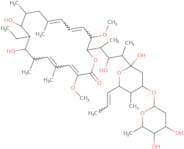
Formule :C45H74O13
InChI :InChI=1/C45H74O13/c1-13-16-34-28(7)37(56-38-22-33(46)42(50)31(10)55-38)23-45(52,58-34)30(9)41(49)29(8)43-35(53-11)18-15-17-24(3)19-26(5)39(47)32(14-2)40(48)27(6)20-25(4)21-36(54-12)44(51)57-43/h13,15-18,20-21,26-35,37-43,46-50,52H,14,19,22-23H2,1-12H3/b16-13+,18-15-,24-17-,25-20-,36-21+/t26?,27?,28?,29?,30?,31-,32?,33-,34?,35?,37?,38-,39?,40?,41?,42-,43?,45?/m1/s1
Code InChI :InChIKey=XKYYLWWOGLVPOR-GKJVGUBMSA-N
SMILES :[C@@H]([C@@H]([C@H](C)[C@@]1([C@@H](OC)/C=C/C=C(\C)/C[C@@H](C)[C@H](O)[C@H](CC)[C@H](O)[C@H](C)/C=C(\C)/C=C(\OC)/C(=O)O1)[H])O)(C)[C@@]2(O)C[C@@H](O[C@H]3C[C@@H](O)[C@H](O)[C@@H](C)O3)[C@H](C)[C@@H](/C=C/C)O2
Synonymes :- (3Z,5E,7R,8R,9S,10S,11R,13E,15E,17S,18R)-18-[(1S,2R,3S)-3-[(2R,4R,5S,6R)-4-[(2,6-Dideoxy-β-<span class="text-smallcaps">D</span>-arabino-hexopyranosyl)oxy]tetrahydro-2-hydroxy-5-methyl-6-(1E)-1-propen-1-yl-2H-pyran-2-yl]-2-hydroxy-1-methylbutyl]-9-ethyl-8,10-dihydroxy-3,17-dimethoxy-5,7,11,13-tetramethyloxacyclooctadeca-3,5,13,15-tetraen-2-one
- 2,4-dideoxy-3-O-(2,6-dideoxy-α-D-arabino-hexopyranosyl)-1-C-{3-[(16E)-11-ethyl-10,12-dihydroxy-3,17-dimethoxy-7,9,13,15-tetramethyl-18-oxooxacyclooctadeca-4,6,14,16-tetraen-2-yl]-2-hydroxy-1-methylbutyl}-4-methyl-5-[(1E)-prop-1-en-1-yl]pentopyranose
- 4'-O-De(aminocarbonyl)concanamycin A
- Concanamycin A, 4'-O-de(aminocarbonyl)-
- Concanamycin C
- Oxacyclooctadeca-3,5,13,15-tetraen-2-one, 18-[(1S,2R,3S)-3-[(2R,4R,5S,6R)-4-[(2,6-dideoxy-β-<span class="text-smallcaps">D</span>-arabino-hexopyranosyl)oxy]tetrahydro-2-hydroxy-5-methyl-6-(1E)-1-propen-1-yl-2H-pyran-2-yl]-2-hydroxy-1-methylbutyl]-9-ethyl-8,10-dihydroxy-3,17-dimethoxy-5,7,11,13-tetramethyl-, (3Z,5E,7R,8R,9S,10S,11R,13E,15E,17S,18R)-
- Oxacyclooctadeca-3,5,13,15-tetraen-2-one, 18-[(1S,2R,3S)-3-[(2R,4R,5S,6R)-4-[(2,6-dideoxy-β-<span class="text-smallcaps">D</span>-arabino-hexopyranosyl)oxy]tetrahydro-2-hydroxy-5-methyl-6-(1E)-1-propenyl-2H-pyran-2-yl]-2-hydroxy-1-methylbutyl]-9-ethyl-8,10-dihydroxy-3,17-dimethoxy-5,7,11,13-tetramethyl-, (3Z,5E,7R,8R,9S,10S,11R,13E,15E,17S,18R)-
- Oxacyclooctadecane, concanamycin A deriv.
- (3Z,5E,7R,8R,9S,10S,11R,13E,15E,17S,18R)-18-[(1S,2R,3S)-3-[(2R,4R,5S,6R)-4-[(2,6-Dideoxy-β-D-arabino-hexopyranosyl)oxy]tetrahydro-2-hydroxy-5-methyl-6-(1E)-1-propen-1-yl-2H-pyran-2-yl]-2-hydroxy-1-methylbutyl]-9-ethyl-8,10-dihydroxy-3,17-dimethoxy-5,7,11,13-tetramethyloxacyclooctadeca-3,5,13,15-tetraen-2-one
- Oxacyclooctadeca-3,5,13,15-tetraen-2-one, 18-[(1S,2R,3S)-3-[(2R,4R,5S,6R)-4-[(2,6-dideoxy-β-D-arabino-hexopyranosyl)oxy]tetrahydro-2-hydroxy-5-methyl-6-(1E)-1-propen-1-yl-2H-pyran-2-yl]-2-hydroxy-1-methylbutyl]-9-ethyl-8,10-dihydroxy-3,17-dimethoxy-5,7,11,13-tetramethyl-, (3Z,5E,7R,8R,9S,10S,11R,13E,15E,17S,18R)-
- Oxacyclooctadeca-3,5,13,15-tetraen-2-one, 18-[(1S,2R,3S)-3-[(2R,4R,5S,6R)-4-[(2,6-dideoxy-β-D-arabino-hexopyranosyl)oxy]tetrahydro-2-hydroxy-5-methyl-6-(1E)-1-propenyl-2H-pyran-2-yl]-2-hydroxy-1-methylbutyl]-9-ethyl-8,10-dihydroxy-3,17-dimethoxy-5,7,11,13-tetramethyl-, (3Z,5E,7R,8R,9S,10S,11R,13E,15E,17S,18R)-
Trier par
Degré de pureté (%)
0
100
|
0
|
50
|
90
|
95
|
100
3 produits concernés.
Concanamycin C
CAS :Concanamycin C, a natural macrolide antibiotic, was initially isolated from Streptomyces and identified as an inhibitor of T-cell proliferation in response to concanavalin A (1,2). It exhibits cytotoxicity to fungi, including yeasts, by inhibiting vacuolar-type ATPases (3,4).Formule :C45H74O13Couleur et forme :SolidMasse moléculaire :823.1Concanamycin C
CAS :Concanamycin C is an analog of the human kinase inhibitor that has been shown to have potent anticancer activity. This compound induces apoptosis in cancer cells by inhibiting the activity of protein kinases involved in cell cycle regulation and tumor growth. Concanamycin C is a medicinal compound that has been used as a research tool in the development of novel kinase inhibitors for cancer therapy. This potent inhibitor has been shown to be effective against various types of cancer, making it a promising candidate for further investigation as an anticancer drug. Its unique properties make it an attractive target for the development of new and more effective kinase inhibitors.
Formule :C45H74O13Degré de pureté :Min. 95%Masse moléculaire :823.1 g/mol