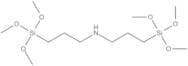
CAS 82985-35-1
:Bis(triméthoxysilylpropyl)amine
- 1-(trimethoxysilyl)-N-[1-(trimethoxysilyl)propyl]propan-1-amine
- 1-Propanamine, 3-(trimethoxysilyl)-N-[3-(trimethoxysilyl)propyl]-
- 3-(Trimethoxysilyl)-N-[3-(trimethoxysilyl)propyl]-1-propanamine
- 3-(trimethoxysilyl)-N-[3-(trimethoxysilyl)propyl]propan-1-amine
- A 1170
- Bis(γ-trimethoxysilylpropyl)amine
- Bis[3-(trimethoxysilyl)propyl]amine
- Bistrimethoxysilylpropylamine
- D 1189
- Dynasylan 1124
- Geniosil GF 192
- Kbm 666P
- N,N-Bis[3-(trimethoxysilyl)propyl]amine
- Sib 1833.0
- Silquest 1170
- Silquest 9492
- Silquest A 1170
- Tsl 8206
- Tsl 8208
- Zh 1170
- Voir plus de synonymes
Bis[3-(trimethoxysilyl)propyl]amine
CAS :Formule :C12H31NO6Si2Degré de pureté :>98.0%(T)Couleur et forme :Colorless to Light yellow to Light orange clear liquidMasse moléculaire :341.55Bis(trimethoxysilylpropyl)amine
CAS :S02260 - Bis(trimethoxysilylpropyl)amine
Formule :C12H31NO6Si2Degré de pureté :95%Couleur et forme :ClearMasse moléculaire :341.551Bis[3-(trimethoxysilyl)propyl]amine
CAS :Bis[3-(trimethoxysilyl)propyl]amineFormule :C12H31NO6Si2Degré de pureté :96%Couleur et forme : clear. almost colourless liquidMasse moléculaire :341.55g/molBIS(3-TRIMETHOXYSILYLPROPYL)AMINE, 96%
CAS :Amine Functional Alkoxy Silane
Silane coupling agents have the ability to form a durable bond between organic and inorganic materials to generate desired heterogeneous environments or to incorporate the bulk properties of different phases into a uniform composite structure. The general formula has two classes of functionality. The hydrolyzable group forms stable condensation products with siliceous surfaces and other oxides such as those of aluminum, zirconium, tin, titanium, and nickel. The organofunctional group alters the wetting or adhesion characteristics of the substrate, utilizes the substrate to catalyze chemical transformations at the heterogeneous interface, orders the interfacial region, or modifies its partition characteristics, and significantly effects the covalent bond between organic and inorganic materials.
Dipodal Silane
Dipodal silanes are a series of adhesion promoters that have intrinsic hydrolytic stabilities up to ~10,000 times greater than conventional silanes and are used in applications such as plastic optics, multilayer printed circuit boards and as adhesive primers for ferrous and nonferrous metals. They have the ability to form up to six bonds to a substrate compared to conventional silanes with the ability to form only three bonds to a substrate. Many conventional coupling agents are frequently used in combination with 10-40% of a non-functional dipodal silane, where the conventional coupling agent provides the appropriate functionality for the application, and the non-functional dipodal silane provides increased durability. Also known as bis-silanes additives enhance hydrolytic stability, which impacts on increased product shelf life, ensures better substrate bonding and also leads to improved mechanical properties in coatings as well as composite applications.
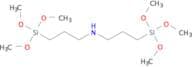
Bis-(3-trimethoxysilylpropyl)amine
Secondary amine allows more control of reactivity with isocyanatesEmployed in optical fiber coatingsUsed in combination with silane, (3-Acryloxypropyl)trimethoxysilane, (SIA0200.0), to increase strength and hydrolytic stability of dental compositesDipodal analog of AMEO (SIA0611.0 )Formule :C12H31NO6Si2Degré de pureté :96%Couleur et forme :Straw LiquidMasse moléculaire :341.56
![Bis[3-(trimethoxysilyl)propyl]amine](/_next/image/?url=https%3A%2Fstatic.cymitquimica.com%2Fproducts%2F3B%2Fthumb%2FB2548.jpg&w=3840&q=75)


![Bis[3-(trimethoxysilyl)propyl]amine](/_next/image/?url=https%3A%2Fstatic.cymitquimica.com%2Fproducts%2F54%2Fthumb%2FOR51899.jpg&w=3840&q=75)