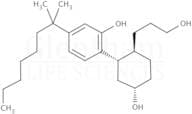
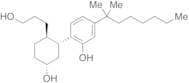
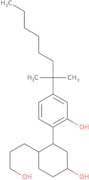
![5-(1,1-Dimethylheptyl)-2-[(1R,2R,5R)-5-hydroxy-2-(3-hydroxypropyl)cyclohexyl]phenol](/_next/image/?url=https%3A%2Fstatic.cymitquimica.com%2Fcas-image%2Fthumb-webp%2F2403-5-11-dimethylheptyl-2-1r-2r-5r-5-hydroxy-2-3-hydroxypropyl-cyclohexyl-phenol.webp&w=3840&q=75)
CAS 83002-04-4
:5-(1,1-Diméthylheptyl)-2-[(1R,2R,5R)-5-hydroxy-2-(3-hydroxypropyl)cyclohexyl]phénol
Description :
La substance chimique connue sous le nom de 5-(1,1-Diméthylheptyl)-2-[(1R,2R,5R)-5-hydroxy-2-(3-hydroxypropyl)cyclohexyl]phénol, avec le numéro CAS 83002-04-4, est un composé synthétique principalement reconnu pour son application dans le domaine de la recherche sur les cannabinoïdes. Ce composé présente une structure moléculaire complexe qui comprend un groupe phénolique et un moiety cyclohexyle, qui contribuent à son activité biologique potentielle. Il se caractérise par sa nature hydrophobe en raison de la présence de longues chaînes alkyles, ce qui peut influencer sa solubilité et son interaction avec les membranes biologiques. La stéréochimie indiquée par la configuration (1R,2R,5R) suggère des arrangements spatiaux spécifiques qui peuvent affecter les propriétés pharmacologiques du composé. En tant qu'analogue des cannabinoïdes, il peut interagir avec les récepteurs des cannabinoïdes dans le corps, influençant potentiellement divers processus physiologiques. Cependant, des études détaillées sont nécessaires pour comprendre pleinement son efficacité, sa sécurité et ses applications thérapeutiques potentielles.
Formule :C24H40O3
InChI :InChI=1S/C24H40O3/c1-4-5-6-7-14-24(2,3)19-11-13-21(23(27)16-19)22-17-20(26)12-10-18(22)9-8-15-25/h11,13,16,18,20,22,25-27H,4-10,12,14-15,17H2,1-3H3/t18-,20-,22-/m1/s1
Code InChI :InChIKey=YNZFFALZMRAPHQ-SYYKKAFVSA-N
SMILES :C(CCO)[C@H]1[C@@H](C[C@H](O)CC1)C2=C(O)C=C(C(CCCCCC)(C)C)C=C2
Synonymes :- (-)-Cp 55940
- 2-[(1S,2R,5S)-5-hydroxy-2-(3-hydroxypropyl)cyclohexyl]-5-(2-methyloctan-2-yl)phenol
- 5-(1,1-Dimethylheptyl)-2-[(1R,2R,5R)-5-hydroxy-2-(3-hydroxypropyl)cyclohexyl]phenol
- 5-(1,1-dimethylheptyl)-2-[(1S,2R,5S)-5-hydroxy-2-(3-hydroxypropyl)cyclohexyl]phenol
- Phenol, 5-(1,1-dimethylheptyl)-2-[5-hydroxy-2-(3-hydroxypropyl)cyclohexyl]-, (1α,2β,5α)-(-)-
- phenol, 5-(1,1-dimethylheptyl)-2-[(1R,2R,5R)-5-hydroxy-2-(3-hydroxypropyl)cyclohexyl]-
- phenol, 5-(1,1-dimethylheptyl)-2-[(1S,2R,5S)-5-hydroxy-2-(3-hydroxypropyl)cyclohexyl]-
Trier par
Degré de pureté (%)
0
100
|
0
|
50
|
90
|
95
|
100
3 produits concernés.
(-)-CP 55,940 (10 mg/mL in methanol)
CAS :Produit contrôléApplications CP 55,940 is a cannabinoid agonist which is considerably more potent than Δ9-THC in both behavioral tests and receptor binding assays. Displays high and roughly equal affinity for both central and peripheral cannabinoid receptors (Ki = 0.6 - 5.0 and 0.7 - 2.6 nM at CB1 and CB2 respectively; EC50 values are 0.2, 0.3 and 5 nM at CB1, CB2 and GRP55 respectively).Controlled substance. Synthetic Cannabinoids
References Wiley, et al.: Neuropharmacology, 34, 669 (1995); Griffin, et al.: J. Pharmacol. Exp. Ther., 285, 553 (1998); Thomas, et al.: J. Pharmacol. Exp. Ther., 285, 285 (1998); Ryberg, et al.: Br. J. Pharmacol., 152, 1092 (2007);Formule :C24H40O3Couleur et forme :Single SolutionMasse moléculaire :376.57CP 55940
CAS :Produit contrôléCP 55940 is a cannabinoid receptor agonist that inhibits acetylcholine release in the brain and has been shown to cause neuronal death. CP 55940 binds to the α7 nicotinic acetylcholine receptor, which is important for memory and learning. The binding of this drug causes an increase in guanine nucleotide-binding protein (G protein) activity by reducing the rate of GTP hydrolysis, leading to inhibition of adenylyl cyclase activity and subsequent decrease in cAMP levels. CP 55940 has significant up-regulation of toll-like receptors following exposure, which leads to an increased immune response. This drug can also cause bowel disease or side effects such as seizures and psychotic symptoms. CP 55940 can interact with other drugs, including cannabinoids that may lead to serious side effects.Formule :C24H40O3Degré de pureté :Min. 95%Masse moléculaire :376.57 g/mol