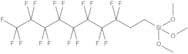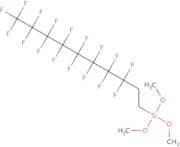
CAS 83048-65-1
:Heptadécafluorodécyltriméthoxysilane
- (3,3,4,4,5,5,6,6,7,7,8,8,9,9,10,10,10-Heptadecafluorodecyl)(Trimethoxy)Silane
- (3,3,4,4,5,5,6,6,7,7,8,8,9,9,10,10,10-Heptadecafluorodecyl)trimethoxysilane
- (Heptadecafluoro-1,1,2,2-Tetrahydrodecyl)Trimethoxysilane
- (Heptadecafluoro-1,1,2,2-tetradecyl)trimethoxysilane
- 1,1,2,2-Tetrahydroperfluorodecyltrimethoxysilane
- 1H,1H,2H,2H-Heptadecafluorodecyltrimethoxysilane
- 2-Heptadecafluorooctylethyltrimethoxysilane
- 2-Perfluorooctylethyltrimethoxysilane
- Dmt 17
- Fas 17
- Heptadecafluorodecyltrimethoxysilane
- Hetadecafluoro-1,1,2,2-tetrahydrodecyltrimethoxysilane
- Kbm 7803
- Lp 8T
- Ls 4875
- SG-SiF 17
- SiSiB PC 9751
- Sih 5841.5
- Silane, (3,3,4,4,5,5,6,6,7,7,8,8,9,9,10,10,10-heptadecafluorodecyl)trimethoxy-
- T 2917
- Trimethoxy(1H,1H,2H,2H-heptadecafluorodecyl)silane
- Tsl 8233
- Tslb 8233
- Ws 1160
- Xc 95-470
- Voir plus de synonymes
(HEPTADECAFLUORO-1,1,2,2-TETRAHYDRODECYL)TRIMETHOXYSILANE
CAS :Fluorinated Alkyl Silane - Conventional Surface Bonding
Aliphatic, fluorinated aliphatic or substituted aromatic hydrocarbon substituents are the hydrophobic entities which enable silanes to induce surface hydrophobicity. The organic substitution of the silane must be non-polar. The hydrophobic effect of the organic substitution can be related to the free energy of transfer of hydrocarbon molecules from an aqueous phase to a homogeneous hydrocarbon phase. A successful hydrophobic coating must eliminate or mitigate hydrogen bonding and shield polar surfaces from interaction with water by creating a non-polar interphase. Although silane and silicone derived coatings are in general the most hydrophobic, they maintain a high degree of permeability to water vapor. This allows coatings to breathe and reduce deterioration at the coating interface associated with entrapped water. Since ions are not transported through non-polar silane and silicone coatings, they offer protection to composite structures ranging from pigmented coatings to rebar reinforced concrete. A selection guide for hydrophobic silanes can be found on pages 22-31 of the Hydrophobicity, Hydrophilicity and Silane Surface Modification brochure.
(Heptadecafluoro-1,1,2,2-tetrahydrodecyl)trimethoxysilane; (1H,1H,2H,2H-Perfluorodecyl)trimethoxysilane; Heptadecafluorodecyltrimethoxysilane
Packaged over copper powderTreated surface contact angle, water: 115 °Cγc of treated surfaces: 12 mN/mSurface modification of titanium and silica substrates reduces coefficient of frictionForms inorganic hybrids with photoinduceable refractive index reductionTrialkoxy silaneFormule :C13H13F17O3SiDegré de pureté :97%Couleur et forme :Straw LiquidMasse moléculaire :568.3Trimethoxy(1H,1H,2H,2H-heptadecafluorodecyl)silane
CAS :Produit contrôléTrimethoxy(1H,1H,2H,2H-heptadecafluorodecyl)silane is a hydrophobic coating that can be used to modify the surface of a variety of materials. It is used in the production of metal coatings in order to improve adhesion and corrosion resistance. Trimethoxy(1H,1H,2H,2H-heptadecafluorodecyl)silane is also used as an electron microscope probe for investigating surfaces at high resolution. The chemical composition of trimethoxy(1H,1H,2H,2H-heptadecafluorodecyl)silane includes carbon chains and metal cations such as aluminum and magnesium. Uv irradiation can alter the chemical stability of trimethoxy(1H,1H,2H,2H-heptadecafluorodecyl)silaneDegré de pureté :Min. 97%Couleur et forme :Clear LiquidMasse moléculaire :568.3 g/mol