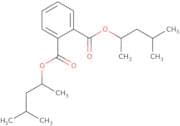
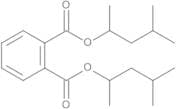
CAS 84-63-9
:Bis(4-Méthyl-2-pentyle) phtalate
Description :
Bis(4-Méthyl-2-pentyle) phtalate, communément appelé un ester de phtalate, est un composé organique caractérisé par ses groupes fonctionnels d'ester dérivés de l'acide phtalique. Il s'agit généralement d'un liquide incolore à jaune pâle avec une texture légèrement huileuse et une odeur aromatique faible. Cette substance est principalement utilisée comme plastifiant, améliorant la flexibilité et la durabilité des plastiques, en particulier le polychlorure de vinyle (PVC). Sa structure moléculaire comprend deux groupes 4-méthyl-2-pentyle attachés à une colonne vertébrale de phtalate, contribuant à ses propriétés. Bis(4-Méthyl-2-pentyle) phtalate est connu pour sa volatilité relativement faible et sa bonne stabilité thermique, ce qui le rend adapté à diverses applications industrielles. Cependant, comme de nombreux phtalates, il a soulevé des préoccupations environnementales et sanitaires en raison de ses effets potentiels de perturbation endocrinienne et a été soumis à un examen réglementaire. Une manipulation et un élimination appropriées sont essentielles pour atténuer les risques associés à l'exposition.
Formule :C20H30O4
InChI :InChI=1S/C20H30O4/c1-13(2)11-15(5)23-19(21)17-9-7-8-10-18(17)20(22)24-16(6)12-14(3)4/h7-10,13-16H,11-12H2,1-6H3
Code InChI :InChIKey=UAFXUVUVOTXFND-UHFFFAOYSA-N
SMILES :C(OC(CC(C)C)C)(=O)C1=C(C(OC(CC(C)C)C)=O)C=CC=C1
Synonymes :- Phthalic acid, bis(1,3-dimethylbutyl) ester
- Di-(4-Methyl-2-pentyl)phthalate
- 1,2-Benzenedicarboxylic acid, 1,2-bis(1,3-dimethylbutyl) ester
- 1,2-Benzenedicarboxylic acid, bis(1,3-dimethylbutyl) ester
- 2-Pentanol, 4-methyl-, phthalate (2:1)
Trier par
Degré de pureté (%)
0
100
|
0
|
50
|
90
|
95
|
100
13 produits trouvés.
Phthalic acid, bis-4-methyl-2-pentyl ester
CAS :Formule :C20H30O4Couleur et forme :NeatMasse moléculaire :334.45Bis(4-methyl-2-pentyl) phthalate
CAS :Dibutyl phthalate is a mixture of two isomers, butyl benzyl phthalate and dibutyl phthalate. It is used as a plasticizer in the manufacture of polyvinyl chloride plastics. The health effects of dibutyl phthalate are not well-studied, although it has been shown to cause liver toxicity in rats. Dibutyl phthalate can be analyzed by gas chromatography or high-performance liquid chromatography. The chromatographic method for determining the presence of dibutyl phthalate is based on the chemical properties of the functional groups, which are determined by the type of solvent and the matrix effect. Dibutyl phthalate can also be determined using magnetic particles. This technique uses an analytical method that involves preparing a solution with a known concentration, followed by adding magnetic particles to the solution and measuring their response to an applied magnetic field.Formule :C20H30O4Degré de pureté :Min. 95%Couleur et forme :PowderMasse moléculaire :334.45 g/molBis(4-Methyl-2-pentyl) Phthalate
CAS :Produit contrôléFormule :C20H30O4Couleur et forme :NeatMasse moléculaire :334.45