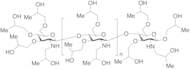
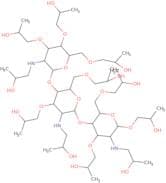
CAS 84069-44-3
:Chitofilmer
Description :
Chitofilmer, avec le numéro CAS 84069-44-3, est une substance chimique principalement utilisée dans diverses applications industrielles, en particulier dans le domaine de l'agriculture et de la transformation des aliments. Elle est connue pour ses propriétés de biopolymère, dérivé de la chitine, qui est un polymère naturel trouvé dans les exosquelettes de crustacés et d'insectes. Chitofilmer présente des capacités de formation de film, ce qui le rend utile en tant qu'agent de revêtement pouvant améliorer la durée de conservation des produits alimentaires en fournissant une barrière contre l'humidité et l'oxygène. De plus, il possède des caractéristiques biodégradables, s'alignant avec des pratiques respectueuses de l'environnement. La substance est également reconnue pour ses potentielles propriétés antimicrobiennes, qui peuvent aider à conserver les aliments et à prévenir leur détérioration. Ses applications s'étendent aux produits pharmaceutiques et cosmétiques, où elle peut servir de stabilisant ou d'agent épaississant. Dans l'ensemble, Chitofilmer est apprécié pour sa polyvalence, sa sécurité et sa durabilité dans diverses formulations.
- Chitosan, 2-hydroxypropyl ether
- Hydroxy Propyl Chitosan Powder - Aqueous
- Hydroxypropyl Chitosan Powder
Trier par
Degré de pureté (%)
0
100
|
0
|
50
|
90
|
95
|
100
3 produits concernés.
Hydroxypropyl Chitosan
CAS :Produit contrôléApplications Hydroxypropyl Chitosan is an antibacterial used to make organic rectorite-based nanofibrous mats with bacterial inhibition. Hydroxypropyl Chitosanhas been shown to exhibit inhibitory effects on the levels of Fe, Zn and Ca in liver, heart, lung, spleen, kidney and femur at high dosages in mice.
References Deng, H., et. al.: J. Biotma. Sci-Polym. E., 24, 485 (2013); Wang, Z., et. al.: Int. J. Biol. Macromol., 64, 25 (2014);Formule :C36H72N2O17C15H29NO7nCouleur et forme :Light Yellow To BrownMasse moléculaire :1140.353Hydroxypropyl chitosan
CAS :Hydroxypropyl chitosan is a biopolymer that can be used to treat tissue infections. It has been shown to have a low cytotoxicity and good antimicrobial activity against bacteria and fungi in vitro. Hydroxypropyl chitosan is synthesized by the reaction of chitosan with propylene oxide, which results in a covalent attachment of hydroxypropyl groups to the nitrogen atoms on the chitosan backbone. This polymer has been shown to be effective against methicillin-resistant Staphylococcus aureus (MRSA) and Candida albicans, with inhibitory concentrations that are lower than those for other polymers. Hydroxypropyl chitosan is also able to reduce biofilm formation by inhibiting microbial adhesion and spreading.Formule :C36H72N2O17(C15H29NO7)nDegré de pureté :Min. 95%Masse moléculaire :804.96 g/mol