CAS 85901-57-1
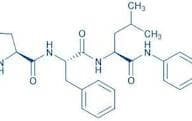
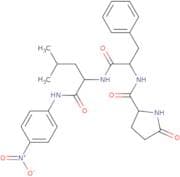
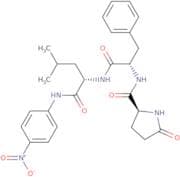
:Pyr-Phe-Leu-pNA
Description :
Pyr-Phe-Leu-pNA, également connu sous le nom de Leucine p-Nitroanilide Phényl Pyridyle, est un substrat peptidique synthétique couramment utilisé dans les essais biochimiques, en particulier dans l'étude des enzymes protéolytiques. Ce composé présente un groupe pyridine, un résidu de phénylalanine, un résidu de leucine et un groupe p-nitroanilide, qui contribuent collectivement à ses propriétés en tant que substrat pour diverses protéases. La présence du groupe p-nitroanilide permet une détection colorimétrique lors de la clivage par des enzymes, ce qui le rend utile dans les essais d'activité enzymatique. Pyr-Phe-Leu-pNA est généralement soluble dans des solvants organiques et présente une stabilité dans des conditions de laboratoire standard. Sa structure moléculaire permet des interactions spécifiques avec des enzymes cibles, facilitant l'étude de la cinétique et des mécanismes enzymatiques. De plus, en raison de sa nature synthétique, il peut être modifié pour améliorer la spécificité ou la sensibilité pour des applications particulières en recherche et en diagnostic. Comme pour toutes les substances chimiques, des précautions appropriées de manipulation et de sécurité doivent être observées lors de l'utilisation de Pyr-Phe-Leu-pNA dans des environnements de laboratoire.
Formule :C26H31N5O6
InChI :InChI=1/C26H31N5O6/c1-16(2)14-21(25(34)27-18-8-10-19(11-9-18)31(36)37)29-26(35)22(15-17-6-4-3-5-7-17)30-24(33)20-12-13-23(32)28-20/h3-11,16,20-22H,12-15H2,1-2H3,(H,27,34)(H,28,32)(H,29,35)(H,30,33)/t20-,21-,22-/m0/s1
SMILES :CC(C)C[C@@H](C(=O)Nc1ccc(cc1)N(=O)=O)N=C([C@H](Cc1ccccc1)N=C([C@@H]1CCC(=N1)O)O)O
Synonymes :- Pyroglutamyl-phenylalanyl-leucine-4-nitroanilide
- Pglu-phe-leu-pna
- L-Leucinamide, 5-oxo-L-prolyl-L-phenylalanyl-N-(4-nitrophenyl)-
- 5-oxo-L-prolyl-L-phenylalanyl-N-(4-nitrophenyl)-L-leucinamide
- pglu-phe-leu P-nitroanilide
- PYR-FL-PNA
- PYR-PHE-LEU-PNA
- PYR-PHE-GLY-PNA
- Pyr-FG-pNA
- L-PYROGLUTAMYL-L-PHENYLALANYL-L-LEUCINE P-NITROANILIDE
Trier par
Degré de pureté (%)
0
100
|
0
|
50
|
90
|
95
|
100
3 produits concernés.
Pyr-Phe-Leu-pNA
CAS :Chromogenic substrate for thiol proteinases from plants (caricain, papain, ficin, and bromelain) and from mammalian brain (cathepsin B). pEFL-pNA is also cleaved by a serine carboxypeptidase (HlSCP1) identified in the midgut of the hard tick Haemaphysalis longicornis, which was shown to process hemoglobin.Formule :C26H31N5O6Degré de pureté :99.4%Couleur et forme :Light YellowMasse moléculaire :509.56Pyr-Phe-Leu-pNA
CAS :Pyr-Phe-Leu-pNA is a proteolytic enzyme that can be used as a pharmaceutical drug. It has been shown to have insecticidal activity against the Anopheles mosquito and other insects, as well as antimicrobial activity against bacteria and fungi. Pyr-Phe-Leu-pNA is activated by tryptophan fluorescence, which is why it is suitable for use in peptide mapping. This enzyme also has an important physiological function in the zymogen activation pathway, which enables it to act as an enzyme substrate. Pyr-Phe-Leu-pNA will also degrade proteins that contain sequences of leishmania protease activity or signal peptide.Formule :C26H31N5O6Degré de pureté :Min. 95%Masse moléculaire :509.55 g/molPyr-Phe-Leu-pNA
CAS :Pyr-Phe-Leu-pNA is a proteolytic enzyme that is used in the production of monoclonal antibodies. The enzyme was originally isolated from human pancreas, but has also been found in other sources including eggs, bovine pancreas, and various bacteria. Pyr-Phe-Leu-pNA hydrolyzes peptide bonds with a preference for serine and threonine residues. This enzyme has been shown to be effective at cleaving influenza virus protein hemagglutinin, which may be useful in the development of new vaccines. Pyr-Phe-Leu-pNA has also been shown to have high salt tolerance, making it a good candidate for use in food processing applications.
Formule :C26H31N5O6Degré de pureté :Min. 95%Masse moléculaire :509.55 g/mol