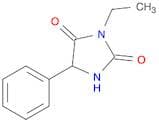
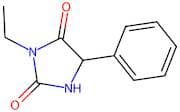
CAS 86-35-1
:Éthotoïne
Description :
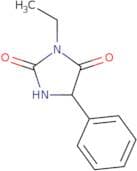
Éthotoïne, avec le numéro CAS 86-35-1, est un composé chimique principalement reconnu pour son utilisation en tant que médicament anticonvulsivant. Il est classé comme un dérivé de l'hydantoïne, similaire en structure à la phénytoïne, et est utilisé dans la gestion de l'épilepsie. Éthotoïne se caractérise par sa capacité à stabiliser les membranes neuronales et à réduire la fréquence des crises en modulant les canaux sodiques dans le cerveau. Le composé est généralement administré par voie orale et est connu pour sa toxicité relativement faible par rapport à d'autres anticonvulsivants. Éthotoïne est également remarquable pour ses propriétés pharmacocinétiques, y compris son absorption, sa distribution, son métabolisme et son excrétion, qui peuvent varier d'un individu à l'autre. Bien qu'il ait été efficace pour certains patients, son utilisation a diminué au profit de nouveaux anticonvulsivants avec des profils de sécurité et d'efficacité améliorés. Comme pour tout médicament, les effets secondaires potentiels peuvent inclure des vertiges, de la somnolence et des troubles gastro-intestinaux, nécessitant une surveillance attentive pendant le traitement.
Formule :C11H12N2O2
InChI :InChI=1/C11H12N2O2/c1-2-13-10(14)9(12-11(13)15)8-6-4-3-5-7-8/h3-7,9H,2H2,1H3,(H,12,15)
Code InChI :InChIKey=SZQIFWWUIBRPBZ-UHFFFAOYSA-N
SMILES :O=C1C(NC(=O)N1CC)C2=CC=CC=C2
Synonymes :- 1-Ethyl-2,5-dioxo-4-phenylimidazolidine
- 2,4-Imidazolidinedione, 3-ethyl-5-phenyl-
- 3-Ethyl-5-Phenylhydantoin
- 3-Ethyl-5-Phenylimidazolidine-2,4-Dione
- 3-Ethyl-5-phenyl-2,4-imidazolidinedione
- 3-Ethyl-5-phenyl-hydantoin
- 3-Ethyl-5-phenylimidazolidin-2,4-dione
- Ac-695
- Accenon
- Ethotoine
- Etotoina
- Hydantoin, 3-ethyl-5-phenyl-
- Peganone
- Pegoanone
- ETHOTOIN (200 MG)
- ETHOTOIN USP/EP/BP
- Ethotoin ((±)-Ethotoin)
- Hydantoin, 3-ethyl-5-phenyl- (6CI, 7CI, 8CI)
- 3-ethyl-5-phenyl-hydantoi
- Etbotoin
- ETHOTOIN
- Voir plus de synonymes
Trier par
Degré de pureté (%)
0
100
|
0
|
50
|
90
|
95
|
100
8 produits concernés.
Ethotoin
CAS :Hydantoin and its derivativesFormule :C11H12N2O2Couleur et forme :PowderMasse moléculaire :204.08988Ethotoin
CAS :Formule :C11H12N2O2Degré de pureté :98%Couleur et forme :SolidMasse moléculaire :204.2252ETHOTOIN
CAS :Ethotoin (Peganone), an orally active anticonvulsant agent utilized in epilepsy research, is a hydantoin derivative analogous to phenytoin [1].Formule :C11H12N2O2Degré de pureté :≥98%Couleur et forme :Stout Prisms From Water SolidMasse moléculaire :204.23Ethotoin
CAS :Produit contrôléApplications Ethotoin is a hydantoin based anticonvulsant drug used in the treatment of epilepsy.
References Kesselheim, A.S., et al.: Drugs., 70, 605 (2010);Formule :C11H12N2O2Couleur et forme :NeatMasse moléculaire :204.23Ethotoin-d5
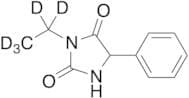
CAS :Produit contrôléApplications Ethotoin-d5 is the labelled analogue of Ethotoin, a hydantoin based anticonvulsant drug used in the treatment of epilepsy.
References Kesselheim, A.S., et al.: Drugs., 70, 605 (2010);Formule :C11H7D5N2O2Couleur et forme :NeatMasse moléculaire :209.26Ethotoin-d5
CAS :Ethotoin is a hydantoin antiepileptic drug. It acts by blocking the action of the sodium/potassium ATPase pump, which is important in maintaining the electrochemical gradient necessary for nerve cell repolarization and subsequent synaptic transmission. This leads to an increase in neuronal excitability and seizures, making it an effective antiepileptic drug. Ethotoin is also used to treat depression and other mental disorders. The uptake of ethotoin into nervous tissue can be inhibited by calcium ions, stabilizing membranes and preventing depolarization.Formule :C11H7D5N2O2Degré de pureté :Min. 95%Masse moléculaire :209.26 g/mol