![α-D-Glucopyranose, 2-deoxy-2-[[(3R)-3-hydroxy-1-oxotetradecyl]amino]-, 1-(dihydrogen phosphate) 3-…](/_next/image/?url=https%3A%2Fstatic.cymitquimica.com%2Fcas-image%2Fthumb-webp%2F349702-lipid-x.webp&w=3840&q=75)
CAS 86559-73-1
:α-D-Glucopyranose, 2-désoxy-2-[[(3R)-3-hydroxy-1-oxotétradécyle]amino]-, 1-(dihydrogène phosphate) 3-[(3R)-3-hydroxytétradécanoate]
- α-D-Glucopyranose, 2-deoxy-2-[[(3R)-3-hydroxy-1-oxotetradecyl]amino]-, 1-(dihydrogen phosphate) 3-[(3R)-3-hydroxytetradecanoate]
- α-D-Glucopyranose, 2-deoxy-2-[(3-hydroxy-1-oxotetradecyl)amino]-, 1-(dihydrogen phosphate) 3-(3-hydroxytetradecanoate), [2(R),3(R)]-
- lipid X
- Phosphoric acid dihydrogen [2-deoxy-3-O-[(R)-3-hydroxytetradecanoyl]-2-[(R)-3-hydroxytetradecanoylamino]-α-D-glucopyranosyl] ester
- 2,3-Di(3-hydroxymyristoyl)glucosamine 1-phosphate
- 2-[[(3R)-3-Hydroxymyristoyl]amino]-2-deoxy-3-O-[(3R)-3-hydroxymyristoyl]α-D-glucopyranose 1-phosphoric acid
- N,3-O-Bis[(R)-3-hydroxytetradecanoyl]-α-D-glucosamine 1-phosphoric acid
- Compound 401
- Voir plus de synonymes
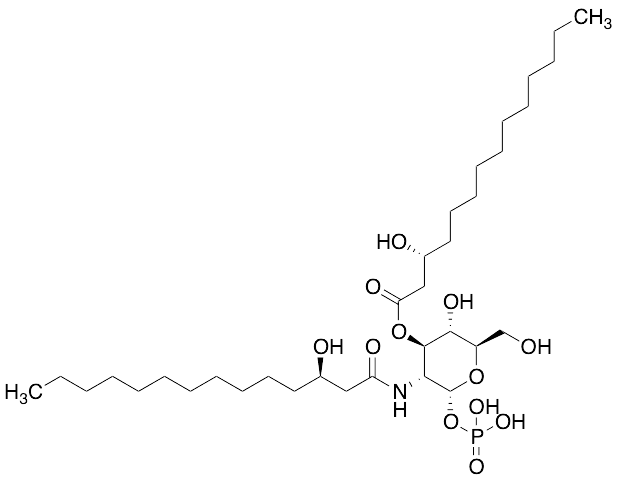
Lipid X
CAS :Lipid X is a monosaccharide precursor of E coli lipid A.Formule :C34H66NO12PCouleur et forme :SolidMasse moléculaire :711.86Lipid X
CAS :Lipid X is a monosaccharide precursor of E. coli lipid A. It is an N-acyl-D-glucosamine 1-phosphate where the N-acyl group is (R)-3-hydroxytetradecanoyl and carrying an additional (R)-3-hydroxytetradecanoyl, and it is a component of the cell wall of Gram-negative bacteria. Due to its physiological functions and biological properties, Lipid X can be used to treat infectious diseases, autoimmune diseases, and HIV infection. It has also been shown to inhibit the production of inflammatory cytokines such as tumor necrosis factor alpha (TNF-α) and interleukin-1β (IL-1β). This effect is due to its ability to disrupt hydrogen bonds between lipids in the cell membrane. As a biosynthetic intermediate of Lipid A, it seems to play a role in bacterial virulence and can trigger an immune response in humans, and protect against endotoxins.
Formule :C34H66NO12PDegré de pureté :Min. 95%Masse moléculaire :711.86 g/mol