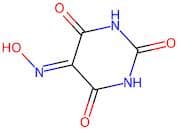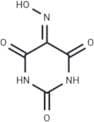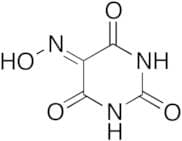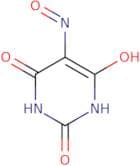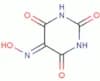
CAS 87-39-8
:Acide violurique
- 2,4,5,6(1H,3H)-Pyrimidinetetrone,5-oxime
- 5-(Hydroxyimino)barbituric acid
- 5-Isonitrosobarbituric acid
- Alloxan,5-Oxime
- NSC 56338
- Violuric Acid Hydrate
- Violuric acid
- pyrimidine-2,4,5,6(1H,3H)-tetrone 5-oxime
Violuric acid
CAS :Violuric acid, a redox mediator, ensures laccase retains high-redox potential in directed evolution assays.Formule :C4H3N3O4Couleur et forme :White To Pale Yellow Crystalline PowderMasse moléculaire :157.08Violuric Acid
CAS :Produit contrôléStability Hygroscopic
Applications Violuric Acid, can be used for the synthesis of some novel pyrimidines fused aza-heterocycles, having broad spectrum of pharmacological activities, such as 2-Methyloxazolo[5,4-d]pyrimidine-5,7(4H,6H)-dione (M324600).
References Abdou, W., et al.: Trends in Heterocyclic Chem., 10, 57 (2005);Formule :C4H3N3O4Couleur et forme :NeatMasse moléculaire :157.08Violuric acid
CAS :Violuric acid is a chemical compound that is used in biological treatment. It has a hydroxyl group and UV absorption, which makes it reactive. Violuric acid undergoes protonation and deprotonation to form an acid complex with water. The nitrogen atoms in violuric acid can react with the oxygen atoms of water molecules to form nitrous acid, which then reacts with hydrogen peroxide to form an oxidizing agent. Violuric acid is synthesized by chain reactions between organic acids and inorganic acids. Violuric acid has a redox potential of −0.35 volts, making it an excellent reducing agent for organic compounds. In organic chemistry, violuric acid is used as a reducing agent for esters or amides.
Formule :C4H3N3O4Degré de pureté :Min. 95%Couleur et forme :PowderMasse moléculaire :157.08 g/mol