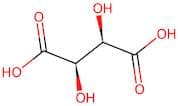
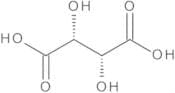
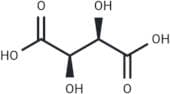
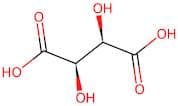
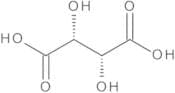
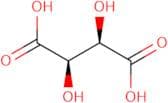
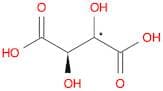
CAS 87-69-4
:Acide tartrique (+)
- (+)-(2R,3R)-Tartaric acid
- (+)-(R,R)-Tartaric acid
- (+)-<span class="text-smallcaps">L</span>-Tartaric acid
- (+)-L-Tartaric acid
- (+)-Tartaric Acid
- (+)-Weinsaure
- (2R,3R)-2,3-Dihydroxybutanedioic acid
- (2R,3R)-2,3-Dihydroxysuccinic acid
- 1,2-Dihydroxyethane-1,2-dicarboxylic acid
- 2,3-Dihydroxybutanedioic acid
- 2,3-Dihydroxysuccinic acid
- Acide (+)-tartrique
- Acido (+)-Tartarico
- Butanedioic Acid, 2,3-Dihydroxy-
- Butanedioic acid, 2,3-dihydroxy- [R-(R*,R*)]-
- Dextrotartaric acid
- Dihydroxy Butanedioic Acid
- Dihydroxysuccinic acid
- E 334
- Natural tartaric acid
- Nsc 62778
- Succinic acid, 2,3-dihydroxy
- Tartaric Acid AR (1LB/BT)
- Tartaric acid, <span class="text-smallcaps">L</span>-(+)-
- Tartaric acid, L-(+)-
- Threaric acid
- Weinsaeure
- d-Tartaric acid
- d-α,β-Dihydroxysuccinic acid
- Butanedioic acid, 2,3-dihydroxy- (2R,3R)-
- (2R,3R)-2,3-dihydroxybutanedioate
- (2R,3S)-2,3-dihydroxybutanedioate
- L(+)-Tartaric Acid (FCCIV)
- L(+)-2,3-dihydrooxy butanedioic acid
- 2,2-dihydroxybutanedioic acid
- L(+)-Dihydroxysuccinic acid
- L(+)tartaric acid sigmaultra
- (2S,3S)-(-)-Tartaric acid
- L(+)-Tartaric Acid (BP2000)
- L-Tartaric acid anhydrous
- L-1,2-Dihydroxyethan-1,2-dicarbonsaeure
- 2,3-DIHYDROXYDUTANEDIOIC ACID
- ACIDUM TARTARICUM
- L-THREACRIC ACID
- L-2,3-DIHYDROXYBUTANEDIOIC ACID
- FEMA 3044
- Voir plus de synonymes
L-(+)-Tartaric Acid
CAS :Formule :C4H6O6Degré de pureté :>99.0%(T)Couleur et forme :White or Colorless powder to crystalMasse moléculaire :150.09L-(+)-Tartaric acid, 99%
CAS :L-(+)-Tartaric acid is widely utilized in pharmaceutical industries. It is used in soft drinks, confectionaries, food products, gelatin desserts and as a buffering agent. It forms a compound, TiCl2(O-i-Pr)2 with Diels-Alder catalyst and acta as a chelate agent in metal industries. Owing to its efficFormule :C4H6O6Degré de pureté :99%Couleur et forme :Crystals or crystalline powder or powder, White to pale creamMasse moléculaire :150.09Tartaric Acid
CAS :Tartaric acid (dihydroxysuccinic acid)Formule :C4H6O6Couleur et forme :White CrystalsMasse moléculaire :150.01644L-Tartaric acid
CAS :Formule :C4H6O6Degré de pureté :99.7 - 100.5 % (dried basis)Couleur et forme :Colourless crystals or white powderMasse moléculaire :150.09L-(+)-Tartaric acid
CAS :Formule :C4H6O6Degré de pureté :99.0%Couleur et forme :Solid, CrystallineMasse moléculaire :150.086L-Tartaric acid
CAS :L-Tartaric acid, found in grapes/tamarinds, is a wine acid and antioxidant. High doses are toxic and may cause paralysis or death.Formule :C4H6O6Degré de pureté :99.38%Couleur et forme :Solid PowderMasse moléculaire :150.09L-(+)-Tartaric acid
CAS :L-(+)-Tartaric acidFormule :C4H6O6Degré de pureté :98%Couleur et forme : white solidMasse moléculaire :150.08684g/molL-(+)-Tartaric Acid
CAS :Produit contrôléApplications L-(+)-Tartaric Acid is a naturally occurring chemical compound found in berries, grapes and various wines. It provides antioxidant properties and contributes to the sour taste within these products.
References Baiano, A. et al.: Food. Chem., 135, 2694 (2012); Forney, C. et al.: J. Berry. Res., 2, 169 (2012); Khiati, Z. et al.: Chem. Sci. Trans., 1, 185 (2012);Formule :C4H6O6Couleur et forme :WhiteMasse moléculaire :150.09L-Tartaric acid
CAS :L-Tartaric acid is a white crystalline powder that is soluble in water. It is a model system for the study of calcium and its interactions with other ions, such as sodium and magnesium. L-Tartaric acid has been found to decrease the growth of carcinoma cell lines and increase the activity of certain enzymes, such as sodium salts, in mammalian cells. L-Tartaric acid crystals have been used for biological samples and electrochemical impedance spectroscopy. L-Tartaric acid also inhibits tumor growth in mice by inhibiting the production of proteins vital for cell division. This compound can be toxic at high doses and should not be administered to pregnant women or children.
Formule :C4H6O6Degré de pureté :Min. 95%Couleur et forme :White PowderMasse moléculaire :150.09 g/molL-(+)-Tartaric Acid extrapure AR, ACS, ExiPlus, Multi-Compendial, 99.7%
CAS :Formule :C4H6O6Degré de pureté :min. 99.7%Couleur et forme :White to off white, Crystalline powder, Clear, ColourlessMasse moléculaire :150.08L-(+)-Tartaric acid
CAS :Formule :C4H6O6Degré de pureté :102.00%Couleur et forme :SolidMasse moléculaire :150.0868