CAS 87-88-7
:Acide chloranilique
Description :
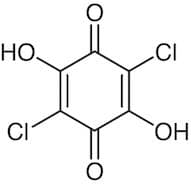
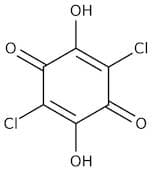
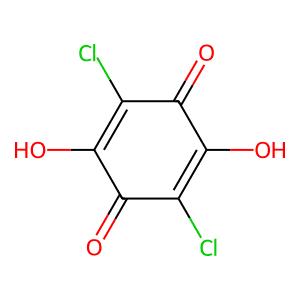
Acide chloranilique, avec le numéro CAS 87-88-7, est un composé organique qui appartient à la classe des acides aromatiques. Il se caractérise par son apparence cristalline rouge foncé à marron et est connu pour sa solubilité dans des solvants polaires tels que l'eau et l'alcool. La structure chimique présente un groupe d'aniline chlorée, qui contribue à ses propriétés acides et à sa réactivité. Acide chloranilique est souvent utilisé comme réactif en chimie analytique, en particulier dans la détermination des ions métalliques en raison de sa capacité à former des complexes colorés. De plus, il présente des propriétés qui le rendent utile dans la synthèse de colorants et comme indicateur de pH. Le composé est également noté pour ses applications potentielles dans l'électronique organique et la science des matériaux. Cependant, il doit être manipulé avec précaution, car il peut présenter des risques pour la santé en cas d'exposition. Dans l'ensemble, Acide chloranilique est un composé polyvalent avec une utilité significative dans diverses applications chimiques.
Formule :C6H2Cl2O4
InChI :InChI=1S/C6H2Cl2O4/c7-1-3(9)5(11)2(8)6(12)4(1)10/h9,12H
Code InChI :InChIKey=IPPWILKGXFOXHO-UHFFFAOYSA-N
SMILES :ClC=1C(=O)C(O)=C(Cl)C(=O)C1O
Synonymes :- 2,5-Cyclohexadiene-1,4-Dione, 2,5-Dichloro-3,6-Dihydroxy-
- 2,5-Dichloro-3,6-Dihydroxy-1,4-Benzoquinone
- 2,5-Dichloro-3,6-Dihydroxy-P-Benzoquinon
- 2,5-Dichloro-3,6-Dihydroxy-P-Benzoquinone
- 2,5-Dichloro-3,6-Dihydroxy-P-Quinon
- 2,5-Dichloro-3,6-Dihydroxy-P-Quinone
- 2,5-Dichloro-3,6-Dihydroxybenzo-1,4-Quinone
- 2,5-Dichloro-3,6-Dihydroxybenzoquinone
- 2,5-Dichloro-3,6-Dihydroxycyclohexa-2,5-Diene-1,4-Dione
- 2,5-Dichloro-3,6-Dihydroxyquinone
- 2,5-Dichloro-3,6-dihydroxy-1,4-quinone
- 2,5-Dichloro-3,6-dihydroxy-2,5-cyclohexadiene-1,4-dione
- 2,5-Dihydroxy-3,6-Dichlorobenzoquinone
- 2,5-Dihydroxy-3,6-dichloro-1,4-benzoquinone
- 2,5-Dochloro-3,6-Dihydroxy Benzoquinone
- 2,5-Dochloro-3,6-Dohydroxy-P-Benzoquinone
- 2,5-Dochloro-3,6-Dyhydroxybenzoquinone
- 2,5-Dyhydroxy-3,6-2-Benzoquinone
- 3,6-Dichloro-2,5-dihydroxy-1,4-benzoquinone
- 3,6-Dichloro-2,5-dihydroxybenzoquinone
- 4-Dione,2,5-Dichloro-3,6-Dihydroxy-5-Cyclohexadiene-1
- 5-Cyclohexadiene-1,4-Dione,2,5-Dichloro-3,6-Dihydroxy-2
- Chloranilic
- Chloranilic Acid,(2,5-Dichloro-3,6-Dihydroxy-1,4
- Chloranilic Acid Crystalline
- Chlorobenzene Acid
- Dichloro Hydroquinone
- Labotest-Bb Lt00159487
- NSC 6108
- NSC 97383
- P-Benzoquinone, 2,5-Dichloro-3,6-Dihydroxy-
- P-Chloranilicacid
- Quinone, 2,5-dichloro-3,6-dihydroxy-
- Timtec-Bb Sbb008913
- p-Chloranilic acid
- Voir plus de synonymes
Trier par
Degré de pureté (%)
0
100
|
0
|
50
|
90
|
95
|
100
7 produits concernés.
Chloranilic Acid
CAS :Formule :C6H2Cl2O4Degré de pureté :>98.0%(T)(HPLC)Couleur et forme :Orange to Brown powder to crystalMasse moléculaire :208.98Chloranilic acid, 98+%
CAS :Chloranilic acid is used in spectrophotometry. It reacts with metal ions to form stable complexes. It is also used as a reactant in the preparation of dimethylbipyridyl complexes and (nonylbenzimidazolylmethyl)benzene. Further, it is used in charge-transfer reactions with metoprolol tartrate. It isFormule :C6H2Cl2O4Degré de pureté :98+%Couleur et forme :Red to orange or reddish-orange, Powder or crystalline powderMasse moléculaire :208.98Chloranilic acid
CAS :Formule :C6H2Cl2O4Degré de pureté :97%Couleur et forme :SolidMasse moléculaire :208.9837Chloranilic Acid extrapure, 98%
CAS :Formule :C6H2Cl2O4Degré de pureté :min.98%Couleur et forme :Orange to Brown, Powder, ClearMasse moléculaire :208.98Chloranilic acid
CAS :Chloranilic acid is a thermally unstable compound that undergoes a number of reactions with the addition of heat. It reacts with nitrogen atoms to form amides, nitriles, and nitro compounds. Chloranilic acid also reacts with polymerases to form stable complexes. The proton at the center of the chloranilic acid molecule is lost when it forms an acid complex. This reaction occurs in aqueous solution as well as in biological systems, where it is used for hydrogen bonding interactions. The stable complexes that are formed by chloranilic acid have been shown to have biological properties such as antimicrobial activity, antiviral activity, and antifungal activity.Formule :C6H2Cl2O4Degré de pureté :Min. 95%Couleur et forme :Orange To Red SolidMasse moléculaire :208.98 g/mol