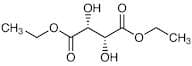
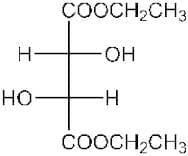
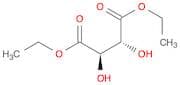
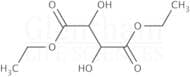
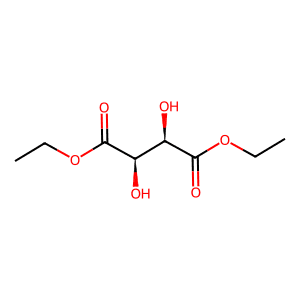
CAS 87-91-2
:Tartrate de diéthyle
- (+)-(R,R)-Diethyl tartrate
- (+)-Diethyl <span class="text-smallcaps">L</span>-tartrate
- (+)-Diethyl L-tartrate
- (+)-Diethyl-2,3-dihydroxysuccinate
- (2R,3R)(+)-Dihydroxybutane-1,4-dioic acid diethyl ester
- (R,R)-Tartaric acid diethyl ester
- <span class="text-smallcaps">L</span>-(+)-Tartaric acid diethyl ester
- <span class="text-smallcaps">L</span>-Diethyl tartrate
- Butanedioic acid, 2,3-dihydroxy- (2R,3R)-, 1,4-diethyl ester
- Butanedioic acid, 2,3-dihydroxy- (2R,3R)-, diethyl ester
- Butanedioic acid, 2,3-dihydroxy- [R-(R*,R*)]-, diethyl ester
- Diethyl (2R,3R)-(+)-tartrate
- Diethyl (2R,3R)-2,3-dihydroxysuccinate
- Diethyl (R,R)-(+)-tartrate
- Diethyl 1,2-dihydroxy-1,2-ethanedicarboxylate
- Diethyl <span class="text-smallcaps">L</span>-tartarate
- Diethyl L-tartarate
- Diethyl tartarate
- Diethyl tartrate
- Diethyltartrat
- Dimethyl Tartrate
- Ethyl Tartrate
- L-Diethyl tartrate
- L-Tartaric acid diethyl ester
- Nsc 44808
- Nsc 8878
- Tartaric acid, diethyl ester
- Tartrate de diethyle
- Tartrate(L-), Diethyl, (+)-
- Tartrato De Dietilo
- [R-(R*,R*)]-2,3-Dihydroxybutanedioic acid diethyl ester
- Voir plus de synonymes
Diethyl L-(+)-Tartrate
CAS :Formule :C8H14O6Degré de pureté :>98.0%(GC)Couleur et forme :Colorless to Light yellow clear liquidMasse moléculaire :206.19(+)-Diethyl L-tartrate
CAS :Formule :C8H14O6Degré de pureté :97%Couleur et forme :Liquid, liquidMasse moléculaire :206.194(+)-Diethyl L-tartrate, 98%
CAS :(+)-Diethyl L-tartrate is used as a chiral auxiliary in the Sharpless enantioselective epoxidation of allylic alcohols, for Sharpless-type enantioselective oxidation of sulfides to sulfoxides and as a chiral auxiliary in the enantioselective construction of cyclopropanes from allylic alcohols by anFormule :C8H14O6Degré de pureté :98%Couleur et forme :Clear colorless, LiquidMasse moléculaire :206.19(2R,3R)-Diethyl 2,3-dihydroxysuccinate
CAS :Formule :C8H14O6Degré de pureté :98%Couleur et forme :LiquidMasse moléculaire :206.1932Diethyl L-tartrate
CAS :Formule :C8H14O6Degré de pureté :≥ 99.0%Couleur et forme :Colourless to light yellow liquidMasse moléculaire :206.19(+)-Diethyl L-tartrate
CAS :(+)-Diethyl L-tartrateFormule :C8H14O6Degré de pureté :≥95%Couleur et forme : colourless to light yellow oilMasse moléculaire :206.19g/molDiethyl L-(+)-Tartrate-13C4
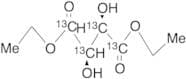
CAS :Produit contrôléApplications Diethyl L-(+)-Tartrate-13C4 is the isotope labelled analog of Diethyl L-(+)-Tartrate. Diethyl L-(+)-Tartrate is used as a chiral reagent in a host of chemical reactions, such as the synthesis of isoquinoline alkaloids and arundic acid, which has been used in acute ischemic stroke therapy.
References Ziolkowski, M. et al.: Tetrahedron Lett., 41, 1963 (2000); Fernandes, R. et al.: Tetrahedron Lett. 50, 5903 (2009);Formule :C4C4H14O6Couleur et forme :NeatMasse moléculaire :210.16Diethyl L-(+)-Tartrate
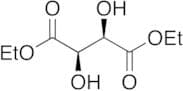
CAS :Produit contrôléApplications Diethyl L-(+)-Tartrate is used as a chiral reagent in a host of chemical reactions, such as the synthesis of isoquinoline alkaloids and arundic acid, which has been used in acute ischemic stroke therapy.
References Ziolkowski, M. et al.: Tetrahedron Lett., 41, 1963 (2000); Fernandes, R. et al.: Tetrahedron Lett. 50, 5903 (2009);Formule :C8H14O6Couleur et forme :NeatMasse moléculaire :206.19Diethyl L-(+)-Tartrate-13C8
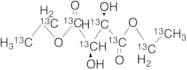
CAS :Produit contrôléApplications Diethyl L-(+)-Tartrate-13C8 is the isotope labelled analog of Diethyl L-(+)-Tartrate. Diethyl L-(+)-Tartrate is used as a chiral reagent in a host of chemical reactions, such as the synthesis of isoquinoline alkaloids and arundic acid, which has been used in acute ischemic stroke therapy.
References Ziolkowski, M. et al.: Tetrahedron Lett., 41, 1963 (2000); Fernandes, R. et al.: Tetrahedron Lett. 50, 5903 (2009);Formule :C8H14O6Couleur et forme :NeatMasse moléculaire :214.13(+)-Diethyl-L-tartrate
CAS :(+)-Diethyl-L-tartrate is a chiral compound that can be synthesized from the reaction of sodium carbonate and anhydrous diethyl tartrate. It is used for the treatment of inflammatory bowel disease. The (+) form of this substance is more effective than the (–) form, which may be due to its ability to inhibit the production of prostaglandins that are involved in inflammation.
Formule :C8H14O6Degré de pureté :Min. 95%Couleur et forme :Colorless Clear LiquidMasse moléculaire :206.19 g/mol